
A wet basement is one of the most common problems homeowners across Western Pennsylvania and Eastern Ohio deal with — and one of the most consistently misunderstood. Ask ten different contractors what the right solution is and you’ll get a range of answers that can leave you more confused than when you started. Exterior waterproofing. Interior drainage systems. Sump pumps. Vapor barriers. The terminology alone is enough to make your eyes glaze over.
What makes the decision genuinely complicated in our region isn’t just the variety of products and methods available — it’s the climate. Cold winters, freeze–thaw cycling, clay soils, and spring snowmelt create a waterproofing environment in PA and Ohio that behaves differently than what you’d find in the South or the arid West. Methods that work well in a mild climate don’t always hold up in ours.
At Matthews Wall Anchor & Waterproofing, we’ve been solving basement water problems for homeowners across the Pittsburgh area, Youngstown, Canton, Beaver County, and the surrounding tri-state region since the 1980s. Here’s our honest breakdown of interior versus exterior waterproofing — what each method does, where each one works, and how our cold-climate conditions should factor into the decision.
Understanding the Core Difference
Before comparing the two approaches, it helps to understand what each one is actually trying to accomplish — because they work on fundamentally different principles.
Exterior waterproofing is designed to prevent water from ever reaching your foundation walls in the first place. It involves excavating the soil around the outside of your foundation, applying a waterproof membrane or coating directly to the exterior wall surface, and installing drainage board and a perimeter drainage system to redirect groundwater away from the foundation before it can penetrate. Done correctly, it addresses the water problem at its source.
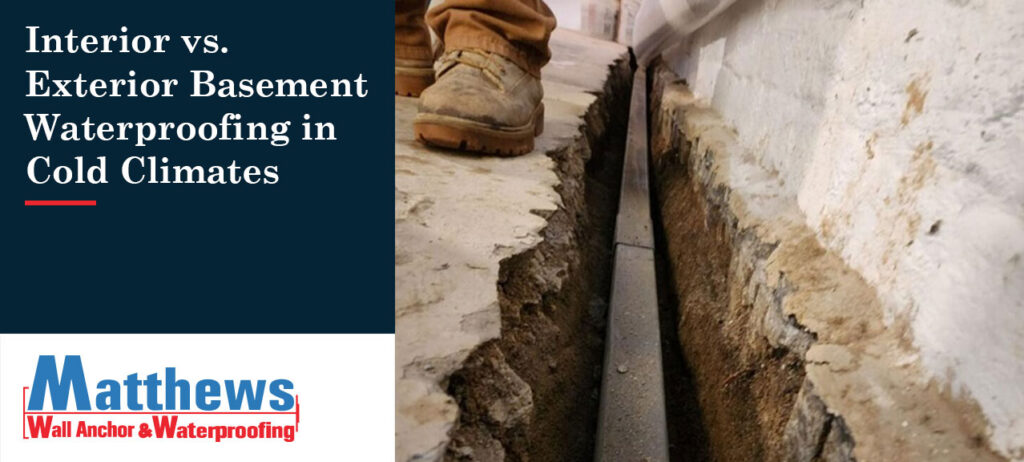
Interior waterproofing doesn’t stop water from entering the wall — it manages water after it gets in. Interior drainage systems (sometimes called French drains or interior weeping tile systems) are installed along the perimeter of the basement floor, collecting water that enters through the walls or floor and channeling it to a sump pit, where a sump pump discharges it away from the home. The goal isn’t to block water — it’s to control where it goes so it never reaches your living space or damages your foundation.
Neither approach is inherently superior. Each has a specific job to do, and in many situations, they work best in combination. But in a cold-climate environment like ours, the choice carries some additional considerations that homeowners need to understand.
The Cold-Climate Complication
In Pennsylvania and Ohio, water doesn’t just enter basements during rainstorms. It enters during snowmelt season when large volumes of water infiltrate the soil rapidly. It enters through walls that have been compromised by years of freeze–thaw cycling, which cracks mortar joints and creates pathways that didn’t exist before. And it enters as hydrostatic pressure builds in saturated, frozen-thawed clay soil that surrounds the foundation on all sides.
This matters for the waterproofing conversation because the volume, timing, and entry points of water in our climate are different from a mild-climate environment. A solution designed for predictable rainfall patterns needs to be evaluated differently when it also has to handle sudden snowmelt events, frost-affected soil, and walls that have already been physically compromised by winter cycling.
Exterior Waterproofing in Cold Climates: The Case For and Against
The advantages of exterior waterproofing are real. It addresses the problem at its origin point — keeping water away from the foundation wall entirely rather than collecting it after it’s already inside. For new construction, exterior waterproofing is straightforward to include in the build. For homes with significant water infiltration through wall cracks or porous block walls, stopping the water before it enters is clearly preferable to managing it afterward.
But in Pennsylvania and Ohio, exterior waterproofing comes with meaningful practical limitations.
The first is seasonal availability. Exterior waterproofing requires full excavation around the foundation perimeter — digging down to the footing depth, which is typically 4 to 6 feet or more in our frost-line zone. That excavation can only happen when the ground isn’t frozen, which in our region means a limited window: spring through fall. Homeowners dealing with a wet basement in November or February don’t have the option of waiting until conditions allow for exterior work.
The second limitation is disruption. Full perimeter excavation destroys landscaping, removes hardscaping, and requires significant restoration work once the waterproofing is complete. For a typical home in Pittsburgh’s older neighborhoods or in the established residential areas around Youngstown and Canton, the exterior of the foundation is often closely bordered by driveways, patios, mature plantings, or neighboring structures — all of which complicate or increase the cost of excavation significantly.
The third — and most important in our climate — is the long-term performance of exterior membranes in freeze–thaw conditions. Waterproof coatings and membranes applied to exterior foundation walls are subject to the same freeze–thaw cycling that affects everything else in our soil environment. Over years and decades, freeze–thaw stress can cause membranes to crack, delaminate, or separate from the wall surface — reducing their effectiveness and requiring re-excavation to repair. This isn’t a reason to never use exterior waterproofing, but it’s a maintenance reality that should factor into the decision.
Interior Waterproofing in Cold Climates: Why It Often Makes More Sense
Interior drainage systems have a reputation in some circles as a “Band-Aid” solution — a way of dealing with symptoms rather than causes. In our experience, that characterization is usually made by people who haven’t seen a well-designed interior system perform through fifteen winters in Western PA.
Here’s what interior waterproofing actually does in a cold-climate environment, and why it’s often the more practical and durable long-term solution for homeowners in our region.
It’s installable year-round. Unlike exterior waterproofing, interior drainage installation isn’t weather-dependent. We can install a perimeter drainage system and sump pump in February when your basement is actively taking on water from snowmelt — which is exactly when many homeowners discover the problem. You don’t have to wait months for the ground to thaw to get the solution in place.
It accommodates freeze–thaw-compromised walls. Once a block or poured concrete wall has been cycling through freeze–thaw stress for decades, it has developed micro-pathways and hairline cracks throughout its structure. Even if you applied an exterior membrane to that wall tomorrow, water would continue to find paths through compromised sections over time. A properly designed interior system accepts that water will enter through an aged wall and manages it reliably — channeling it to the sump before it can pool on the floor or wick into the wall cavity above the drainage line.
It handles hydrostatic pressure effectively. One of the biggest water intrusion challenges in our clay-heavy, high-moisture-retention soils is hydrostatic pressure — the force water exerts against the foundation when the surrounding soil is saturated. An interior drainage system with an appropriately sized sump pump relieves that pressure continuously, discharging water fast enough to stay ahead of infiltration even during heavy spring snowmelt or sustained rainfall events.
It’s built to be maintained. Sump pumps have service lives and need to be replaced periodically. Interior drainage channels can be inspected and cleaned. The system components are accessible — you can see them, test them, and service them without any excavation. This is a meaningful advantage over exterior membranes buried under 5 feet of soil, where you often don’t know there’s a problem until water is coming in again.
When Exterior Waterproofing Is the Right Call
Interior drainage systems are not the answer to every basement water problem, and we won’t pretend otherwise. There are situations where exterior waterproofing is clearly the right approach — or where a combined strategy is the only one that makes sense.
If a foundation wall has developed significant structural damage — deep horizontal cracks, visible bowing, or sections where the wall face is deteriorating — exterior excavation may be necessary anyway to assess and repair the structural issue. In that scenario, combining the excavation with exterior waterproofing is a logical and cost-effective pairing.
For new construction in our region, we strongly recommend exterior waterproof membranes paired with exterior drainage board as a baseline, with interior drainage and a sump pump system as a second line of defense. The combination approach gives the home the best long-term protection against both surface and subsurface water.
And for homes where water is entering specifically through above-grade wall cracks or gaps at the wall-to-floor joint — rather than through the wall face under hydrostatic pressure — targeted exterior crack injection or exterior sealing may address the issue more directly than a full interior system.
The Matthews Approach: Honest Assessment First
The waterproofing conversation we have most often with homeowners goes something like this: they’ve gotten estimates from multiple contractors, each one has recommended a different solution, and they have no idea who to trust or what’s actually right for their home.
Our approach starts with an honest evaluation of where the water is coming from and why — because the right solution is completely dependent on that diagnosis. A wet basement caused by surface grading pushing runoff toward the foundation needs a different fix than one caused by hydrostatic pressure through a porous block wall. A basement taking on water through a single crack needs a different approach than one where moisture is seeping through the entire wall surface.
We don’t sell a one-size-fits-all waterproofing package. We look at your specific home, your specific water source, and your specific conditions — then recommend what will actually work, whether that’s an interior drainage system, a sump pump upgrade, targeted crack repair, vapor barriers, or a combination of methods.
The Bottom Line for PA and Ohio Homeowners
In the cold-climate, freeze–thaw environment of Western Pennsylvania and Eastern Ohio, interior waterproofing systems — particularly perimeter drainage paired with a properly sized sump pump — are the workhorse solution for most residential basement water problems. They’re installable in any season, built to handle our soil and moisture conditions, durable through decades of freeze–thaw cycling, and maintainable without excavation.
Exterior waterproofing has its place — particularly in new construction and in situations where structural repair requires excavation anyway. But for most homeowners dealing with an existing wet basement in our region, an interior solution will deliver reliable long-term performance at a fraction of the cost and disruption.
If your basement is taking on water — whether it’s a chronic problem or something new you’ve noticed after this winter’s snowmelt — now is the right time to get a professional evaluation. Matthews Wall Anchor & Waterproofing offers free, no-obligation inspections for homeowners across Eastern Ohio and Western PA. We’ll tell you honestly what’s happening, what your options are, and what we’d recommend for your specific home.
Call us at (800) 284-7471 or schedule your free inspection online. A dry basement is not a luxury — and the solution is more straightforward than you might think.