
If you’ve spent any time looking at your basement walls and noticed cracking, your first question is probably the right one: how serious is this? The honest answer depends almost entirely on where the crack is, what direction it runs, and whether it’s changing. Two cracks that look similar in size can have completely different structural implications — and the crack type is the first thing an experienced foundation specialist looks at when walking into a basement.
At Matthews Wall Anchor & Waterproofing, we’ve been inspecting basement walls across Western Pennsylvania and Eastern Ohio since the 1980s. We’ve seen every crack pattern that clay soils, freeze-thaw cycles, and aging block walls produce. Here’s a plain-language breakdown of the two most common and most consequential crack types — horizontal and stair-step — what each one tells you about what’s happening structurally, and what the appropriate response is for each.
Why Crack Direction Matters
Before getting into the specifics, it helps to understand why the orientation of a crack carries so much diagnostic weight.
Foundation walls fail in response to forces acting on them — primarily the lateral pressure of soil pushing against the outside face of the wall, hydrostatic pressure from water saturating that soil, and the freeze-thaw stress that cycles through our region every winter. Different forces produce different stress patterns in the wall material, and those patterns determine where and how cracks form.
A crack isn’t just damage — it’s a record of the force that created it. Horizontal cracks and stair-step cracks form through different mechanisms, indicate different types and levels of stress, and point toward different repair approaches. Getting that diagnosis right is the foundation of everything that comes after.
Horizontal Cracks: The Most Urgent Presentation
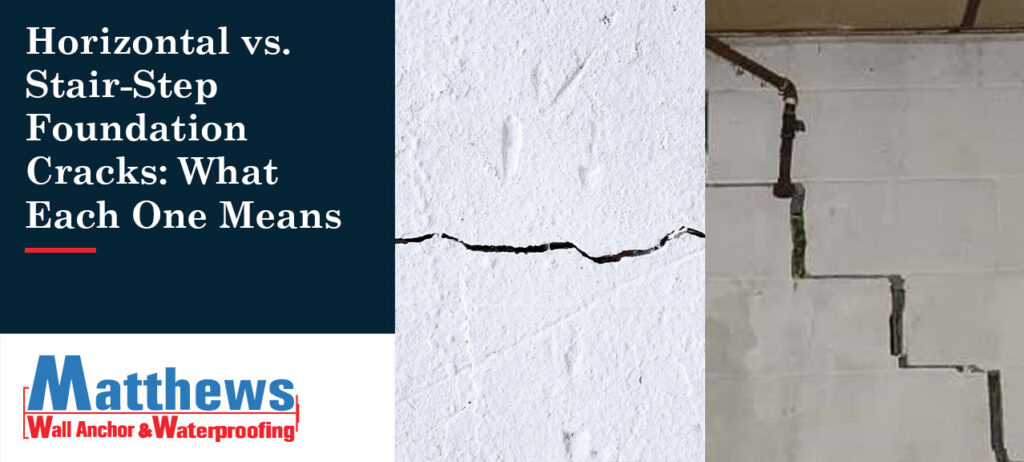
A horizontal crack runs straight across the wall face, parallel to the floor, typically appearing in the middle third of the wall. On block foundations — which are extremely common in Western PA and Eastern Ohio — horizontal cracks often track along a single mortar joint for much or all of the wall’s width. On poured concrete walls, they tend to be more continuous through the concrete itself.
What causes them: Horizontal cracks are the direct result of lateral soil pressure overwhelming the wall’s resistance at a specific point. The surrounding soil — particularly the heavy clay common throughout Beaver County, Mahoning County, Lawrence County, and the greater Pittsburgh and Youngstown areas — exerts a powerful inward force on the wall face. That force is greatest at the mid-height of the wall, where the wall has the least structural support from the floor systems above and below it. When that pressure exceeds what the wall can resist, it yields — and the crack forms at the weakest point, which is typically a mortar joint in a block wall or a stress concentration in poured concrete.
Freeze-thaw cycling amplifies this dramatically. Every winter in our region, saturated clay freezes and expands against the wall face, generating forces well beyond what warmer-season soil pressure produces. Walls that have withstood years of summer conditions can crack during a single hard winter if soil saturation is high enough.
Why horizontal cracks are the most serious crack type: Once a horizontal crack forms, the wall above the crack line is no longer functioning as a unified structural element. The section above the crack has lost its direct connection to the stable base below it, and it’s now being held roughly in position by friction, remaining mortar adhesion, and whatever load the floor system above is placing on it. That’s not a reliable structural arrangement.
More critically, horizontal cracks are almost always associated with some degree of inward wall movement — bowing — because the force that created the crack is the same force that’s pushing the wall inward. A wall with a horizontal crack is almost certainly a wall that has moved, and unless something counteracts that force, it will continue to move.
What to do: A horizontal crack requires professional evaluation promptly — not at the end of the season, not when you get around to it. If the crack is accompanied by visible inward bowing (you can often see this by sighting down the wall from one corner), that evaluation becomes more urgent. The repair method depends on how much movement has occurred, but wall anchor systems are the most common and effective solution: they create a mechanical connection between the wall and stable soil beyond the foundation, counteracting the lateral pressure that caused the crack and — over time and with periodic tightening — can often pull the wall back toward its original position.
Stair-Step Cracks: Serious, But a Different Story
A stair-step crack follows the mortar joints of a block or brick wall in a diagonal, alternating horizontal-vertical pattern — stepping from one mortar joint to the next in a way that resembles a staircase. These cracks are almost exclusive to block and brick foundations, because they follow the path of least resistance through the mortar rather than through the block material itself.
What causes them: Stair-step cracks are primarily caused by differential settlement — the condition where different sections of the foundation are moving vertically at different rates. When one corner or section of a foundation settles more than the adjacent section, the wall is placed under diagonal tension, and the mortar joints — weaker than the block units themselves — give way along the diagonal stress path. The result is the characteristic stair-step pattern.
In Western PA and Eastern Ohio, differential settlement is most commonly driven by uneven soil conditions beneath the foundation, drainage patterns that cause one area to experience more moisture fluctuation than another, the moisture-extracting effect of nearby tree root systems, and in some cases, compromised or failing footings beneath specific sections of the wall.
How serious are stair-step cracks? They’re significant, but their urgency is generally lower than horizontal cracks. Stair-step cracks indicate vertical movement rather than lateral wall failure, which means they’re not typically associated with the kind of progressive bowing that can lead to catastrophic wall failure. That said, differential settlement doesn’t stop on its own, and stair-step cracks that are actively growing — getting longer, wider, or multiplying — indicate ongoing movement that will cause increasing structural and cosmetic damage if left unaddressed.
The other concern with stair-step cracks is water infiltration. A crack that traces along a mortar joint creates a direct pathway for water to enter the basement, and in our climate’s wet seasons and snowmelt periods, that infiltration can be significant. Water entering through stair-step cracks contributes to the moisture conditions that accelerate further mortar deterioration and freeze-thaw damage.
What to do: Stair-step cracks warrant professional evaluation, but the response is typically less urgent than horizontal cracking. The key diagnostic question is whether the crack is stable or active. If you can document that the crack hasn’t changed over a full seasonal cycle — including through a winter freeze-thaw period — it may be appropriate to monitor while planning a repair. If it’s growing, or if you’re seeing it in multiple locations simultaneously, evaluation should happen sooner. Repair approaches depend on the cause: settlement-related stair-step cracking may be addressed with pier systems if the footing has lost bearing capacity, while water infiltration through stair-step cracks can often be managed with targeted waterproofing.
When You Have Both
It’s not uncommon to find walls in older Western PA and Ohio homes that show both crack types — horizontal cracking at mid-height and stair-step cracking at the corners. This combination typically indicates a wall that has been under multiple types of stress over a long period: lateral soil pressure driving the horizontal crack and bowing, and differential movement or settling at the corners driving the stair-step pattern.
When both are present, the horizontal cracking takes diagnostic priority — because the lateral failure mechanism it represents is the more structurally dangerous condition. The stair-step cracking provides additional context about what’s been happening around the foundation perimeter, but the repair focus starts with stopping the inward movement.
What Neither Crack Type Means
One thing worth saying directly: the presence of either crack type doesn’t automatically mean your wall is about to fail, or that you’re facing a catastrophic and budget-breaking repair. The majority of cracked basement walls we evaluate are repairable — often with wall anchors or carbon fiber straps that can be installed in a single day without major excavation or disruption.
What these cracks do mean is that something real is happening to your wall, and that getting a professional evaluation is the right next step. A crack that’s caught early — before significant bowing has occurred — is almost always a more straightforward and less expensive repair than one that’s been progressing for years.
Matthews Wall Anchor & Waterproofing offers free foundation inspections for homeowners across Eastern Ohio and Western Pennsylvania — including the Pittsburgh metro, Youngstown, Akron, Canton, and the surrounding counties. We’ll tell you exactly what we’re seeing, what’s causing it, and what your options are.
Call us at (800) 284-7471 or schedule your free inspection online. The sooner you know what type of crack you’re dealing with, the more options you have.