
If you’ve gotten to the point of asking what wall anchors cost, you’re probably already dealing with a bowing or leaning basement wall and trying to figure out whether the repair is going to be manageable or financially devastating. We’ve had that conversation with homeowners across Western Pennsylvania and Eastern Ohio for decades, and the most useful thing we can do is give you a real, honest answer — not a vague range designed to get you on the phone.
So here it is: wall anchor systems in the PA and Ohio market in 2026 typically run between $4,000 and $14,000 for a residential project, with most standard jobs falling in the $5,500 to $10,000 range. The variation in that spread is real, and it’s driven by specific factors — not contractor markup randomness. Understanding what moves the price up or down helps you evaluate any estimate you receive and make a confident decision.
What You’re Actually Paying For
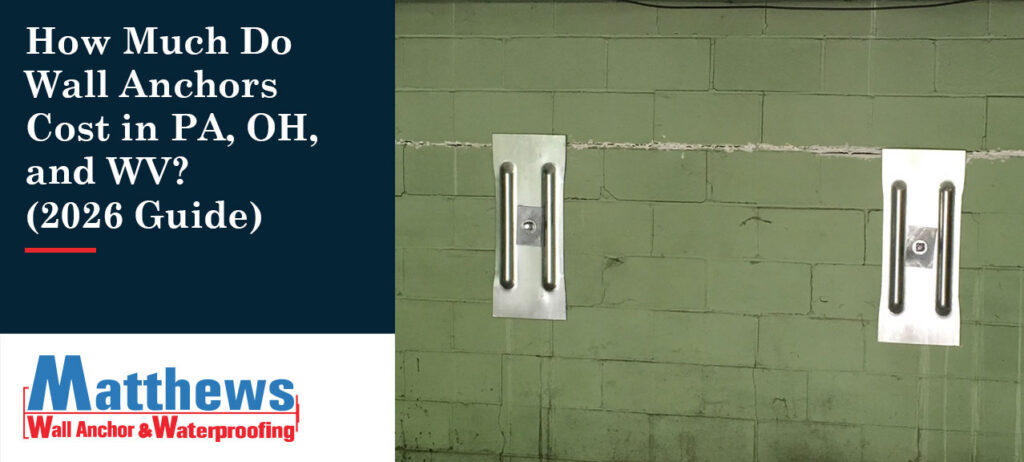
A wall anchor system is not a simple product. It’s a mechanically engineered connection between your failing basement wall and stable load-bearing soil beyond your foundation. The system consists of a steel wall plate secured to the interior wall surface, a steel rod driven horizontally through the wall and out into the yard, and an anchor plate buried in undisturbed soil at a distance calculated to reach beyond the zone of active soil pressure. The whole assembly is tensioned to apply controlled counter-force against the wall.
Done correctly, it stops further movement and — in the right soil conditions — allows the wall to be gradually tightened back toward its original position over time as the anchor is periodically adjusted.
The materials are industrial grade. The installation requires equipment to drive the rod, skilled labor to tension the system correctly, and in many cases, coordination with yard access and landscaping considerations. None of that is cheap, but it’s also not something you want done for the lowest possible price by someone who cuts corners on tensioning or anchor depth.
The Primary Cost Drivers
Number of anchors required
This is the biggest variable in any wall anchor estimate. A standard residential wall anchor installation typically involves placing anchors at intervals of 5 to 8 feet along the affected wall. A 20-foot bowing wall might need 3 to 4 anchors. A 40-foot wall with movement along its full length might need 7 or 8. More anchors means more materials, more labor, and more yard disruption — all of which drive the total cost up.
The anchor count should be determined by the wall’s length, the degree of bowing, and the wall type. Block walls typically require closer anchor spacing than poured concrete walls because of how they distribute load. Any estimate you receive should specify how many anchors are included and at what spacing.
Wall length and severity of movement
A wall that has bowed 1.5 inches is a different repair proposition than one that has moved 3 or 4 inches. More severe displacement may require additional anchors, more careful tensioning to avoid cracking an already-stressed wall during installation, and in some cases, pairing wall anchors with Fortress Carbon Fiber Straps to stabilize the wall surface while the anchor system addresses the underlying pressure. Combined repair approaches cost more — but they’re sometimes the right answer, and the alternative of under-engineering the repair is worse.
Accessibility of the installation area
Wall anchor installation requires running a steel rod through the wall and out into the yard to a depth of several feet. That process is straightforward on a home with open yard space along the affected wall. It becomes more complex — and more expensive — when the installation path runs under a concrete patio, through landscaping, beneath a deck, or into a narrow side yard with limited equipment access.
If you have hardscape adjacent to the bowing wall, expect the estimate to account for either working around it, cutting through it, or restoring it after installation. Any reputable contractor will identify this upfront.
Foundation type
Block foundations and poured concrete foundations are both candidates for wall anchors, but they behave differently and may require slightly different hardware configurations. Older block walls in particular — common throughout Pittsburgh’s established neighborhoods, the Youngstown metro, and communities like Beaver Falls, New Castle, and Steubenville — may need additional evaluation of the wall’s material condition before anchoring. A wall whose block faces are significantly deteriorated or whose mortar has failed across large sections may need supplemental work to provide reliable anchor attachment points.
How Wall Anchors Compare to Other Repair Options
One question homeowners frequently ask is how wall anchor pricing compares to the alternatives. Here’s an honest comparison.
Fortress Carbon Fiber Straps are typically less expensive per linear foot than wall anchors and involve no yard disturbance. They’re an excellent solution for walls with minimal to moderate bowing — generally less than 2 inches of inward displacement — where the goal is preventing further movement. Carbon fiber straps don’t have the ability to pull a wall back toward plumb the way a tensioned wall anchor system can. For walls that need correction over time in addition to stabilization, anchors are the better long-term choice. Many projects use both: anchors to address existing movement and provide corrective capability, carbon fiber to reinforce the wall surface.
Full wall excavation and replacement is the most expensive option and is rarely necessary for walls that are caught before catastrophic failure. Expect full wall replacement to run $25,000 to $60,000 or more depending on wall size, access, and what else gets disturbed in the process. Wall anchors and carbon fiber, done at the right time, prevent projects from ever reaching that threshold.
Doing nothing has a cost too, even though it doesn’t show up on an estimate. Foundation wall movement is progressive. A wall that’s within the repair range today will be further along in a year, and further still in three. The project that costs $7,000 today doesn’t become cheaper by waiting — it becomes a $12,000 project when additional anchors are needed for increased displacement, or a $40,000 project if the wall progresses to failure.
What to Look For When Comparing Estimates
Wall anchor pricing in the PA and Ohio market has a real range, and not all of the variation reflects quality differences. Some of it does. Here’s what to pay attention to.
Anchor count and spacing should be specified. A proposal that says “wall anchor system” without specifying the number of anchors isn’t a complete estimate. You should know exactly how many anchors are included, at what spacing, and why that count was determined.
Ask what happens to your yard. Installation requires accessing the anchor point from outside. A responsible contractor explains upfront how much yard disturbance is involved, whether any concrete cutting is required, and what restoration is included in the price.
Understand the warranty. Wall anchor systems installed by Matthews Wall Anchor carry a transferable lifetime warranty. Not every contractor’s warranty is equivalent — ask specifically whether the warranty is transferable to future owners (which matters for resale value), whether there are any conditions that void it, and how long the company has been around to stand behind it.
Be cautious of very low estimates. Anchor spacing that’s too wide, insufficient anchor depth, or under-tensioning are the most common ways to deliver a lower price on paper and an inferior repair in practice. A wall anchor system that isn’t properly tensioned and anchored deep enough in undisturbed soil isn’t doing the job it’s supposed to do.
Financing — Because This Rarely Fits Neatly Into a Budget
Wall anchor repair is not something most homeowners are planning for when they start noticing their basement wall looks different than it used to. Matthews Wall Anchor offers financing options to help make the repair accessible without delaying work that needs to happen. Deferring a repair to save up for it rarely works out in the homeowner’s favor — the wall keeps moving, and the repair cost when you get there is higher than it would have been today.
Start With a Free Inspection
Every wall anchor estimate starts with a free, in-person inspection — because there’s no honest way to price this work without seeing the wall, measuring the displacement, and evaluating the soil and access conditions specific to your property. Any contractor who quotes you a final number over the phone or from a photograph is guessing.
Matthews Wall Anchor provides free foundation inspections for homeowners across Eastern Ohio and Western Pennsylvania, including Pittsburgh, Youngstown, Akron, Canton, Beaver Falls, New Castle, and the surrounding communities. We’ll measure the wall accurately, explain what we’re seeing, and give you a transparent, detailed estimate with no pressure and no surprises.
Call us at (800) 284-7471 or schedule your free estimate online. Knowing exactly what you’re dealing with — and what it will cost to fix — is always better than wondering.