
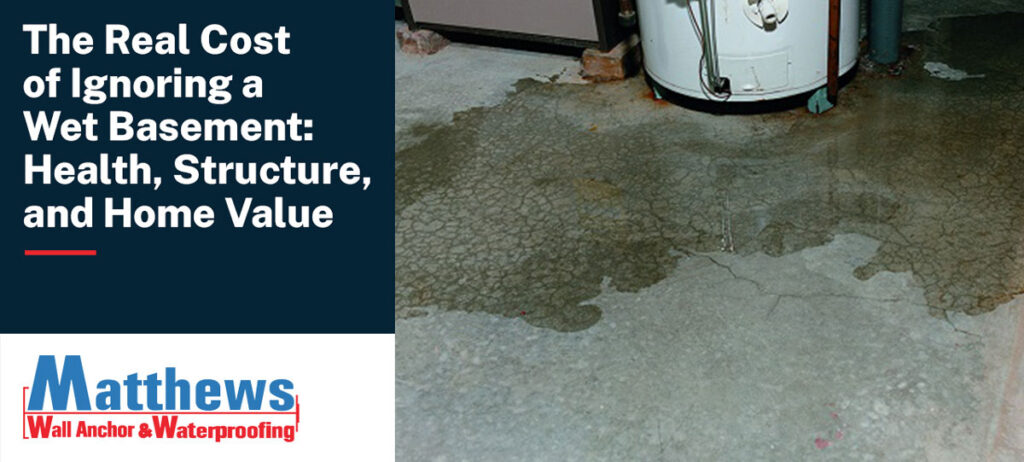
A little water in your basement. Maybe a musty smell after it rains. A small stain along the base of the wall. It’s easy to tell yourself it’s not that bad — that you’ll deal with it later. But “later” has a price tag, and it gets bigger every season you wait.
Here’s the honest truth about what a wet basement actually costs you — in your home’s structure, your family’s health, and your bottom line when it’s time to sell.
What’s Actually Happening When Water Gets In
Basement water intrusion isn’t random. It’s the result of hydrostatic pressure — groundwater building up in the saturated soil around your foundation and pushing inward through any available path: cracks, wall joints, floor-wall seams, and window wells.
In Western Pennsylvania and Eastern Ohio, our heavy spring rainfall and clay-heavy soils make this an almost inevitable issue in homes without proper waterproofing. The water you see on the floor after a storm is just the visible symptom. The real damage is the ongoing moisture cycle — even in homes that never flood outright. Chronic humidity, condensation, and minor seepage all create the same downstream problems.
The Health Toll: What You’re Breathing
Moisture breeds mold, and mold doesn’t stay in the basement. Mold spores are microscopic and travel freely through your HVAC system, floor gaps, and wall penetrations into the living areas above. The EPA has found that 40 to 60% of the air on your home’s first floor comes from the basement and crawl space below.
For most healthy adults, mold exposure causes nagging symptoms that are often mistakenly attributed to allergies or seasonal illness:
- Persistent coughing or wheezing
- Sinus congestion and irritation
- Headaches and fatigue
- Itchy or watery eyes
For children, the elderly, and anyone with asthma or a compromised immune system, long-term exposure can be significantly more serious. One study found that 76% of homeowners dealing with basement mold feared that they and their families were being harmed by it. And 13% had to temporarily leave their homes because the conditions had become uninhabitable.
The Structural Toll: What Water Does to Your Home
Beyond health, chronic basement moisture attacks the physical structure of your home on multiple fronts:
Foundation walls — Water infiltrating through wall cracks widens those cracks over time, allowing more water in, which widens them further. Freeze-thaw cycles in our PA/OH winters turn small cracks into serious structural failures. Horizontal cracks and bowing walls — two of the most serious foundation problems — are almost always moisture-related.
Floor joists and beams — Wood joists sitting above a damp basement absorb moisture continuously. Over months and years, this causes rot, softening, and structural weakening of the floor above — leading to squeaky, bouncy, or sagging floors.
Insulation and ductwork — Wet insulation loses its R-value and becomes a mold-growing medium. Moisture in ductwork spreads air quality problems to every room in your home.
Personal property — Furniture, boxes, electronics, and anything stored in a wet basement is at constant risk. Many homeowners don’t discover the extent of the damage until something irreplaceable is destroyed.
The Financial Toll: What It Costs to Ignore It
Here’s where the numbers really start to make the case for acting sooner rather than later.
Mold remediation is not cheap. Removing mold from a basement runs $1,500 to $6,000 for a partial remediation — and up to $15,000 if the entire basement is affected. And that’s just the remediation. It doesn’t include repairing the water problem that caused the mold in the first place.
Structural repairs — Rotted floor joists, compromised sill plates, and severely damaged foundation walls can run $5,000 to $15,000 or more in repair costs once the damage has progressed.
Home value loss — This one surprises homeowners most. Homes with documented water intrusion or a history of basement moisture can lose 10% to 25% of their market value according to industry data. On a $300,000 home, that’s a potential $30,000 to $75,000 hit. And 39% of buyers surveyed said they would never buy a home if they knew or suspected it had a wet basement.
On the flip side, waterproofing has one of the strongest returns of any home improvement investment — approximately 85% return on investment at resale, and up to a 25% increase in home value for properly waterproofed homes.
What Professional Waterproofing Actually Costs
A complete interior basement waterproofing system — drainage channel, sump pump, and vapor barrier — typically runs $5,000 to $15,000 depending on the size of your basement and the extent of the problem. That’s a meaningful investment, no question.
But compare it to:
- $6,000–$15,000 in mold remediation
- $5,000–$15,000+ in structural repairs
- $30,000–$75,000 in home value loss at sale
Waterproofing your basement isn’t a cost. It’s protection for every dollar you’ve already invested in your home.
Don’t Let “Later” Become “Too Late”
The homeowners who end up with the biggest repair bills are almost never the ones who didn’t know they had a problem. They’re the ones who knew — and waited. Foundation and waterproofing problems are progressive. They don’t stabilize on their own. Every rain event, every freeze-thaw cycle, every humid summer pushes the damage a little further.
If your basement is wet, damp, musty, or stained — it’s telling you something. Matthews Wall Anchor & Waterproofing has been listening to PA and OH basements for over 30 years. Contact us for a free inspection and an honest assessment of what it will take to protect your home.