

There’s a question that comes up in a certain percentage of our foundation inspections — usually after we’ve walked a homeowner through what we’re seeing in their basement and the damage is significant enough that they need to ask it directly: “At what point does it make more sense to just replace the whole thing?”
It’s a fair question, and it deserves a straight answer. Unfortunately, the straight answer isn’t a simple one. Whether foundation repair or full foundation replacement is the right call depends on several factors that vary considerably from home to home — the type of foundation, the degree of damage, the age and construction of the structure, the homeowner’s long-term plans for the property, and yes, the budget reality of both options.
At Matthews Wall Anchor & Waterproofing, we’ve been having this conversation with homeowners across Western Pennsylvania and Eastern Ohio for decades. We’ve seen cases where repair was absolutely the right call on a wall that looked like it was past saving. We’ve also seen cases where replacement was the only responsible recommendation. Here’s how we think about the decision — and what every homeowner facing serious foundation damage should understand before they commit either direction.
First: What Foundation Replacement Actually Involves
When most homeowners imagine foundation replacement, they picture something dramatic — and they’re right to. Full foundation replacement is one of the most significant and disruptive projects a residential property can undergo.
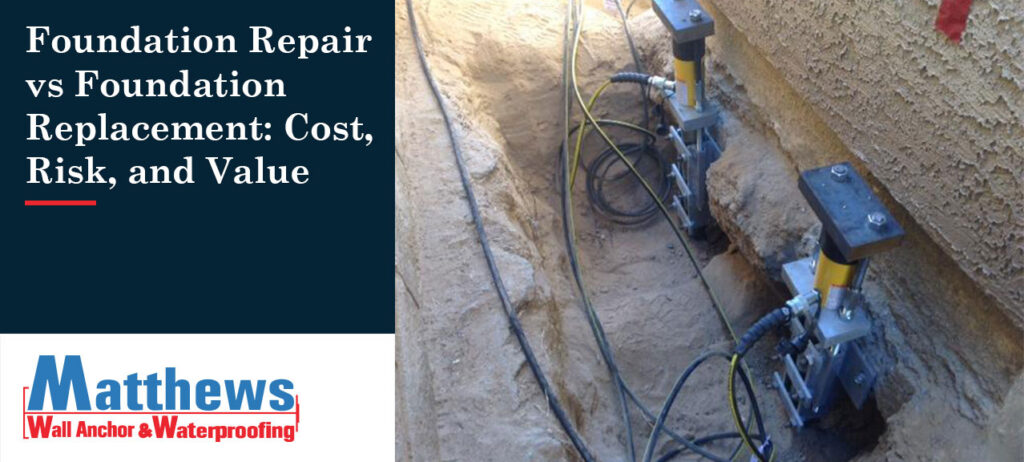
The process typically involves excavating entirely around the perimeter of the home, temporarily supporting the structure above using steel beams and hydraulic jacks while the existing foundation is demolished and removed, constructing a new foundation — either poured concrete or block — and then backfilling, restoring drainage, and reconnecting any utilities that were disrupted. Depending on the size of the home and the complexity of the existing structure, this process can take several weeks to complete.
The cost reflects that complexity. Full foundation replacement for a typical residential home in the PA and Ohio region generally runs from $30,000 to $100,000 or more, with larger homes, difficult access situations, or complicated utility relocation pushing toward the higher end of that range. That figure often doesn’t include landscaping restoration, interior finishing work, or any structural repairs to the above-grade portion of the home that the foundation failure may have caused.
This context matters before any comparison to repair costs is made.
What Foundation Repair Involves — and What It Can Actually Accomplish
Foundation repair covers a wide range of methods, and one of the most common misconceptions homeowners bring into our inspections is that repair is inherently a lesser solution — a way of patching a problem that will eventually come back anyway. In the majority of cases, that’s simply not accurate.
Modern foundation repair methods are engineered to provide permanent structural correction, not temporary stabilization. Wall anchor systems mechanically counteract the lateral forces that caused the wall to bow and, over time, can pull the wall back toward its original position. Carbon fiber straps bond to the wall with tensile strength that prevents further movement indefinitely. Steel push piers and helical piers transfer the structural load of the home past the unstable near-surface soils to deep, competent bearing material — a solution that doesn’t degrade with soil conditions.
These methods, properly installed by qualified contractors, come with substantial warranties and have documented performance histories spanning decades. They are not patch jobs. They are engineered solutions that address the root cause of failure.
The cost difference compared to replacement is substantial. A wall anchor system for a seriously bowed wall might run $5,000 to $15,000 depending on wall length and number of anchors required. Carbon fiber reinforcement for a compromised wall typically falls in a similar range. Even combined repair approaches — anchors plus carbon fiber plus drainage correction — rarely approach the lower end of what full replacement costs.
When Repair Is the Right Answer
The honest answer is that repair is the right answer the majority of the time — including in situations that look alarming to a homeowner who hasn’t seen a lot of damaged foundations. Here’s the general framework we use.
Walls that are bowing but structurally intact are almost always good repair candidates. Even significant inward displacement — up to two inches, and in some cases beyond — can often be addressed with wall anchors, particularly when the wall material itself is still fundamentally sound and the mortar joints or wall face haven’t deteriorated to the point of crumbling. The goal of the repair is to stop further movement and, over time, restore the wall toward plumb. It works.
Walls with horizontal cracking along a single course are a classic Eastern Ohio and Western PA presentation — usually the result of lateral soil pressure concentrated at a specific point. These walls need reinforcement, but the cracking itself doesn’t automatically mean the wall is unsalvageable. How much displacement has occurred, how much deterioration is present in the wall material around the crack, and whether the wall above and below the crack line is still in reasonable condition all factor into the repair-versus-replace calculation.
Foundations with settling or sinking rather than bowing — where the concern is vertical movement rather than lateral wall failure — are typically addressed with pier systems rather than wall anchors or carbon fiber. Steel push piers or helical piers driven to bearing depth below the home can stabilize and often partially lift a settling foundation, preserving the existing foundation rather than replacing it. This is a well-established, permanent repair method that makes replacement unnecessary in the vast majority of settling cases.
When Replacement Becomes the Honest Recommendation
We don’t recommend replacement lightly — the cost and disruption are significant, and we’re not in the business of recommending work that isn’t genuinely necessary. But there are conditions where repair is not the responsible answer.
Complete wall collapse or imminent failure is the clearest case. A foundation wall that has moved past the point where it can be mechanically stabilized — one that is no longer capable of bearing the structural loads transferred to it from the home above — cannot be anchored back to function. At this stage, the wall has to come out and be rebuilt. Fortunately, this represents a small minority of the damaged foundations we see. Most homeowners contact us well before their walls reach this point, especially in today’s environment where information about foundation warning signs is more accessible.
Severe, widespread deterioration of block material can also push the math toward replacement. Block walls that have experienced extensive spalling, where the block faces have disintegrated and mortar joints are entirely absent across large sections, may not provide the surface integrity that repair methods depend on. Wall anchors need a wall to attach to. Carbon fiber straps need a wall to bond to. If the wall itself is so far gone that those attachment points are unreliable, rebuilding becomes more sensible than attempting repair on a structurally compromised substrate.
Homes where the existing foundation is fundamentally undersized or incorrectly built for the load occasionally present as replacement candidates — particularly in very old construction where original footings are inadequate or where additions were built without proper foundation engineering. In these cases, the issue isn’t just the condition of the existing wall, it’s the design of the original system.
The Risk Equation: What Happens If You Wait
Whether you’re leaning toward repair or trying to decide if the situation has progressed to replacement, there’s a timeline dimension that matters more than anything else in this decision: the longer damage progresses unaddressed, the more likely it is to shift from a repair scenario to a replacement scenario.
Foundation wall movement is progressive. The forces causing it — lateral soil pressure, freeze–thaw cycling, hydrostatic pressure — don’t take seasons off. A wall that’s bowed one inch today will bow further next year. A crack that’s hairline-width in the fall will be wider after winter. The wall that’s firmly in the “repair is appropriate” category in 2025 may cross into more complicated territory by 2027 if nothing is done.
This is the most important practical point in the repair-versus-replacement conversation: the decision you’re making today is not just about the current condition of your foundation. It’s about whether you want to address it at its current level of damage — or at whatever level it reaches while you’re deliberating.
Early repair is almost always cheaper, faster, less disruptive, and more certain in outcome than late-stage repair or replacement. That’s not a sales point — it’s the consistent reality we’ve seen over decades of foundation work in this region.
The Value Consideration: What Foundation Work Does for Your Home
One dimension of this decision that homeowners sometimes underweight is the effect on property value and transferability. A home with a documented, warrantied foundation repair — performed by a credentialed contractor and backed by a transferable lifetime warranty — is a meaningfully different asset than a home with an unaddressed foundation issue.
Buyers and their home inspectors look at foundations. Mortgage lenders and their appraisers look at foundations. A visible bowing wall or documented movement without professional repair in place creates real complications at the point of sale — price reductions, failed financing, or deals that fall apart entirely.
A professionally repaired foundation with a transferable warranty, by contrast, demonstrates that the issue was identified and addressed responsibly. In many cases, that documentation actually supports the home’s value rather than undermining it.
Our Recommendation: Start with an Honest Inspection
The repair-versus-replacement question can’t be answered from a photograph or a description over the phone. It requires an in-person evaluation by someone with enough experience to assess the actual condition of the wall, measure displacement accurately, evaluate the material integrity of the foundation, and consider the structural loads the foundation is supporting.
At Matthews Wall Anchor & Waterproofing, that evaluation is free. We don’t have a financial incentive to recommend replacement over repair — our business is built on providing the right solution, which in the overwhelming majority of cases is repair. We’ll tell you honestly what we see, what your options are, and what we’d recommend. If it’s a repair situation, we’ll tell you. If it’s not, we’ll tell you that too.
Call us at (800) 284-7471 or schedule your free inspection online. The sooner you know what you’re dealing with, the more options you have.