
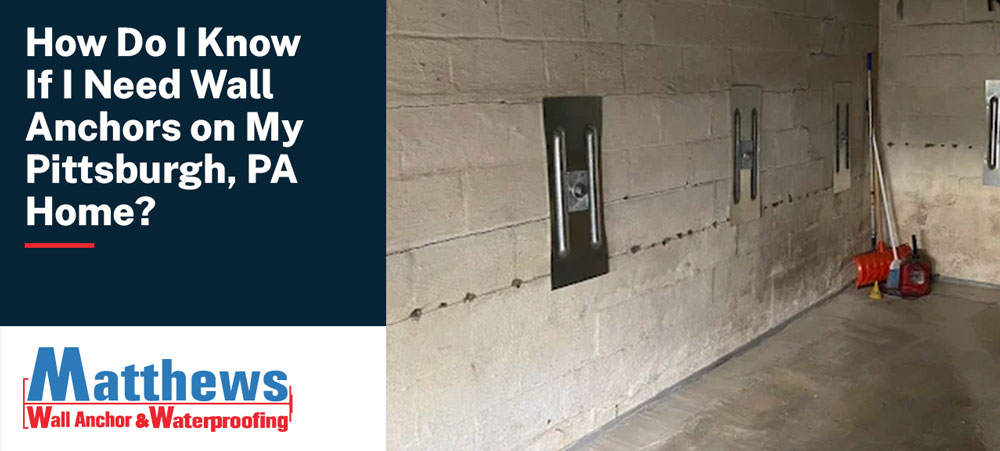
Your basement walls are doing a tough job every single day. They’re holding back thousands of pounds of soil, absorbing the pressure of rain and groundwater, and supporting the weight of the structure above them. Most of the time, they do this work quietly and without complaint. But over time — especially in Pittsburgh’s climate, with its heavy clay soils and significant rainfall — that constant pressure can start to win. When it does, the signs usually appear in your basement walls. Knowing what to look for can help you catch the problem before it becomes a crisis.
What Are Wall Anchors?
Wall anchors are a proven foundation repair solution designed to stabilize and, over time, straighten bowing or leaning basement walls. They work by using a steel plate anchored to the wall on the inside and another plate installed in stable soil away from the home. The two plates are connected by a steel rod, and the system is tightened to counteract the pressure that’s been pushing your wall inward. It’s one of the most effective and cost-efficient ways to address inward movement in basement walls without major excavation.
Signs Your Basement Walls May Need Wall Anchors
Not every crack or blemish in your basement walls is cause for concern — but some warning signs are serious enough that you should contact a foundation repair expert right away. Here’s what to look for:
- Horizontal cracks: These are among the most serious types of foundation wall cracks. They typically indicate that lateral soil pressure is overcoming your wall’s resistance. If you see a horizontal crack running across your block or poured concrete wall, don’t wait to have it evaluated.
- Bowing or bulging walls: If your wall curves inward — even slightly — it’s a sign that pressure from the outside is exceeding the wall’s structural capacity. Even an inch of movement is significant and should be addressed promptly.
- Stair-step cracks in block walls: These diagonal cracks that follow the mortar joints between concrete blocks indicate uneven settling or lateral pressure. Combined with other symptoms, they’re a strong indicator of a structural problem.
- Gaps at the top or bottom of the wall: If your basement wall has separated from the floor slab or the rim joist above it, that’s a sign of movement that needs immediate professional evaluation.
- Walls that are tilting inward at the top: Unlike bowing (which is inward movement in the middle of the wall), tilting affects the top of the wall. Either way, inward movement is a red flag.
Why Pittsburgh Homes Are Especially Vulnerable
The Pittsburgh area’s geology creates challenging conditions for foundation walls. Our heavy clay soils absorb water and expand — a process called hydrostatic pressure — which pushes against foundation walls with tremendous force. When the soil dries out, it contracts and can pull away from the wall, reducing support. This cycle of expansion and contraction, repeated over years and decades, is one of the primary reasons Pittsburgh homeowners see bowing and cracking in their basement walls more often than homeowners in regions with sandier soils.
Hillside homes — which are extremely common throughout Pittsburgh, the North Hills, South Hills, and surrounding communities — face additional lateral pressure from the slope of the land. This makes wall movement even more likely without proper support.
The Earlier You Act, the Better
Here’s something homeowners often don’t realize: wall anchors are most effective when installed before significant movement has occurred. A wall that has moved two inches is harder to address than one that has moved a quarter inch. Catching the problem early gives you more options, typically results in a lower repair cost, and may even allow the wall to be gradually straightened over time by periodically tightening the anchor system.
If you’ve noticed any of the warning signs above, the smart move is to schedule a free inspection with Matthews Wall Anchor & Waterproofing. Our engineers will assess the extent of the movement, explain your options clearly, and recommend the best solution for your specific situation — whether that’s wall anchors, carbon fiber straps, or another approach entirely.
Don’t Guess — Get a Professional Opinion
Foundation problems don’t fix themselves, and they don’t stay the same size, either. A small crack or subtle bowing that’s ignored today can become a major structural failure tomorrow. If something in your basement doesn’t look right, trust that instinct and call the experts. At Matthews Wall Anchor & Waterproofing, we’ve been protecting Pittsburgh-area homes for years with foundation repair services and we’re here to help you protect yours.