

If you’ve noticed your basement walls starting to bow inward, lean, or crack along horizontal lines, you’re not dealing with a cosmetic issue—you’re watching active structural failure happen in slow motion. For homeowners across Eastern Ohio and Western Pennsylvania, this is one of the most common and most urgent foundation problems we see. The good news: wall anchor systems are a proven, minimally invasive solution that actually addresses the root cause instead of masking it.
At Matthews Wall Anchor & Waterproofing, we’ve been installing wall anchor systems for homeowners in the Pittsburgh area, Youngstown, Canton, and throughout the tri-state region since the 1980s. Here’s a clear, no-fluff explanation of how these systems actually work—and why they’re one of the most effective foundation repair solutions available.
Why Foundation Walls Move in the First Place
Foundation walls don’t bow for no reason. In Eastern Ohio and Western PA, our soil conditions are a significant contributing factor. Heavy clay soils—common throughout the region—absorb moisture and expand dramatically, creating what engineers call “lateral soil pressure.” This is the outward and inward force that the surrounding earth exerts against your basement walls.
Add in our freeze-thaw cycles each winter, seasonal heavy rainfall, poor drainage around the foundation, and the natural settling that comes with decades-old homes—and you have a recipe for progressive wall movement. Left unaddressed, bowing walls can eventually lead to complete wall failure, which is far more expensive (and dangerous) to fix.
How Wall Anchor Systems Actually Work
Wall anchor systems work by transferring the lateral force pushing on your foundation wall to a more stable point in the soil away from your home. Think of it as creating a counterbalance deep in the earth that holds your wall steady—and in many cases, can gradually pull it back toward its original position.
Here’s the process broken down step by step:
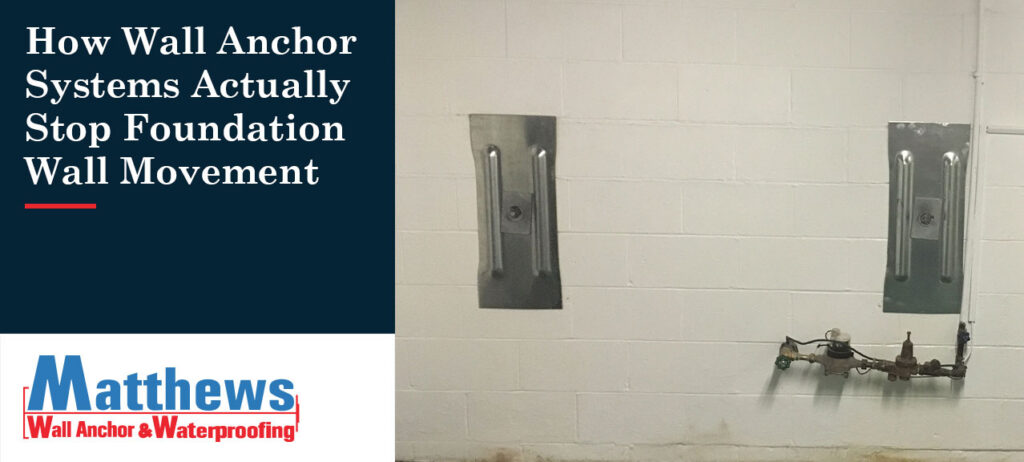
- A steel wall plate is secured to the interior side of your bowing basement wall.
- A steel rod is driven horizontally through the wall and out into the soil beyond your foundation.
- An earth anchor plate is attached at the end of the rod, deep in undisturbed, load-bearing soil—well away from the house.
- A nut and torque system connects everything, allowing our technicians to tension the anchor and apply controlled counter-pressure against the wall.
- Over time, as the soil conditions allow, the wall can often be gradually tightened back toward plumb—restoring it closer to its original position.
The result is a mechanically sound connection between your foundation wall and stable earth, creating a system that actively resists the pressure that caused the problem in the first place.
Are Wall Anchors the Right Solution for Your Home?
Wall anchor systems are ideal for walls that are bowing or leaning inward but haven’t yet experienced catastrophic failure. They’re particularly well-suited for block foundation walls and poured concrete walls with horizontal cracks or step cracks—both of which are extremely common in older homes throughout the Pittsburgh metro area, Beaver County, Lawrence County, Mahoning County, and Columbiana County.
For walls that are still in good structural condition but need reinforcement without large-scale excavation, wall anchors provide a non-disruptive, permanent solution. Installation typically requires only a small amount of yard disturbance and can often be completed in a single day—with no major landscaping damage.
If the bowing is more severe, or if cracking indicates the wall is at greater risk, we may recommend pairing wall anchors with our Fortress Carbon Fiber Straps for added reinforcement across the wall’s surface. Every home is different, which is why we always start with a free, thorough inspection.
Wall Anchors vs. Other Foundation Repair Methods
Homeowners often ask how wall anchors compare to other options like carbon fiber straps or full excavation and wall replacement. Here’s the honest answer: each method has its place, and the right choice depends on the severity of movement and your specific foundation type.
Carbon fiber straps are excellent at preventing further movement, but they can’t actively pull a wall back toward plumb the way a properly tensioned wall anchor system can. Full excavation and replacement is sometimes necessary for severely damaged walls, but it’s far more disruptive and costly. Wall anchors hit a sweet spot: they stop movement, can reverse it over time, and do so without tearing up your yard or your budget.
Don’t Wait—Foundation Wall Movement Only Gets Worse
This is the most important point we can make: foundation wall movement doesn’t stop on its own. Every freeze-thaw cycle, every heavy rain, and every passing season increases the cumulative pressure on a compromised wall. What starts as a minor bow or a hairline crack can progress to a major structural failure that requires full wall replacement—a project that costs exponentially more than early intervention.
Homeowners in Youngstown, Akron, Pittsburgh, and surrounding communities throughout Eastern Ohio and Western Pennsylvania trust Matthews Wall Anchor because we give straight answers. We’ll tell you what’s happening with your foundation, what your options are, and what we’d recommend—without pressure and without gimmicks.
Ready to Stop the Movement? Start with a Free Inspection
If you’ve seen the signs—bowing walls, horizontal cracks, leaning foundation walls, or doors and windows that no longer open smoothly—now is the time to act. Matthews Wall Anchor & Waterproofing offers free, no-obligation inspections for homeowners across Eastern Ohio and Western PA. Our local foundation repair experts will assess your foundation, explain exactly what’s happening, and walk you through your repair options.
Call us at (800) 284-7471 or request your free estimate online. Your home’s foundation is too important to wait.