

There’s a particular kind of anxiety that settles in once a homeowner notices their basement wall isn’t straight anymore. You look at it. You wonder how long it’s been like that. You wonder if it looked that way six months ago. You wonder if it’s going to keep going — and if so, how fast, and how bad it’s going to get.
The not-knowing is often worse than the reality. And the most dangerous version of that uncertainty is when homeowners decide to keep watching and waiting without any system for actually determining whether the wall is moving, standing still, or getting close to a point where the decision gets made for them.
At Matthews Wall Anchor & Waterproofing, we’ve inspected thousands of leaning and bowing basement walls across Western Pennsylvania and Eastern Ohio. The single most consistent thing we hear from homeowners who waited too long is some version of: “I knew something was wrong, but I wasn’t sure how serious it was.” This post is for those homeowners — the ones who’ve seen something concerning and want to know how to evaluate it honestly before calling anyone.
The Difference Between Leaning and Bowing — and Why It Matters
These two terms are often used interchangeably, but they describe different types of movement with different structural implications.
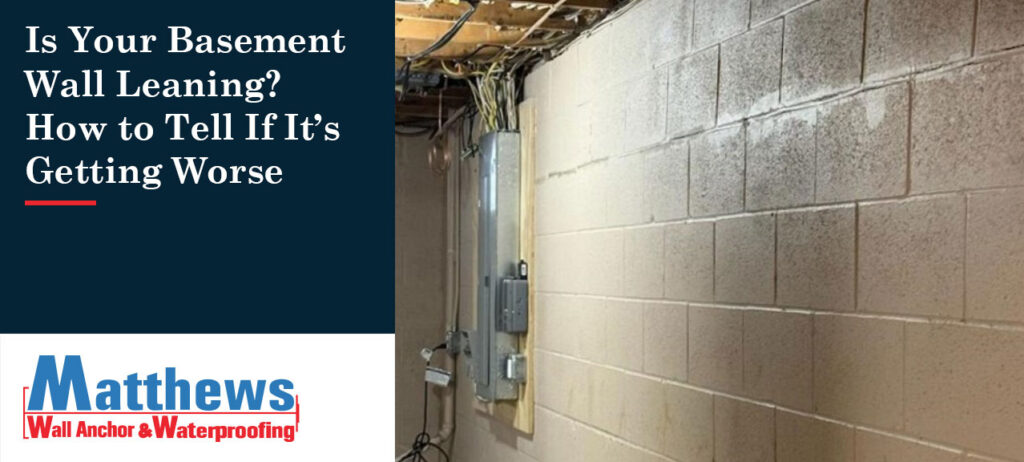
A bowing wall curves inward at its midpoint while remaining relatively anchored at the top and bottom. If you looked at a cross-section of the wall from the side, it would have a slight arc shape — straight at the floor and ceiling, pushed inward somewhere in the middle third. Bowing is typically caused by lateral soil pressure acting on a wall that has a weak point — often along a horizontal crack or a deteriorated mortar course — and the wall is deflecting at that point while the top plate and footer hold.
A leaning wall rotates. The top of the wall moves inward while the base stays in roughly the same position, pivoting around the footing. In cross-section, a leaning wall looks like a wall that’s been tipped inward from the top. This is sometimes called “top rotation” by structural engineers, and it’s a more urgent condition than bowing in many cases — because a leaning wall means the connection between the wall and the floor structure above has been compromised or is under extreme stress. The wall is no longer acting as a vertical load-bearing element the way it was designed to.
In practice, many walls show elements of both — some bowing in the middle and some rotation at the top — particularly in homes where movement has been ongoing for several years. But understanding which type of movement is dominant helps determine what repair method is appropriate and how urgent the situation is.
How to Actually Measure Whether Your Wall Is Moving
Observing that a wall looks off is one thing. Knowing whether it’s currently moving — and at what rate — is another. Here are the practical methods we use and recommend to homeowners who want to monitor their walls between inspections.
The Long Straightedge Method This is the simplest and most accessible starting point. Hold a six- to eight-foot level or straightedge horizontally against the wall surface at mid-height — roughly where the wall appears to bow most. The gap between the straightedge and the wall at the center gives you a rough measurement of how far the wall has moved inward at that point. Mark the date and measurement on a piece of tape attached to the wall itself. Check it again in 30 days, 60 days, and after any major rain event or temperature swing. If the gap is growing, the wall is moving.
Crack Monitoring with Tell-Tales If your wall has a visible horizontal or stair-step crack, that crack is one of the most informative things you can monitor. A simple crack monitor — sometimes called a tell-tale — is a small plastic gauge that bridges a crack and measures whether the two sides are moving relative to each other. They’re inexpensive and available at hardware stores. If you don’t have one, you can do a lower-tech version: mark both sides of the crack with a pencil line on a piece of tape, note the date, and photograph it. Check it monthly, and particularly after hard freezes and heavy rain events. Width changes tell you the wall is actively moving. A crack that stays the same width month after month — especially through a full seasonal cycle — is a more stable situation than one that’s widening.
The Plumb Bob Test for Leaning For assessing top rotation rather than midpoint bowing, a plumb bob is your most reliable tool. Suspend it from the top of the wall — ideally from the rim joist or the base of the floor system directly above the wall — and let it hang freely down to the floor. The distance between the string and the wall face at the top versus the bottom tells you whether and how far the wall is leaning. A wall in plumb position will show the same distance at top and bottom. A leaning wall will show a smaller gap at the top than the bottom (inward lean) or the opposite (outward lean, which is less common but also concerning).
Documenting with Photography Alongside physical measurements, regular photographs from a consistent position and angle are invaluable for building a timeline of wall movement. Use a fixed reference point — a floor drain, a support column, a specific block course — and shoot from the same spot each time. Changes that are too gradual to notice in person often become obvious when you compare photos taken three or six months apart.
The Warning Signs That Mean Stop Monitoring and Start Calling
Monitoring is appropriate when you’re dealing with a wall that may have existing damage of unknown age and want to establish whether it’s currently active. It is not appropriate as an indefinite strategy when certain conditions are present. These are the signs that move a situation from “monitor and evaluate” to “get a professional out now.”
Rapid or Visible Change If you can see that a crack has widened or a wall has moved more in the past few weeks than it did over the previous several months — particularly after a hard freeze-thaw event or a period of heavy rain — that acceleration is a significant warning. Foundation walls don’t typically fail in a sudden dramatic collapse, but they can reach tipping points where damage that was progressing slowly begins progressing quickly. Acceleration is that signal.
Horizontal Cracking Along a Single Course A single horizontal crack running continuously across a block or poured concrete wall — especially one located in the lower third of the wall — is one of the most structurally serious presentations we see. This type of crack indicates that the wall has been stressed beyond the tensile capacity of the material at that point, and that the wall above the crack is now effectively floating, held in position only by whatever friction and remaining connection exists. This is not a wait-and-see situation.
Wall Separation at the Top If you can see daylight, feel a draft, or fit your hand into a gap between the top of the basement wall and the floor framing above it, the wall has moved significantly and is no longer providing adequate support to the structure. The connection between the wall and the floor system is one of the most critical structural junctions in the home. Separation there is an urgent problem.
Sticking Doors and Windows — Especially New Ones Interior doors and windows that have suddenly become difficult to operate — particularly if they were fine six months ago — are one of the most reliable above-grade indicators of active foundation movement. As walls shift, the door and window openings they support shift with them, binding frames that were previously square. If you’ve noticed this changing recently, it’s worth correlating with a basement inspection.
Diagonal Cracks Radiating from Corners Diagonal cracks running from the corners of basement windows or from the upper corners of the wall toward the ceiling are a sign that the wall is experiencing racking stress — meaning it’s being pushed in a direction that’s distorting its rectangular shape. In block walls, these often follow the stair-step pattern of mortar joints. In poured concrete walls, they tend to radiate diagonally. Either way, they indicate that the forces on the wall are significant and directional.
Common Things Homeowners Get Wrong While Monitoring
A few patterns come up repeatedly in our inspections of homes where monitoring has been going on for a while without a professional evaluation — and they’re worth naming directly.
Assuming stability because nothing changed last summer. Summer is often the most stable season for foundation walls in our region. Dry soil shrinks away from walls, reducing lateral pressure. The real test is always the winter freeze–thaw season and the spring thaw/rain period. A wall that looked unchanged from June through September may have moved meaningfully from November through April. Annual monitoring that only covers the stable season produces false confidence.
Judging severity by crack width alone. A narrow crack on a wall that has measurably moved two inches is a more serious situation than a wide crack on a wall that hasn’t moved at all. Width tells you about the material; displacement tells you about the structural situation. Both matter, but displacement is the more important variable.
Assuming the problem is cosmetic because the house “feels fine.” Foundation wall movement in the range we typically see — up to a few inches over several years — rarely produces dramatic above-grade symptoms until the movement is already quite advanced. The house feeling structurally sound from the inside is not a reliable indicator that the foundation is stable. Walls can bow significantly before the effects translate noticeably to the living spaces above.
What a Professional Inspection Actually Tells You That Self-Monitoring Can’t
There’s a real and meaningful difference between what a homeowner can assess with a level and a plumb bob and what an experienced foundation specialist evaluates during an inspection. A professional assessment includes an accurate measurement of total displacement, an evaluation of the wall material’s structural integrity (not just its surface appearance), an assessment of the forces acting on the wall from soil conditions and drainage patterns, and a determination of whether the wall is currently active or in a stable period.
That last point matters more than most homeowners realize. A wall with two inches of historic displacement that has been stable for five years is a fundamentally different situation from a wall with one inch of displacement that moved a quarter inch in the last three months. Both need attention — but the urgency and the repair priority are different.
Matthews Wall Anchor offers free foundation inspections across Eastern Ohio and Western Pennsylvania — including the Pittsburgh metro area, Youngstown, Akron, Canton, Beaver County, Lawrence County, Mahoning County, and Columbiana County. We’ll measure accurately, explain clearly, and give you honest guidance on whether what you’re seeing is a monitor-and-plan situation or a repair-this-season situation.
Call us at (800) 284-7471 or schedule your free inspection online. Knowing exactly what you’re dealing with is always better than wondering.