

Drive through any established neighborhood in the Pittsburgh metro area — Bethel Park, Carnegie, Canonsburg, Beaver Falls, New Castle, or dozens of communities across Beaver, Lawrence, Washington, and Allegheny Counties — and you’re looking at a lot of homes built between 1920 and 1975. Western PA has one of the older residential housing stocks in the country, and that’s largely a story of the region’s industrial history: steel, coal, manufacturing, and the densely built working-class communities that grew up around those industries.
Those homes have character, history, and — in many cases — basement walls that are under a level of stress their original builders didn’t fully account for. Bowed basement walls are more common in pre-1980 Western PA homes than in newer construction, and it’s not a coincidence or a reflection of how well those homes were built. It’s the predictable result of several specific factors that compound over time: construction methods of the era, the accumulated effect of Western PA’s soil and climate conditions, and the simple reality of what decades of freeze-thaw cycles do to unreinforced masonry.
Here’s the breakdown of why older homes in our region face this problem at a higher rate — and what to do about it.
Block Wall Construction Was the Standard — and Block Has Specific Vulnerabilities
The overwhelming majority of pre-1975 homes in Western Pennsylvania were built with concrete masonry unit (CMU) foundations — concrete block walls, laid in courses with mortar joints. This was the dominant construction method of the era, and in its time it was considered a perfectly solid approach.
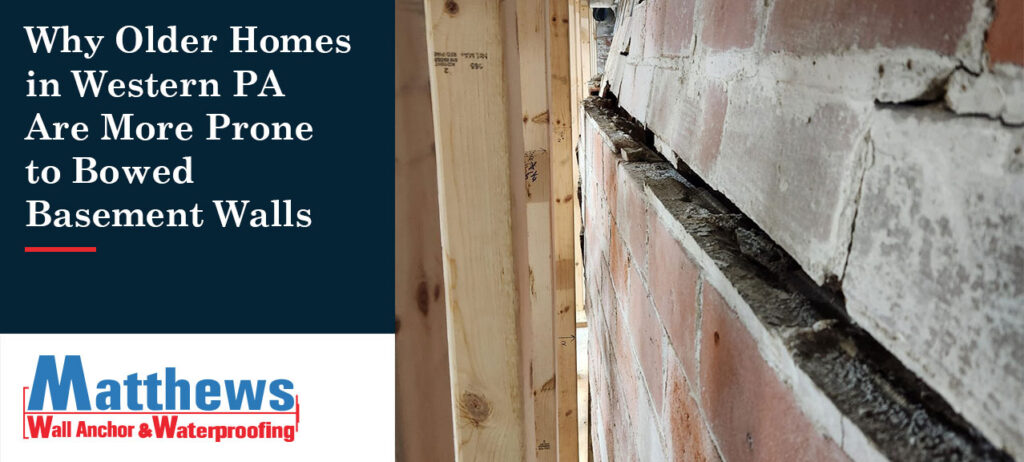
The limitation is that unreinforced concrete block walls have a fundamental structural weakness when subjected to lateral soil pressure. A block wall is assembled from individual units bonded with mortar — it’s not a monolithic structure. Its resistance to inward pressure depends on the tensile strength of the mortar joints and on the friction and adhesion between block units. When lateral soil pressure builds to a sufficient level, the wall yields at its weakest point — almost always a horizontal mortar joint at the mid-height of the wall — and begins to bow inward.
Poured concrete walls — which became far more common after the 1970s and 1980s, particularly with the widespread adoption of post-World War II suburban construction standards — are monolithic. They resist lateral forces as a single continuous element, which gives them significantly greater resistance to the kind of bowing we see in block walls.
Modern block construction often includes vertical steel reinforcement embedded in the cores of the block units, filled with grout — a technique that dramatically improves the wall’s lateral resistance. Most pre-1975 block walls in Western PA were built without this reinforcement, which means they’re relying entirely on the mortar bond and block stacking to resist whatever the soil is pushing at them.
After 50 or 60 or 80 winters of freeze-thaw cycling, that mortar has been stressed repeatedly. The block material itself has likely experienced some internal microcracking. And the wall’s original resistance capacity is lower than it was when it was built.
Decades of Freeze-Thaw Cycling Have Accumulated
Western Pennsylvania’s winters are not kind to masonry. We don’t have the sustained deep freezes of the northern Great Plains — what we have is something arguably harder on structures: a back-and-forth pattern where temperatures move above and below freezing repeatedly throughout the winter season. Pittsburgh and the surrounding region can cycle through freezing and thawing dozens of times between November and March.
Each cycle does something to the masonry. When moisture in the mortar joints or inside the porous block material freezes, it expands by roughly 9 percent. That expansion generates stress within the wall assembly — stress that, over hundreds of cycles across decades, causes mortar to crack and eventually crumble, block faces to spall, and the microstructural integrity of the wall to degrade progressively.
A block wall that went through its first winter in 1955 in essentially perfect condition has now been through somewhere around 70 winters in Western PA. The cumulative effect of that cycling — even without any single dramatic event — is a wall that is meaningfully less resistant to lateral soil pressure than it was originally. The mortar joints that bond the blocks together are thinner, softer, and less cohesive than they were. The adhesion that holds the wall together under lateral load has been worn down by decades of thermal cycling.
This is the mechanism that produces the pattern we see consistently in our inspections: older homes where the wall was apparently fine for many years, then began showing horizontal cracking and inward movement over the past decade or two as the cumulative degradation finally reduced the wall’s resistance below the threshold needed to hold the soil pressure back.
The Clay Soils Haven’t Changed — But Their Cumulative Effect Has
The heavy clay soils common throughout Western PA — particularly in the river valley communities and flat-to-rolling terrain of Beaver, Lawrence, Washington, and Allegheny Counties — have been exerting lateral pressure on basement walls since those walls were built. But the effect of that pressure is not static. It compounds with wall degradation.
A new block wall with fresh mortar and intact block material can resist a level of clay soil pressure that the same wall — 60 years of freeze-thaw cycling later — cannot. As the wall’s resistance capacity decreases over time, the same soil pressure that it managed for decades eventually becomes enough to cause movement.
Poor drainage conditions around older homes also tend to worsen over time rather than improve. Gutters and downspouts on homes built in the 1940s through 1960s often weren’t sized or positioned to today’s standards for water management away from the foundation. Grading that may have been adequate when the home was built can degrade over decades as soil settles, landscaping matures, and neighboring development changes surface water flow patterns. The result is that many older Western PA homes are now managing more soil moisture adjacent to their foundations than they were designed to handle — and the walls have less capacity to resist the pressure that moisture creates.
Original Construction Standards Were Different
This isn’t a criticism of the craftsmen who built these homes — they built to the standards and knowledge of their time. But structural engineering understanding of foundation design has advanced considerably since the mid-20th century.
Footing sizes and depths in pre-1960 construction were often determined by rule of thumb rather than soil load analysis. Block walls were laid without the steel reinforcement that modern codes require. Drainage provisions for foundation perimeters were minimal or absent by today’s standards. And in some cases, particularly in working-class neighborhoods built quickly during post-war housing booms, construction timelines and material availability created foundations that were functional but not optimally engineered for the long-term soil and climate conditions of Western PA.
None of this means these homes are fundamentally flawed. It means they’re operating with a foundation system that wasn’t designed to accommodate 70+ years of unaddressed lateral pressure, and that needs professional attention to perform reliably for the next several decades.
What This Means If You Own an Older Western PA Home
If your home was built before 1975 and has a concrete block foundation, having it professionally evaluated is not a sign of panic — it’s a sensible acknowledgment of what the statistics tell us about homes of this age in this region. The majority of significant bowed wall issues we see could have been addressed at a much earlier and less expensive stage if the homeowner had known what to look for and had acted when the early signs appeared.
The early signs in an older block wall home include: horizontal cracking along mortar joints at mid-height, white mineral deposits (efflorescence) on the wall surface indicating water movement through the block, mortar joints that appear recessed or crumbly when you look closely, and any visible inward curvature when you sight down the wall from one corner.
Wall anchor systems are the most effective repair for bowed block walls that haven’t yet reached the point of structural failure — and most walls we evaluate in older Western PA homes are still well within the range where anchors are appropriate. The system counteracts the lateral pressure that’s been building against that wall for decades, stops further movement, and with periodic tightening over time, can often restore the wall toward its original position.
The homes in our region’s older neighborhoods are worth preserving. A solid wall anchor repair — done properly and backed by a transferable lifetime warranty — is one of the most meaningful investments an older home owner can make in the long-term structural integrity of the property.
Matthews Wall Anchor & Waterproofing has been serving Western Pennsylvania and Eastern Ohio since the 1980s. We offer free foundation inspections across the region — from Pittsburgh and the surrounding suburbs to Youngstown, Canton, and the communities in between. We’ll assess your foundation honestly, explain what we find, and give you real options.
Call us at (800) 284-7471 or schedule your free inspection online. If your home is 50 years old and hasn’t had a foundation evaluation, now is a good time.