

You walk downstairs, there’s no water on the floor, no obvious wet spots on the walls, no puddles in the corner — and yet the smell hits you immediately. That damp, earthy, slightly sour odor that tells you something is wrong even though you can’t point to exactly what.
This is one of the most common basement complaints we hear from homeowners across Western Pennsylvania and Eastern Ohio, and it’s also one of the most misunderstood. The absence of visible water doesn’t mean the absence of a moisture problem. In fact, a basement that smells persistently musty without standing water is often telling you something more insidious than a basement with an obvious puddle — because the moisture source is hidden, and it’s been active long enough to produce the biological conditions that create the odor.
Here’s what’s actually happening, why it’s worth taking seriously, and what actually fixes it.
Where the Musty Smell Actually Comes From
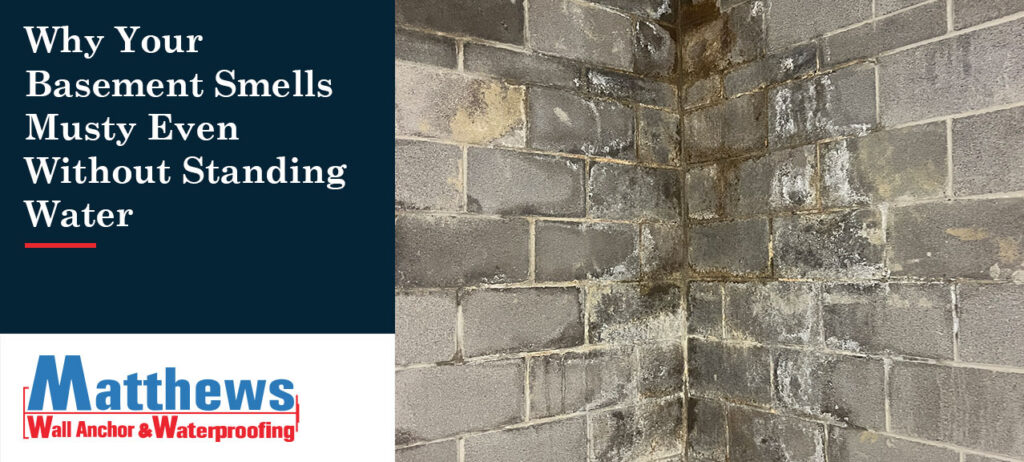
The musty odor itself is biological in origin. It’s produced by mold and mildew — specifically by microbial volatile organic compounds (MVOCs), which are gases released by mold colonies as they grow and metabolize. You don’t need visible mold colonies to produce a detectable odor. A thin layer of mold growth on the back side of a wall, on the paper facing of fiberglass insulation, on wood framing, or on stored cardboard boxes can generate a pervasive smell throughout an entire basement.
Mold grows wherever three conditions are met: a food source (organic material — wood, drywall paper, cardboard, dust), an appropriate temperature range, and moisture. Basements in Western PA and Eastern Ohio provide all three year-round. The food sources are built in. The temperatures are consistent. The moisture — even without standing water — is often being continuously supplied through mechanisms that aren’t visible on the floor.
The Hidden Moisture Sources You’re Not Seeing
Vapor transmission through walls and floor
Concrete is not waterproof. Poured concrete and concrete block walls are porous materials that allow water vapor to move through them from the soil side to the interior. In our region, where soils hold moisture for extended periods after rain and snowmelt, the soil surrounding basement walls is frequently at high moisture content — and that moisture migrates through the wall as vapor, even when no liquid water is penetrating. The same process happens through the concrete floor slab.
This vapor transmission doesn’t produce puddles or wet spots. The moisture disperses into the basement air as it exits the wall or floor surface. But it raises the relative humidity in the basement space — often into the range where mold growth occurs and sustains — and it keeps organic materials in the basement at moisture levels above the threshold where biological activity begins.
Condensation on cold surfaces
In summer, warm and humid outdoor air enters the basement through windows, doors, and gaps in the building envelope. When that warm, moisture-laden air contacts the cooler surfaces of the basement — the concrete floor, the block walls, the exposed ductwork — it deposits moisture as condensation. This is the same process that fogs a cold glass on a humid day, and it happens continuously throughout humid summer months in our region without anyone noticing.
Condensation moisture doesn’t look like a leak. It doesn’t pool. It wets surfaces evenly and subtly — and those consistently dampened surfaces are exactly where mold colonies establish.
Crawl space moisture migration
For homes in Western PA and Eastern Ohio with crawl spaces rather than full basements — or homes where the basement connects to a crawl space area beneath an addition or older section — crawl space moisture is a major and frequently overlooked odor source. Crawl spaces in our region are naturally humid environments, with ground moisture evaporating upward from exposed soil, inadequate ventilation trapping that vapor, and wood framing components absorbing moisture to levels where mold and rot begin.
Musty air from the crawl space doesn’t stay in the crawl space. It migrates into the living areas above through gaps in the floor system, and it fills connected basement spaces. Homeowners often describe a musty smell that seems to come from the floor — that’s frequently a crawl space moisture problem announcing itself.
Minor seepage through wall cracks and joints
A crack in a basement wall or a gap at the wall-to-floor joint doesn’t have to be producing visible water to be contributing to the moisture problem. During wet weather, small amounts of water can move through these openings at a rate slow enough that it evaporates before accumulating on the floor. The moisture goes directly into the air — raising humidity and feeding any mold colonies that have established near the entry point.
Why This Matters Beyond the Smell
The musty odor is the symptom you notice. The underlying conditions causing it are doing real damage that isn’t as immediately obvious.
Chronic elevated humidity in a basement or crawl space accelerates wood deterioration — floor joists, subfloor sheathing, rim joists, and sill plates are all vulnerable. In pier and beam homes across our region, crawl space moisture is one of the primary causes of the structural wood degradation we find during inspections. What starts as elevated humidity becomes surface mold, then wood softening, then rot — a process that compromises the structural capacity of the framing over years and decades.
Mold in a basement or crawl space also doesn’t stay there. Airflow patterns in houses move air from lower levels upward through the structure — carrying mold spores with it. Indoor air quality issues, respiratory irritation, and allergy symptoms throughout the home often trace back to a moisture problem in the basement that was written off as “just the way basements smell.”
And from a property value standpoint, a musty-smelling basement is a red flag for buyers and inspectors that experienced professionals will pursue. Odor alone can complicate a sale or trigger inspection findings that require remediation at closing.
What Doesn’t Fix It
Masking the odor doesn’t fix the underlying problem, and some common responses to basement mustiness actively make the situation worse.
Opening basement windows during summer to “air it out” — this introduces warm, humid outdoor air into the cool basement, which increases condensation and raises the humidity that’s feeding the mold. In humid PA and Ohio summers, ventilating a basement with outdoor air can dramatically worsen moisture conditions.
Running a dehumidifier without addressing the moisture source — a dehumidifier can reduce humidity in the basement air, which helps in the short term. But if the moisture source (vapor transmission, condensation, crawl space migration) continues operating unchecked, the dehumidifier is fighting an ongoing battle against conditions it can’t resolve. It also collects that moisture in a reservoir that needs to be emptied, and if it’s not — the humidity returns immediately.
Painting basement walls with waterproofing paint — surface-applied coatings can slow vapor transmission marginally, but they don’t address hydrostatic pressure, seepage through cracks, or any of the other moisture pathways. They also trap moisture behind the coating, which can cause additional problems with the wall material over time.
What Actually Fixes It
The right solution depends on which moisture pathway is primary — and in most basements, there’s more than one contributing factor.
Interior drainage systems with sump pump address the most significant moisture pathway for most Western PA and Ohio basements: groundwater and seepage pressure that forces moisture through walls and the floor perimeter. A properly designed interior drainage system collects water at the base of the walls before it enters the basement air, channels it to a sump pit, and removes it continuously. Eliminating that moisture source often has a dramatic effect on basement humidity — and on the smell.
Vapor barriers on crawl space floors and walls seal the ground moisture source that feeds crawl space humidity. A properly installed vapor barrier — sealed at seams and edges — dramatically reduces the evaporation from exposed soil that keeps crawl spaces chronically humid and that migrates into connected basement areas.
Crack repair and joint sealing addresses minor seepage points at wall cracks and the wall-floor joint, eliminating entry points for the small amounts of water that contribute to air humidity without creating visible pooling.
Dehumidification as a complement — not a replacement — to the above. Once the primary moisture sources are addressed, a dehumidifier helps maintain the reduced humidity level during peak humid seasons and serves as an ongoing monitoring tool for the basement environment.
Getting to the Bottom of It
If your basement has smelled musty for more than one season — or if the odor seems to be getting worse rather than better — the source needs to be identified and addressed. Matthews Wall Anchor & Waterproofing provides free basement and crawl space moisture evaluations for homeowners across Eastern Ohio and Western Pennsylvania. We’ll identify where the moisture is coming from, explain what it’s doing to the structure, and recommend solutions that address the actual source — not just the symptom.
Call us at (800) 284-7471 or schedule your free inspection online. A musty smell is your basement telling you something. It’s worth listening to.