
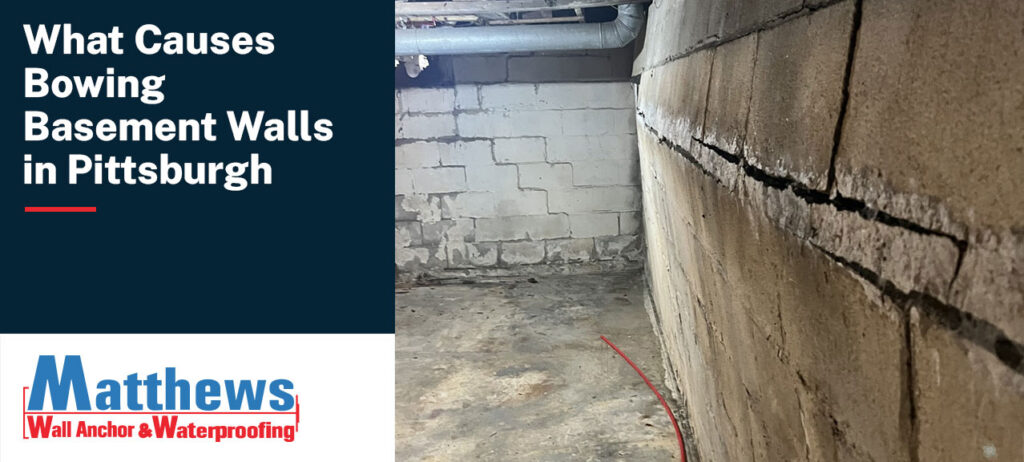
You’re standing in your basement when you notice it. The wall isn’t quite straight anymore. There’s a slight inward curve that wasn’t there before, and a horizontal crack running along the middle. Your stomach drops as you realize you’re looking at a serious foundation problem.
If you’re dealing with bowing basement walls Pittsburgh homeowners know this scenario all too well. Our region’s unique combination of clay soil, heavy precipitation, and freeze-thaw cycles creates the perfect storm for foundation issues. Understanding what’s happening beneath your home is the first step toward protecting your biggest investment.
In this guide, we’ll walk you through the specific causes of bowing basement walls in Pittsburgh, help you recognize the warning signs, and explain the repair solutions available. Matthews Wall Anchor has been helping Pittsburgh homeowners solve these exact problems for over 35 years, and we’re here to give you the straight facts.
What Causes Bowing Basement Walls Pittsburgh Homeowners Experience
The answer to why are my basement walls bowing often lies in a combination of factors unique to our region. Let’s break down the main culprits.
Understanding Hydrostatic Pressure Basement Walls Face
Hydrostatic pressure is the primary force behind most bowing wall problems. When soil around your home becomes saturated with water, it doesn’t just sit there. It pushes against your foundation walls with tremendous force.
Here’s how the process works. Water infiltrates the soil during heavy rain or snowmelt. As the soil absorbs this moisture, it becomes heavier and exerts lateral pressure against your basement walls. This constant sideways push can turn minor structural weaknesses into major problems over time.
The mechanics of hydrostatic pressure basement walls experience create a dangerous cycle. More water means more pressure. More pressure leads to small cracks. Those cracks allow even more water to seep in, and the problem accelerates.
Pittsburgh’s average annual precipitation of 39.61 inches, combined with 44.1 inches of snowfall, means our soil stays saturated for extended periods. That’s a lot of time for hydrostatic pressure to work against your foundation.
Pittsburgh’s Clay Soil Problem
Clay soil presents a particularly challenging issue for basement foundations. Unlike sandy or loamy soil, clay has an expansive nature that causes it to swell when wet and shrink when dry.
This expansion-contraction cycle works like this. When clay soil becomes saturated, it can expand significantly, pushing hard against your foundation walls. When it dries out, it shrinks, potentially creating uneven settling and additional structural stress.
The Midwest region, where Pittsburgh sits, is known for having expansive clay soils that are particularly susceptible to this behavior. This continuous cycle weakens foundations over time, making them increasingly vulnerable to bowing and cracking.
Our local geology adds another layer of complexity. Pittsburgh’s soil is characterized by layers of sandstone, shale, and coal, which complicates drainage patterns and increases the risk of foundation damage.
The Freeze-Thaw Cycle Impact
Pittsburgh’s winter temperatures frequently hover around freezing, creating repeated freeze-thaw cycles that pose a serious threat to foundations. When water in the soil freezes, it expands by about 9%, exerting additional pressure on foundation walls.
This freeze-thaw weathering can widen existing cracks and shift pressure in the surrounding ground, turning minor issues into major structural problems. The U.S. Geological Survey has documented how this process accelerates foundation damage in regions like ours.
Clay soils, with their high water-holding capacity, are particularly susceptible to freeze-thaw cycles. The soil expands when saturated and frozen, applying significant lateral pressure. When it thaws, it contracts, leading to uneven settling and further structural stress.
Poor Drainage and the Clay Bowl Effect
When water isn’t properly directed away from your foundation, it pools near basement walls, increasing soil saturation and hydrostatic pressure. This is especially problematic in what’s known as the “clay bowl” effect.
Managing this requires proper grading away from your foundation. Experts recommend a minimum final grade of 5 percent to direct surface water away from foundations. Installing exterior drainage systems and reducing soil saturation around your home are also critical steps.
The Main Causes of Bowing Basement Walls: A Quick Summary
Understanding the causes of bowing basement walls helps you take preventative action. Here are the key factors:
- Hydrostatic pressure from water-saturated soil pushing against walls
- Expansive clay soil that swells when wet and shrinks when dry
- Freeze-thaw cycles that cause soil to expand and contract repeatedly
- Poor drainage that allows water to pool near your foundation
- Pittsburgh’s heavy precipitation (39.61 inches annually) keeping soil saturated
- Local geological composition of sandstone, shale, and coal affecting drainage
Each of these factors can cause problems on its own. When they work together, as they often do in Pittsburgh, the risk to your foundation increases significantly.
Recognizing Buckling Walls and Other Warning Signs
Homeowners often notice buckling walls as the first visible sign of foundation pressure. But there are several other indicators you should watch for.
Critical Signs of Bowing Basement Walls in Pittsburgh Homes
Recognizing the signs of bowing basement walls in Pittsburgh homes early can prevent costly damage. Here’s what to look for:
Crack Indicators:
- Wide wall cracks: Any crack wider than 1/8 inch suggests serious structural issues
- Horizontal cracks: These indicate significant pressure and potential failure
- Stair-step cracks: Found along mortar joints, these are particularly concerning
- Diagonal cracks: Often appear at corners of poured concrete walls
Physical Movement Signs:
- Visible inward bowing of the wall
- Uneven or sloping floors indicating foundation settlement
- Doors and windows that stick, especially after seasonal changes
- Gaps between the foundation and exterior trim
- Water seepage through cracks
When to Seek Professional Help
You should seek professional help if you notice cracks exceeding 1/8 inch or if walls are visibly bowed. Measuring the degree of bowing is essential. You can use a plumb line to determine how far the wall has moved from its vertical position.
The importance of early detection can’t be overstated. Addressing bowing walls promptly can save you from costly repairs down the line. Timely intervention prevents further damage and reduces repair costs.
Common signs of bowing basement walls in Pittsburgh homes include seasonal cracks that worsen after freeze-thaw cycles, sticking doors, recurring cracks, and dampness in basements.
Professional Basement Wall Bowing Repair Pittsburgh Solutions
Choosing the right basement wall bowing repair Pittsburgh solution depends on the severity of wall movement and the underlying causes. Let’s look at the main repair methods available.
Repair Options Based on Severity
The choice of repair method depends heavily on how far your wall has moved. Bowing less than 2 inches may be stabilized with carbon fiber straps, while more severe cases may require steel beams or wall anchors.
Carbon Fiber Straps
Carbon fiber straps work well for walls that have moved less than 2 inches. These straps are bonded directly to the wall and provide stabilization without requiring excavation. They’re durable, take up minimal space, and often come with a lifetime warranty.
The typical cost for carbon fiber strap installation ranges from $4,000 to $6,000. While they stabilize the wall effectively, they don’t straighten it back to its original position.
Steel I-Beams
For moderate to severe bowing, steel beams provide strong support. These systems can be adjusted to improve the wall’s condition and offer robust structural support for severely compromised walls.
Steel I-beams are effective for holding walls in place but don’t correct their position. They’re more intrusive than carbon fiber and require ongoing maintenance.
Wall Anchor Systems
Wall anchors are particularly effective for moderate bowing and active wall movement. These systems are bolted to the wall and secured in stable soil outside your foundation. The key advantage is that they can be tightened over time to help straighten the wall gradually.
This method offers the potential for wall correction rather than just stabilization. However, it does require exterior excavation.
Helical Piers
For severe foundation support issues, helical piers transfer the weight of your home to stable soil deeper underground. This is typically the most expensive option, with costs upwards of $20,000.
The Critical Importance of Drainage
Professional basement wall bowing repair Pittsburgh services address both symptoms and root causes. Structural repairs must be paired with waterproofing and drainage improvements to prevent the problem from recurring.
Managing water around your home is crucial to reducing hydrostatic pressure and preventing future bowing. This dual approach not only addresses water intrusion but also reduces the pressure exerted by expansive clay soil.
What to Expect: Repair Costs
Repair costs can range from $2,000 to $25,000 or more, depending on the severity of the issue and the repair method chosen. More severe cases requiring extensive reconstruction can cost upwards of $20,000.
When searching for bowing basement wall repair near me, it’s worth getting multiple professional assessments. A thorough inspection will help you understand the extent of damage and the most appropriate repair approach for your situation.
Why Choose Matthews Wall Anchor for Your Foundation Repair
Matthews Wall Anchor has been serving Pittsburgh homeowners for over 35 years. We’re not a corporate chain. We’re a hometown team that stands by our work and understands the unique challenges Pittsburgh foundations face.
Our approach is straightforward. We provide free estimates with no-pressure sales tactics. We’ll give you honest recommendations tailored to your specific situation, not a one-size-fits-all solution.
We partner with Earth Contact Products, using American-made materials known for their quality. Our solutions come with long-term warranties, and we back up our work with thorough inspections and customized recommendations.
Our services include foundation repair using wall anchors, push piers, and carbon fiber straps, along with waterproofing solutions like sump pump installations and French drain systems. We also handle crawl space repair and yard drainage to address the complete picture of your foundation health.
Frequently Asked Questions
How quickly do bowing basement walls get worse?
The progression depends on several factors including soil conditions, drainage, and weather patterns. In Pittsburgh’s climate, walls can deteriorate rapidly during wet seasons or freeze-thaw cycles. If you notice bowing, it’s best to get a professional assessment quickly rather than waiting to see if it worsens.
Can I sell a house with bowing basement walls?
You can, but you’ll need to disclose the issue to potential buyers. A professional inspection is essential to assess the risks and potential repair costs. Many buyers will negotiate repair costs into the purchase price. Getting the repairs done before listing often results in a better sale price.
Will homeowners insurance cover bowing basement walls?
Most standard homeowners insurance policies don’t cover foundation issues caused by soil movement, settling, or poor maintenance. However, if the damage resulted from a sudden, covered event like a burst pipe, you might have coverage. Check your specific policy and talk with your insurance agent.
How can I prevent bowing basement walls?
Prevention focuses on managing water around your foundation. Ensure proper grading with at least a 5 percent slope away from your home. Install and maintain gutters and downspouts. Consider exterior drainage systems if you have persistent water issues. Regular inspections help catch problems early.
What’s the difference between bowing and buckling walls?
The difference between buckling walls and bowing is mostly in how the wall moves. Bowing typically shows a gradual inward curve along the wall’s height. Buckling often appears as a more localized bulge or fold. Both indicate serious pressure issues and require professional evaluation.
Protecting Your Pittsburgh Home’s Foundation
Understanding bowing basement walls Pittsburgh homeowners face is the first step toward protecting your home. The combination of our region’s clay soil, heavy precipitation, and freeze-thaw cycles creates unique challenges that require local expertise to solve properly.
The key takeaways are clear. Watch for warning signs like cracks wider than 1/8 inch, horizontal cracks, and visible wall movement. Act quickly when you spot these issues. The sooner you address foundation problems, the less expensive and extensive the repairs will be.
Remember that effective solutions address both the symptoms and the root causes. Structural repairs work best when paired with proper drainage and waterproofing to prevent future problems.
Get Expert Help for Your Bowing Basement Walls
Don’t let foundation problems keep you up at night. Matthews Wall Anchor has the experience and local knowledge to solve your bowing basement wall issues the right way. We’ll provide a thorough inspection, honest assessment, and customized solution that fits your home and budget.
Ready to protect your home’s foundation? Contact our team today for a free, no-pressure estimate. We’ll help you understand exactly what’s happening with your foundation and what it’ll take to fix it right.