
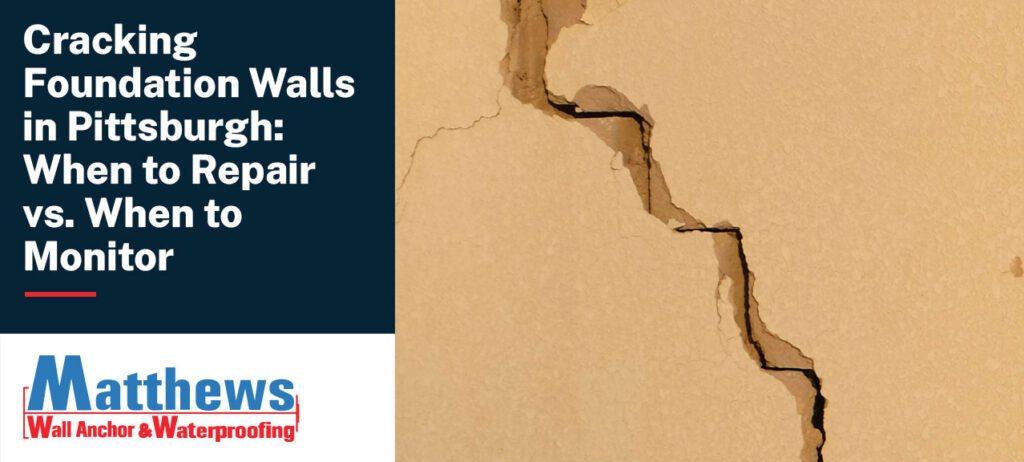
You’re standing in your basement, staring at a crack in the foundation wall. It wasn’t there last year. Or maybe it was, and you just noticed it. Your mind races with questions. Is this serious? Does it need immediate attention? Can you wait and see if it gets worse?
Homeowners dealing with cracked foundation walls Pittsburgh face these exact questions every day. The uncertainty is stressful. You don’t want to ignore a serious problem, but you also don’t want to spend thousands on repairs that might not be necessary.
The truth is straightforward. Some cracks demand immediate professional attention. Others can be safely monitored over time. Understanding the difference protects your home and your wallet. This guide gives you the knowledge to make informed decisions about your foundation cracks.
Understanding Cracked Foundation Walls Pittsburgh: Local Causes and Conditions
Pittsburgh’s unique environmental conditions create specific challenges for foundations. Understanding cracked foundation walls Pittsburgh requires knowledge of what’s happening beneath your home and why our region is particularly vulnerable.
Pittsburgh’s Clay Soil Challenge
Pittsburgh sits in the Appalachian Plateau region, where clay soils dominate the landscape. These clay soils are dense and compact, with excellent moisture retention capabilities. While that sounds beneficial, it creates significant foundation problems.
Clay expands when it absorbs water. It shrinks when it dries out. This constant expansion and contraction creates cyclical movement in the soil beneath your foundation. Over time, this movement stresses foundation walls and creates cracks.
The soil pH in Pittsburgh generally ranges from 4.5 to 7.0, indicating acidic conditions. Combined with urbanization and pollution, this leads to soil compaction and contamination that further affects foundation stability.
Freeze-Thaw Cycles Take Their Toll
Pittsburgh experiences substantial precipitation, averaging 39.61 inches annually. This high rainfall, combined with fluctuating temperatures throughout the year, creates ideal conditions for freeze-thaw damage.
Here’s how it works. Water infiltrates soil and concrete during warmer periods or rainfall events. When temperatures drop below freezing, this water freezes and expands. The expansion exerts tremendous pressure on foundation materials, exacerbating existing cracks and creating new ones.
This cycle repeats dozens of times each winter. Each freeze-thaw event progressively deteriorates foundation integrity. Professional assessment of cracked foundation walls Pittsburgh helps determine whether immediate repair or monitoring is the right approach.
Poor Drainage Compounds the Problem
Poor grading around foundations and inadequate downspout systems lead to water pooling near foundation walls. This significantly increases the likelihood of freeze-thaw damage and accelerates crack formation.
Effective drainage management is critical in Pittsburgh. Without it, even well-constructed foundations eventually develop problems.
Types of Foundation Cracks and Their Severity
Not all cracks are created equal. The type, location, and pattern of cracks tell you everything about their severity and urgency.
Vertical Cracks: Usually the Least Concerning
Vertical cracks run straight up and down along foundation walls. They’re the most common type of foundation crack and typically result from concrete shrinkage during the curing process or minor soil settling.
These cracks are usually considered the least serious type. They often represent cosmetic issues rather than structural concerns. However, they shouldn’t be ignored. They can allow water infiltration and may worsen over time.
Repairing a single vertical crack using polyurethane injection typically takes 2-4 hours. Polyurethane is preferred because it remains flexible and can accommodate future minor movements without re-cracking.
Diagonal Cracks: Signs of Differential Settlement
Diagonal cracks run at an angle across foundation walls or floors. They indicate differential settlement, where one part of the foundation settles at a different rate than another.
These cracks range from moderate to serious severity depending on their width, length, and rate of progression. They signal uneven stress distribution in the foundation and require professional evaluation.
While sealing the crack itself is relatively quick, diagonal cracks often require pier installation to address ongoing settlement issues. Complete repair including stabilization can take 3-7 days.
Horizontal Cracks: Immediate Attention Required
Horizontal cracks are among the most serious foundation issues. They indicate lateral pressure on foundation walls from soil or water pressure. These cracks run horizontally across walls and often signal imminent structural failure if not addressed.
Horizontal cracks require immediate professional attention. They indicate that the foundation wall is being pushed inward by external forces.
Repairing horizontal cracks with carbon fiber reinforcement takes 1-2 days for moderate cases. More severe situations requiring wall anchors or helical tiebacks can extend repair time to 3-5 days.
Stair-Step Cracks: Structural Concerns in Block Foundations
Stair-step cracks follow the mortar joints in brick or block foundations, creating a stepped pattern. These typically indicate structural concerns related to settlement or soil movement.
Stair-step cracks are considered serious structural indicators requiring both sealing and reinforcement. These repairs are typically multi-day projects due to the need for structural reinforcement.
Horizontal vs Vertical Foundation Cracks: Critical Differences
The distinction between horizontal vs vertical foundation cracks determines both urgency and repair approach. Understanding these differences helps you assess the severity of what you’re seeing in your basement.
Vertical Crack Characteristics
Vertical cracks typically indicate:
- Concrete shrinkage during curing
- Minor, uniform settling
- Normal aging of the foundation
- Cosmetic issues in many cases
These cracks usually run straight up and down. They’re often narrow, less than 1/4 inch wide. They may allow some water seepage but rarely indicate structural failure.
Horizontal Crack Characteristics
Horizontal cracks indicate:
- Lateral soil pressure pushing against walls
- Potential wall bowing or failure
- Serious structural concerns
- Urgent need for professional intervention
These cracks run side to side across walls. They often appear in the middle or upper third of basement walls where pressure is greatest. They may be accompanied by visible wall bowing or inward movement.
Knowing the difference between horizontal vs vertical foundation cracks helps homeowners make informed decisions about their foundations. Vertical cracks can often be monitored. Horizontal cracks demand immediate action.
When to Repair Foundation Cracks: Immediate Action Scenarios
Understanding when to repair foundation cracks prevents minor issues from becoming major structural problems. Certain situations demand immediate professional attention.
Cracks Wider Than 1/4 Inch
Any crack wider than a quarter-inch needs professional evaluation. Width indicates the severity of movement and stress. Wider cracks allow more water infiltration and suggest more significant structural issues.
Cracks that grow over time are particularly concerning. If you’ve been monitoring a crack and it’s getting wider or longer, that’s active movement requiring intervention.
Horizontal Cracks at Any Width
We’ve said it before, but it bears repeating. Horizontal cracks are serious regardless of width. They indicate lateral pressure that can lead to wall failure. Don’t wait on these.
Active Water Infiltration
Cracks that allow water into your basement need immediate attention. Water infiltration leads to:
- Mold growth and health hazards
- Damage to stored items and finished spaces
- Accelerated foundation deterioration
- Reduced property value
If you see water coming through cracks during rain, that’s your signal to act.
Multiple Crack Patterns
When you see multiple types of cracks, or cracks appearing in several locations, that suggests widespread foundation movement. This pattern indicates problems beyond simple settling and requires professional assessment.
Doors and Windows Sticking Progressively
If doors that used to close easily now stick, or windows become increasingly difficult to open, your foundation is moving. This progressive change indicates active settlement requiring intervention.
Cracks Allowing Light or Air Through
Any crack that allows you to see daylight through it, or feel air movement, has penetrated completely through the foundation wall. These cracks compromise your home’s structural envelope and need immediate repair.
Homeowners often struggle with when to repair foundation cracks, but these clear guidelines exist for making this decision. When in doubt, professional inspection provides clarity.
Foundation Crack Monitoring Pittsburgh: Protocols and Timeframes
Professional foundation crack monitoring Pittsburgh services provide data-driven insights into whether cracks represent active or past movement. Monitoring is appropriate when cracks don’t meet the immediate repair criteria but warrant observation.
What Crack Monitors Are and How They Work
A crack monitor is a diagnostic tool designed to determine whether there is active movement in a foundation. The device is installed at the current state of a crack, allowing you to track any changes over time.
Think of it as a measuring device that shows you if the crack is getting wider, longer, or if the wall is moving. It provides objective data rather than relying on memory or visual estimates.
Recommended Monitoring Timeframes
The recommended monitoring period is 1-2 years after installation to assess whether the wall is actively moving. This extended timeframe is necessary because it allows for seasonal variations and soil load factors to be properly accounted for.
You should check the monitor quarterly. That means four times per year, ideally at the change of each season. This schedule captures the full range of environmental conditions affecting your foundation.
Contact professionals immediately if any movement is observed during your quarterly checks. Movement indicates an active problem requiring intervention.
Acceptable Movement vs. Concerning Movement
A critical distinction exists between past movement and active movement:
Past Movement: Up to 1/2 inch of inward deflection is considered acceptable if the movement has stopped. This suggests the foundation experienced settling in the past but has now stabilized.
Active Movement: Any ongoing movement is cause for concern and requires immediate professional attention. Active movement means the problem is progressing and will worsen without intervention.
Critical Deflection: Walls showing more than 1 inch of inward deflection require immediate reinforcement regardless of whether active movement is detected. The accumulated damage warrants repair even if movement has stopped.
Cost-Effectiveness of Monitoring
Installing foundation crack monitoring Pittsburgh devices costs under $200 and can save thousands in premature repairs. Installing a crack monitor is relatively inexpensive, typically costing under $200. This modest investment can save homeowners significant amounts by catching structural deficiencies early before they require extensive repairs.
Monitoring prevents two costly mistakes. First, it prevents unnecessary repairs on cracks that have already stabilized. Second, it catches active problems before they become catastrophic failures requiring major reconstruction.
Structural Cracks Basement Pittsburgh: Identifying Serious Issues
Identifying structural cracks basement Pittsburgh properties develop requires understanding crack patterns and severity indicators. Not every crack is structural, but certain signs demand immediate attention.
Visual Indicators of Structural Problems
Beyond crack monitors, several visual cues indicate active foundation movement:
- Previously repaired mortar joints that have reopened
- New cracks appearing near existing ones
- Paint lines or other markers showing past wall positions that have shifted
- Doors and windows that increasingly stick or fail to close properly
Bowing Walls and Deflection
Foundation walls that bow inward indicate serious lateral pressure. Even without obvious cracks, bowing represents structural compromise. Measure the deflection at the wall’s center point compared to the top and bottom.
Remember the critical thresholds. Up to 1/2 inch of past deflection may be acceptable if movement has stopped. More than 1 inch requires immediate reinforcement regardless of current movement status.
Multiple Symptoms Together
When you see several symptoms together, that’s a red flag:
- Cracks plus sticking doors
- Bowing walls plus floor cracks
- Water infiltration plus progressive crack widening
These combinations indicate systemic foundation problems requiring professional assessment of structural cracks basement Pittsburgh homes experience.
Foundation Crack Repair Cost Pittsburgh: What to Expect
The foundation crack repair cost Pittsburgh homeowners face varies widely depending on crack type and severity. Understanding these costs helps you budget appropriately and make informed decisions.
Minor Crack Repairs
Crack Patching: Simple crack sealing and patching ranges from $150 to $1,000 depending on crack size and accessibility. This covers basic cosmetic repairs and minor vertical cracks.
Epoxy Injection: For structural crack repair using epoxy injection, costs typically range from $500 to $1,500. Epoxy creates a rigid bond and is ideal for dry cracks that aren’t actively leaking.
Moderate Repairs
Foundation Leak Repairs: Addressing active water infiltration through foundation cracks costs between $1,500 and $4,000. This includes polyurethane injection and drainage improvements.
Diagonal Crack Repair with Stabilization: When pier installation is required to address ongoing settlement, costs increase significantly due to the 3-7 day repair timeline and materials involved.
Major Structural Repairs
Bowing Basement Wall Repairs: Addressing bowing walls with carbon fiber reinforcement or wall anchor systems averages between $5,000 and $6,000.
Underpinning: For severe foundation failures requiring underpinning, costs range from $10,000 to $25,000. This is the most extensive repair method, involving strengthening the foundation by extending it deeper or wider.
Factors Affecting Repair Costs
Several factors influence the final foundation crack repair cost Pittsburgh homeowners pay:
- Extent of damage (larger, more numerous cracks require more materials and labor)
- Accessibility (difficult-to-reach areas increase labor costs)
- Repair method (advanced techniques like piering cost more than simple injection)
- Soil conditions (Pittsburgh’s clay soils may require specialized approaches)
- Permit requirements (some structural repairs require permits and inspections)
The Cost of Waiting
Delaying repairs leads to exponentially higher costs. Minor cracks that could be repaired for a few hundred dollars can evolve into major structural issues requiring tens of thousands of dollars in repairs. Early detection and prompt action are consistently the most cost-effective approach.
Professional Repair Methods for Pittsburgh Foundations
Foundation crack repair Pittsburgh services address both cosmetic and structural issues affecting local homes. Modern repair methods provide lasting solutions tailored to Pittsburgh’s unique conditions.
Epoxy and Polyurethane Injection
These injection methods seal cracks and prevent water infiltration.
Epoxy Injection: Best suited for dry cracks that aren’t actively leaking. Epoxy creates a rigid bond and is ideal for structural repairs. Cost ranges from $500 to $1,500 for typical applications.
Polyurethane Foam: Preferred for actively leaking cracks because it expands to fill voids and remains flexible to accommodate minor movements. This flexibility is particularly important in Pittsburgh’s freeze-thaw environment.
Carbon Fiber Reinforcement
Carbon fiber straps or fabric are applied to foundation walls to provide structural reinforcement without extensive excavation. This method is particularly effective for horizontal cracks and bowing walls. Repair time ranges from 1-2 days for standard applications.
Wall Anchors and Helical Tiebacks
For severe wall bowing or displacement, wall anchors and helical tiebacks provide stabilization by connecting the foundation wall to stable soil away from the structure. These systems can actually pull walls back toward their original position over time. Installation typically requires 3-5 days.
Foundation Piering Systems
Helical Piers: Screw-like piers installed into stable soil beneath the foundation to provide support and lift settled areas. These are particularly effective for addressing differential settlement causing diagonal cracks.
Push Piers: Hydraulically driven piers that transfer the structure’s weight to load-bearing soil or bedrock. Both helical and push piers are tailored solutions for Pittsburgh’s specific soil conditions.
Pittsburgh Building Code Requirements
Pittsburgh foundation repair requires understanding the region’s unique soil composition and climate challenges. Pittsburgh building codes mandate that foundation footings must be constructed below the 36-inch frost line. This requirement is critical for preventing damage from freeze-thaw cycles.
Most minor crack repairs don’t require permits in Pittsburgh. However, significant structural repairs, particularly those involving foundation stabilization or underpinning, may require permits depending on the scope of work.
Real Pittsburgh Homeowner Experiences
Local foundation repair companies serving Pittsburgh have documented numerous successful repairs with verified customer feedback.
Keystone Basement Systems, serving the Greater Pittsburgh area, has received consistent five-star reviews from homeowners. Kristen M. from Moundsville, WV praised the thoroughness of the inspection and explanation process. Tara P. from Springdale, PA gave a five-star review praising the thorough explanations of the repair process and options.
Acculevel, providing specialized foundation crack repair services in Downtown Pittsburgh, maintains a customer satisfaction rating of 4.8 out of 5 based on over 2,000 reviews. Their approach focuses on the unique challenges posed by Pittsburgh’s clay-rich soil and freeze-thaw cycles.
These testimonials reflect what we see consistently. Homeowners appreciate thorough explanations, honest assessments, and repairs that actually solve the underlying problem rather than just covering symptoms.
Frequently Asked Questions About Foundation Cracks
How do I know if a foundation crack is serious?
Crack width, type, and location determine severity. Horizontal cracks are always serious. Vertical cracks wider than 1/4 inch need evaluation. Any crack that’s growing, allowing water infiltration, or accompanied by sticking doors requires professional assessment. When in doubt, have it inspected. A professional evaluation costs far less than repairing damage from a crack you ignored.
Can I repair foundation cracks myself?
Minor cosmetic cracks can be patched with DIY products available at hardware stores. However, structural cracks require professional repair. Improper repairs can lead to serious safety hazards and violations of building codes. Professional repairs come with warranties and ensure code compliance, protecting your investment and facilitating future property sales.
How long does foundation crack monitoring take?
The recommended monitoring period is 1-2 years to assess whether walls are actively moving. This timeframe allows for seasonal variations and soil load factors to be properly accounted for. You should check monitors quarterly and contact professionals immediately if any movement is observed.
Will my homeowners insurance cover foundation crack repair?
Standard homeowners insurance typically doesn’t cover foundation cracks resulting from settling, soil movement, or normal wear and tear. However, if cracks result from a covered peril like a burst pipe or sudden ground collapse, you may have coverage. Review your policy and discuss specific situations with your insurance agent. Some policies offer optional foundation coverage for an additional premium.
What happens if I ignore foundation cracks?
Ignoring foundation cracks leads to progressively worse problems and exponentially higher repair costs. Small cracks allow water infiltration, leading to mold growth and health hazards. Structural cracks worsen over time, potentially leading to wall failure. Minor repairs costing hundreds can become major reconstructions costing tens of thousands. Early intervention is always more cost-effective.
How much does foundation crack repair cost in Pittsburgh?
Understanding foundation crack repair cost Pittsburgh helps homeowners budget appropriately for necessary repairs. Costs range from $150-$1,000 for minor crack patching, $500-$1,500 for epoxy injection, $1,500-$4,000 for leak repairs, $5,000-$6,000 for bowing wall repairs, and $10,000-$25,000 for underpinning. The specific cost depends on crack type, severity, repair method, and accessibility.
Should I monitor or repair foundation cracks?
This depends on crack characteristics. Monitor cracks that are narrow (less than 1/4 inch), vertical, not growing, and not allowing water infiltration. Repair cracks that are horizontal, wider than 1/4 inch, growing over time, allowing water entry, or accompanied by other symptoms like sticking doors. Professional inspection provides definitive guidance for your specific situation.
Protect Your Pittsburgh Home’s Foundation
Recognizing signs of foundation problems Pittsburgh early prevents costly repairs down the road. Understanding the difference between cracks that need immediate repair and those that can be safely monitored protects both your home and your budget.
The key takeaways are straightforward. Horizontal cracks demand immediate attention. Vertical cracks can often be monitored. Width matters, with anything over 1/4 inch requiring evaluation. Active water infiltration needs prompt repair. Professional monitoring provides objective data about whether cracks represent past or ongoing movement.
Professional assessment of cracked foundation walls Pittsburgh helps determine whether immediate repair or monitoring is the right approach. The foundation crack repair cost Pittsburgh homeowners face varies widely, but early intervention is always more cost-effective than delayed repairs.
Pittsburgh’s clay soil and freeze-thaw cycles create unique challenges for foundations. These environmental factors mean that foundation issues are common in our region. The good news is that modern repair methods provide lasting solutions when problems are caught early.
At Matthews Wall Anchor, we’ve helped Pittsburgh homeowners solve foundation problems for decades. We understand the unique challenges our local soil conditions, climate, and older housing stock create. We’re straightforward about what you need and honest about what you don’t.
No pressure sales. No gimmicks. Just proven solutions backed by solid warranties.
We know your home depends on a solid foundation. That’s why we stand by every job with craftsmanship you can count on. Our team handles everything from initial assessment through final inspection, ensuring your repairs meet all code requirements and provide lasting protection.
Don’t wait for foundation cracks to get worse. Early intervention saves money and prevents additional damage to your home. If you’ve noticed cracks in your foundation walls, or if you simply want peace of mind about your foundation’s condition, contact our team today for a free, no-obligation inspection.
We’ll evaluate your specific situation, explain your options clearly, and recommend solutions that fit your needs and budget. Let’s get your foundation fixed right the first time.