
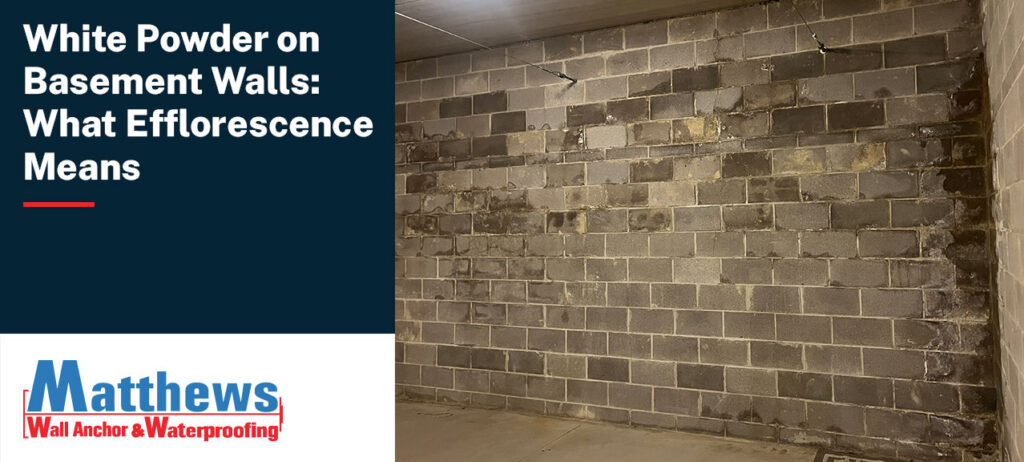
White powder on basement walls often turns out to be efflorescence: mineral salts left on masonry after moisture moves through the material and evaporates. It can appear along mortar joints, near the floor, or beneath peeling paint. The deposit is a clue about moisture movement, but it does not tell you by itself whether the basement is leaking today, where the water started, or whether the wall needs structural repair.
For Pittsburgh homeowners, that distinction matters. Scrubbing the wall may improve its appearance while leaving the underlying issue untouched. Ordering a complete waterproofing system from a photograph is equally premature. Start by identifying the material, documenting the pattern, and checking whether it returns. Then use the surrounding evidence to decide what deserves further investigation.
What is efflorescence?
The Concrete Masonry & Hardscapes Association defines efflorescence as deposits of soluble salts that can appear on masonry or concrete. Water carries dissolved material toward the surface; evaporation leaves the residue behind. (Source: CMHA: Control and Removal of Efflorescence.)
Think of the powder as a record of a process. The surface may look dry when you notice it because the moisture that transported the salts has already evaporated. That does not prove there is an active leak at that moment.
New material, past wetting, and recurring moisture can all complicate interpretation. Look beyond the amount of powder. A small patch beside an actively leaking joint may be more useful diagnostically than a large, unchanged deposit that has been there for years.
Efflorescence versus mold: why color is not enough
Efflorescence and mold are different materials, but homeowners cannot reliably identify every white deposit by sight. EPA notes that mold comes in many colors, including white. A white appearance does not establish that a substance is mineral residue or rule out biological growth. (Source: EPA: Mold Course, Chapter 1.)
| Clue | More consistent with mineral deposits | Reason to investigate further |
|---|---|---|
| Surface | Exposed concrete, block, brick, or mortar | Material on nearby wood, paper, or stored belongings |
| Appearance | Chalky or crystalline residue | Uncertain texture or mixed deposits |
| Pattern | Follows masonry joints or evaporation areas | Several materials affected in a damp area |
| Associated conditions | Old staining without a current odor | Persistent mustiness, damp finishes, or visible growth |
This comparison is a screening aid, not an identification test. Avoid rubbing, smelling closely, or disturbing an unknown substance. If you cannot tell what it is, have an appropriate professional assess it before cleaning. Mineral deposits and mold can also occur in the same damp basement.
What the location can help you ask
A residue pattern is useful when it leads to better questions, rather than a premature diagnosis. Photograph the full wall and note the conditions on the other side.
Powder near the base of the wall
Ask whether the wall-floor joint becomes wet, whether the deposit changes after rain, and whether stored items hide the same pattern elsewhere. Do not assume a low deposit automatically means rising groundwater. An evaluation should consider multiple moisture sources.
Deposits beneath a window
Check whether the window well collects water or whether staining begins at the frame. A leak around an opening and moisture elsewhere in a wall may require different corrections. Photograph the exterior opening without climbing into an unsafe well.
An isolated patch beneath a pipe
Look for a plumbing connection, condensation, or a utility penetration above the mark. A waterproofing project will not correct a leaking supply pipe. Give the evaluator a complete picture of nearby equipment and services.
Widespread residue on a painted wall
Note blistering, flaking, and any older coating layers. Tell the contractor when the wall was painted, if known. Do not treat the coating as evidence that the underlying wall has stayed dry.
Build a moisture record before cleaning
A simple record can make a site visit more productive. Number the affected walls on a sketch and use those numbers in your photographs. Record when the powder was first noticed and whether the basement has been recently cleaned or painted.
For each location, note:
- The date and whether recent weather was wet or dry.
- Whether the surface feels damp without touching unknown material.
- Nearby cracks, stains, pipes, windows, and floor joints.
- Musty odors or damage to neighboring finishes.
- Changes after a comparable rain event.
Describe observations precisely. “Powder returned below the east window after two storms” gives a contractor more useful information than “the whole basement is bad.” Keep original photographs so dates and changes remain traceable.
What about the plastic-sheet moisture test?
You may see advice to tape plastic to a basement wall and inspect where moisture appears. Treat that idea as a limited observation method, not a diagnosis or a pass-fail waterproofing test. Results depend on surface conditions, the seal, temperature, and timing.
A short dry interval does not prove the wall stays dry during storms. Moisture under a sheet does not locate the original source, measure pressure outside the foundation, or identify the correct repair. Adhesive may also damage paint or fragile surfaces.
If an evaluator recommends this method, ask for instructions suited to your wall and a clear explanation of how the result will influence the investigation. Do not apply it over suspected mold, deteriorating historic finishes, or loose coatings.
Should you clean the powder off?
First document the deposit and establish whether it is likely mineral residue. If the material is uncertain, leave it for assessment. If cleaning is appropriate, choose a method compatible with the masonry and its finishes. CMHA cautions that cleaning methods should avoid damaging masonry and that adding water can promote further deposits. (Source: CMHA: Cleaning Concrete Masonry.)
Do not default to acid, pressure washing, or aggressive wire brushing. These can create a new surface problem without answering the moisture question. Follow the product instructions and obtain professional advice for painted walls, soft mortar, or stone.
Cleaning is an appearance task. Its success does not establish that moisture entry has been corrected. If a documented patch returns, compare the new pattern with the original rather than repeatedly cleaning away the evidence.
When does a waterproofing evaluation make sense?
Arrange an evaluation when deposits recur with wetting, water appears on the floor, finishes deteriorate, or you cannot identify the source. Visible bowing, displacement, or changing cracks warrant a separate structural assessment rather than an assumption that moisture control alone will address them.
A useful basement waterproofing evaluation should connect observations to a proposed scope. Ask the contractor to identify what is known, what remains uncertain, and why a particular repair fits the evidence.
Depending on the findings, the conversation may involve exterior waterproofing, interior water management, plumbing repairs, or further investigation. The powder itself does not choose the system.
Common questions about white basement residue
Does efflorescence mean the foundation is failing?
No. Mineral residue alone does not establish structural failure. The condition of the wall, movement, cracking, and other evidence must be evaluated separately. Report those signs even if the powder seems minor.
Can the deposit remain after a leak has been repaired?
Yes. Residue does not disappear simply because the original moisture source has changed. Dated photographs and repair records help distinguish old evidence from new deposits.
Will waterproof paint solve the problem?
Paint alone does not identify or correct the water source. Before applying another coating, ask whether it is compatible with the wall and whether it would conceal conditions that still need attention.
Is a basement with no puddles necessarily dry?
No. Evaluate damp finishes, odors, condensation, and recurring staining as well as standing water. A dry floor during one visit provides only a snapshot of conditions.
Use the residue as a starting point
White powder on basement walls deserves a closer look, but it is not a complete diagnosis. Preserve the evidence, check surrounding conditions, and match the response to the actual moisture source.
If the residue keeps returning or appears alongside leaks, contact Matthews Wall Anchor & Waterproofing to discuss a Pittsburgh-area basement evaluation. Bring your photographs and moisture record so the conversation starts with evidence.