
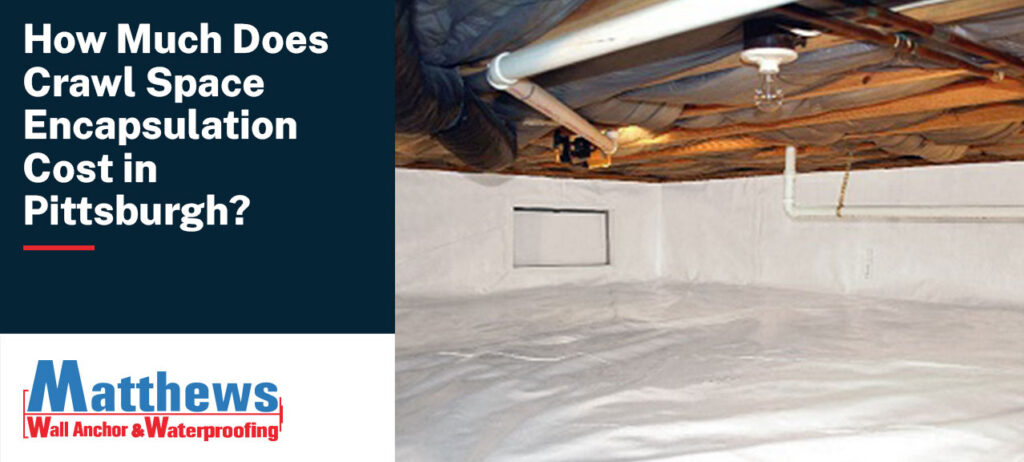
You’ve noticed the musty smell. Maybe you’ve seen moisture on your basement walls, or your energy bills keep climbing despite a new HVAC system. A contractor mentions crawl space encapsulation, and you start researching. Within minutes, you’re more confused than when you started.
One website says $3 per square foot. Another quotes $15. A third won’t give any numbers at all. You’re left wondering what you’ll actually pay and whether you’re comparing apples to apples.
Here’s the truth: the crawl space encapsulation cost Pittsburgh homeowners pay depends on much more than square footage alone. Two crawl spaces with identical floor area can require completely different work—and completely different budgets.
This guide explains what drives encapsulation costs in Allegheny County, what you’re actually buying when you hire crawl space sealing companies, and how to compare proposals so you know exactly what you’re getting for your investment.
Why Crawl Space Encapsulation Pricing Isn’t One-Size-Fits-All
You’ll see plenty of websites advertising a crawl space encapsulation cost per square foot. It’s tempting to multiply that number by your crawl space size and call it done. But that approach leaves out most of what determines your actual cost.
Square footage describes the project area. It doesn’t capture access challenges, moisture problems, structural repairs, or the difference between a basic ground cover and a complete environmental control system.
Before you compare any numbers, you need to understand what “encapsulation” means to each contractor. Does the proposal cover just the soil, or does it include walls and support piers? Are seams sealed properly? What happens at the access door? Which water problems are addressed, and which are excluded?
A lower total might reflect a simpler, more straightforward project. It might also reflect missing work that you’ll pay for later—often at a higher cost than if it had been done right the first time.
The crawl space encapsulation cost per sq ft you see advertised rarely includes the preparation work that makes encapsulation effective. You can’t tell what you’re actually buying without comparing the complete written scope from each contractor.
Seven Factors That Affect Crawl Space Encapsulation Cost Per Square Foot
Understanding what drives costs helps you evaluate proposals and ask better questions. These seven factors explain why crawl space encapsulation pricing varies so much between projects.
1. Floor Area and Why Crawl Space Encapsulation Cost Per Sq Ft Varies
More floor area generally means more material and installation work. That part is straightforward. But two crawl spaces with equal square footage can have very different perimeters, support columns, utility penetrations, and elevation changes. Every interruption creates another installation detail that takes time and skill to handle correctly.
A 1,500-square-foot crawl space that’s a simple rectangle is easier to encapsulate than a 1,500-square-foot space broken into three separate compartments with multiple access points. The second project requires more seam work, more wall attachments, and more coordination between areas.
Ask for both the measured area and a drawing showing which areas are included. An addition or isolated compartment shouldn’t disappear from the scope just because it’s hard to reach. If it’s part of your crawl space, it needs to be part of the solution.
2. Crawl Height and Access Limitations
Low clearances affect how crews remove debris, bring in materials, and work around equipment. A crawl space with 36 inches of clearance is a completely different project than one with 18 inches. Narrow openings and disconnected compartments require additional planning and often specialized equipment.
The contractor should identify access limitations during the initial inspection, not after you’ve signed a contract based on exterior dimensions. A convenient entrance for the sales visit doesn’t necessarily provide access to the entire footprint.
Ask whether opening modifications are needed, who performs them, and whether any restoration is included. These details matter for both the timeline and the final cost.
3. Standing Water and Drainage Requirements
A vapor barrier isn’t a substitute for addressing bulk water. The Department of Energy’s building science resources make an important distinction: moisture coming from soil as liquid water is different from moisture entering as vapor. That’s why drainage and a vapor barrier serve separate roles in moisture control.
If standing water is present during inspection, the proposal should explain the water management scope, collection route, and discharge destination. This might include perimeter drainage, a sump pump system, or exterior grading improvements.
Ask how the contractor determined that drainage is necessary and whether an existing system can be retained or needs replacement. Water management often represents a significant portion of total project cost, so you need to understand exactly what’s included.
4. Cleanup and Material Removal
Debris, abandoned materials, and damaged insulation complicate preparation. Removal should be described separately from installation so you understand what condition the space will be in before the barrier goes down.
Suspected contamination, animal waste, or hazardous building materials may require a different specialist. Ask who is responsible for assessment and whether such work is excluded from the encapsulation proposal. Don’t interpret a general “cleanup” line as unlimited remediation—that’s a recipe for change orders and budget overruns.
5. Understanding Crawl Space Vapor Barrier Cost and Material Differences
Not all vapor barriers are created equal. The crawl space vapor barrier cost varies based on thickness, reinforcement, and durability. A 10-mil barrier costs less than a 20-mil commercial-grade barrier, but the thicker material resists punctures better and lasts longer.
Compare the named product, reinforcement type, attachment approach, seam treatment, and coverage area. Thickness alone doesn’t describe a finished installation. Strong material installed with incomplete seams or poorly detailed penetrations leaves gaps in your moisture protection.
Ask how installers will handle columns, corners, service penetrations, and future maintenance access. The proposal should explain how the liner will be protected in areas where workers are likely to cross during routine maintenance.
6. Humidity Control Equipment
If a dehumidifier is proposed, ask for its model, selection basis, drain arrangement, controls, and maintenance requirements. Equipment cost is only part of ownership. You’ll also pay for electricity, filters or other servicing, and eventual replacement.
Don’t assume the household dehumidifier you already own is suitable for crawl space application. Crawl space dehumidifiers are designed for the specific conditions found in enclosed spaces—higher humidity levels, cooler temperatures, and continuous operation.
Conversely, ask why new equipment is necessary rather than accepting it automatically as a standard add-on. Some crawl spaces in dry climates or with excellent drainage may not need dehumidification at all.
7. Repairs and Related Building Systems
Rotten framing, damaged supports, pest conditions, plumbing leaks, and electrical issues may require work beyond encapsulation. The proposal should distinguish moisture management from structural repair. Covering the ground doesn’t restore the capacity of damaged floor joists.
Sealing a crawl space also requires attention to ventilation, combustion appliances, and radon. If you have a furnace or water heater in the crawl space, combustion safety testing may be necessary. Post-installation radon testing is recommended in areas where radon is a concern.
Ask who will address these items and how responsibilities are coordinated. You don’t want to discover mid-project that critical work was excluded from the scope.
How to Compare Crawl Space Sealing Companies Side by Side
When researching crawl space encapsulation cost Pittsburgh contractors quote, you’ll notice significant price variations. The best crawl space sealing companies provide detailed written proposals that break down every component. Use the same questions with every contractor, and mark an item “not included” when it’s absent rather than assuming it comes with the package.
| Proposal Item | Information to Request | Why It Matters |
|---|---|---|
| Measured Coverage | Area, compartments, walls, columns | Defines the actual footprint being treated |
| Preparation | Removal, cleanup, exclusions | Clarifies the starting condition and what you’re paying for |
| Water Control | Drainage, pump, outlet, if needed | Separates liquid water management from vapor control |
| Barrier Specifications | Product name, thickness, installation details | Makes material claims comparable across proposals |
| Equipment | Model, controls, drainage, power requirements | Identifies operation and maintenance requirements |
| Repairs | Included work and specialist referrals | Prevents hidden scope assumptions and change orders |
| Completion | Photos, walkthrough, maintenance instructions | Gives you a record of the work and ongoing care requirements |
| Warranty | Actual document and exclusions | Shows what’s actually covered, not just the number of years |
Not all crawl space sealing companies define encapsulation the same way. A contractor who explains exclusions clearly makes the project easier to evaluate. An unexplained lump sum leaves you guessing about both the work and potential additional costs.
A Practical Example: Equal Size, Different Scope
Imagine two crawl spaces, both measuring 1,500 square feet. The first has a usable entry, a clear ground surface, and no observed standing water. The second has several disconnected sections, discarded material, a plumbing leak, and evidence of water collecting after storms.
The second project requires access work, removal, plumbing correction, and water management before encapsulation begins. The crawl space encapsulation cost per square foot might look similar on paper, but comparing the two totals as if they bought the same service would be misleading.
This is why understanding crawl space encapsulation cost Pittsburgh properties require starts with a thorough inspection. Use examples like this to ask contractors which conditions at your property change the scope and cost.
How to Plan Your Budget Without Cutting Essential Work
Ask for required work and optional improvements to be identified separately. If your budget is limited, discuss a logical sequence and what each phase will accomplish. A staged proposal should state clearly what will remain unresolved between phases.
Don’t buy a liner now on the assumption that drainage can always be added later without disturbing it. Ask how future work would affect the installation and whether repeated mobilization or removal would increase the total expense. Often, doing the job right the first time costs less than doing it twice.
The crawl space vapor barrier cost represents only a portion of a complete encapsulation system. Moisture control, structural integrity, and long-term performance depend on addressing all the factors we’ve discussed—not just covering the ground.
Cost Questions Pittsburgh Homeowners Ask
Can I get an accurate quote from photographs?
Photos help a contractor prepare, but concealed conditions and access limitations can change scope significantly. Ask whether a remote number is preliminary and which assumptions must be verified on site. Any serious proposal requires an in-person inspection.
Is the crawl space vapor barrier cost the whole project cost?
Not necessarily. A barrier may be one component of a larger system. Compare preparation, sealing, water management, equipment, repairs, and restoration before deciding that two proposals offer equivalent work. The lowest crawl space encapsulation pricing often reflects the smallest scope.
Will encapsulation reduce my energy bill?
Don’t budget around a promised saving without a property-specific basis. Results depend on your existing building conditions and project scope. Ask what evidence supports any estimate and how it was calculated. Realistic expectations prevent disappointment.
Should I choose the longest warranty?
Read the actual document rather than comparing the number of years alone. Ask about covered components, exclusions, maintenance duties, service charges, and transfer conditions. A 25-year warranty with extensive exclusions may provide less protection than a 10-year warranty with comprehensive coverage.
How do I know if I’m getting a fair price?
Fair pricing reflects the actual work required for your specific crawl space. Two projects with identical crawl space encapsulation cost per sq ft can deliver very different results if one includes proper preparation and the other doesn’t. Focus on value—what you’re getting for your investment—rather than finding the lowest number.
Get a Quote You Can Evaluate
The right encapsulation budget starts with a defined problem and a complete scope. Measure the space, separate water control from vapor control, and compare equipment and preparation alongside material specifications.
We’ve worked with Western PA homeowners for more than 35 years, addressing foundation and moisture problems with solutions that last. We’re not a corporate chain. We’re your hometown experts, and we stand behind every job with honesty, craftsmanship, and warranties you can count on.
Ready to Understand Your Crawl Space Costs?
Contact Matthews Wall Anchor & Waterproofing to request a Pittsburgh-area crawl space evaluation. We’ll provide a written proposal that explains the work, exclusions, and ongoing maintenance so you can judge the total project with confidence.
We’ll get you out of the fix you’re in—with straightforward answers, no pressure, and solutions built to protect your home for the long term.