
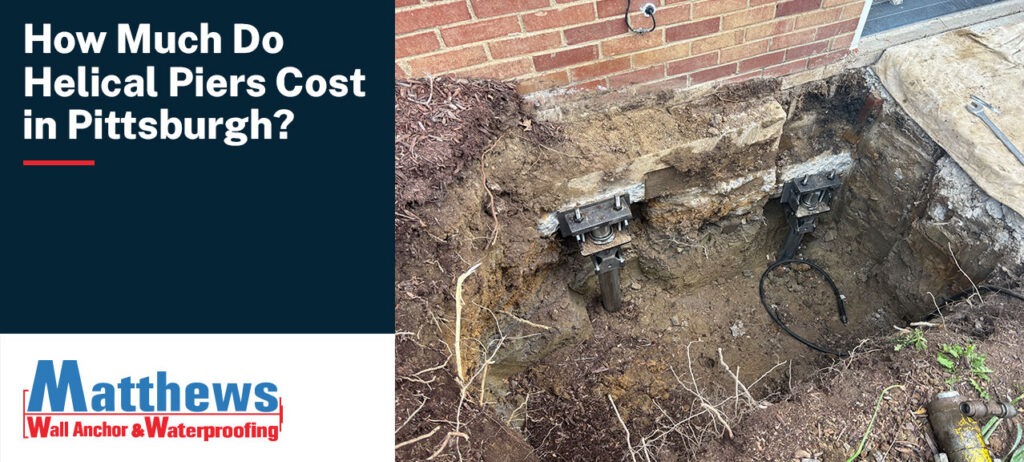
Helical piers cost different amounts from one Pittsburgh project to another because the work depends on the structure, the ground, and the repair design. A quote based only on the number of visible cracks or the length of a wall leaves out the questions that matter most: what needs support, how the load will be transferred, and what installation conditions crews will encounter.
This guide does not publish an unverified per-pier price or present a national average as a Matthews estimate. It explains the factors behind foundation settlement repair cost, the differences between helical and push piers, and the information a useful proposal should contain. The goal is to help you evaluate the scope before comparing totals or deciding that one repair method is the best fit.
What are you paying for in a helical pier project?
A helical pier is a steel shaft with helical bearing plates that is rotated into the ground. For an existing foundation repair, the designed system also needs a suitable connection that transfers load from the structure to the installed pier. Earth Contact Products describes helical piers as engineered deep-foundation elements, not simply metal screws placed beside a house.
A complete project can involve investigation, design, access preparation, excavation, installation, connection work, verification, and restoration. The pier itself is one component of that scope.
Ask the contractor to explain which components appear in the quoted total. A low unit price means little if required brackets, extensions, documentation, or surface restoration are treated separately.
The cost drivers that deserve the closest attention
Pier count and the area being supported
The number of piers should follow the repair design and structural loads. It cannot be determined reliably by dividing the wall length by a spacing rule found online. Corners, concentrated loads, footing conditions, and the extent of movement can affect the plan.
Ask for a location drawing and the reasoning behind the proposed support area. If two estimates show different pier counts, ask each provider to explain the difference. More is not automatically better, and fewer is not automatically efficient.
Installation depth and shaft extensions
The required depth depends on the ground and design criteria. A proposal should state what installation length is included and how additional extensions are handled if needed.
Do not assume a deeper installation is always a better installation. Ask how the contractor establishes that the completed pier meets the specified requirements. Depth is part of the record, not a stand-alone measure of quality.
Pier configuration and capacity requirements
Shaft type, helix configuration, connection details, and required capacity belong in the design process. ECP notes that helix configuration influences interaction with soil and installation torque, and that helical-pier versatility does not replace proper evaluation and design. (Source: Earth Contact Products: Reliable Foundation Support.)
Homeowners do not need to select those details themselves. They do need a provider who can explain the basis for the proposed system and identify who is responsible for design.
Access, excavation, and obstructions
A tight side yard, steps, utilities, pavement, or finished space can change how work is performed. The contractor should identify likely obstructions and access requirements before giving a firm scope.
Ask whether landscaping, fencing, concrete, or other surfaces must be disturbed. Clarify who locates utilities, who restores affected areas, and what happens if an obstruction prevents installation at a planned location. Do not assume “minimal disruption” means no restoration expense.
The existing footing and connection
A pier system must connect to suitable structural material. The condition and geometry of the existing foundation can affect the work needed to create that connection.
Request an explanation of any footing preparation or repair included in the proposal. If conditions are concealed, ask how they will be assessed and how changes will be priced and authorized once exposed.
Engineering, permits, and completion records
Project requirements vary. Ask which professional design services, permits, inspections, and installation records are included, and who coordinates them. Do not accept a blanket claim that every job needs identical paperwork or that no job needs it.
A clear proposal names the deliverables. “Engineer if needed” is incomplete unless the contractor explains who decides, when that decision occurs, and how any additional fee is handled.
How many helical piers does my home need?
There is no safe universal answer based on house size or the number of stories alone. A site assessment should distinguish suspected foundation settlement from other causes of cracks, floor unevenness, or sticking doors.
Be prepared to share when changes began, whether they appear to be progressing, and whether previous repairs were performed. Photographs, prior drawings, and dated repair records can help the evaluator understand the history.
Do not fill or cover significant cracks before the assessment simply to improve appearances. Preserve useful evidence and avoid assuming that every crack needs underpinning. An evaluation may identify a different problem or a need for further investigation.
Helical piers versus push piers
Both systems can be used in foundation support, but their installation methods differ. Matthews provides separate information on helical pier installation and steel push piers.
| Question | Helical piers | Push piers |
|---|---|---|
| How are they advanced? | Rotated into the ground | Hydraulically advanced using reaction from the structure or designed setup |
| What needs evaluation? | Loads, ground, configuration, access, connection | Loads, ground, available reaction, access, connection |
| Is one always cheaper? | No universal rule | No universal rule |
| Who should choose the method? | Qualified project team using site conditions | Qualified project team using site conditions |
Ask why the proposed method suits your property. A comparison based entirely on advertised per-pier pricing skips the suitability question. Neither system should be selected because it happens to be the only product discussed at the sales visit.
Stabilization and lifting are different objectives
A proposal should explain whether the goal is to stabilize the affected foundation, attempt a controlled lift, or both. Those objectives are related but not interchangeable.
Do not assume repair will return every floor, window, and crack to its original condition. Ask what movement may be attempted, who controls the decision, and which cosmetic repairs remain outside the scope. If lifting is limited by the condition of the structure, that limitation should be discussed before installation.
Likewise, underpinning does not automatically resolve lateral wall movement or basement water entry. Ask the evaluator to separate those conditions so each proposed repair has a clear purpose.
Compare the whole project, including contingencies
Before signing, request a written answer to the following:
- Which foundation sections and pier locations are included?
- What installation lengths and connection components are included?
- How are extra depth, obstructions, or relocation priced?
- What design and verification records will be supplied?
- What restoration and cosmetic work are excluded?
- What warranty document applies to this scope?
Have allowances and change-order procedures written into the proposal. A contingency is easier to manage when the trigger, price basis, and approval process are established before excavation starts.
Questions about helical pier pricing
Can you give a price per pier over the phone?
A contractor may offer preliminary information, but a unit figure does not establish total project cost. Ask which assumptions support it and what must be confirmed on site before it becomes a written proposal.
Will one pier fix one crack?
Crack count is not a design method. The repair plan should address the affected structure and its support requirements rather than matching a pier to each visible symptom.
Does a pier project include waterproofing?
Only if the proposal says so. Foundation support and water management have different purposes. Ask whether disturbed waterproofing will be restored and whether any separate leak correction is included.
Should I get another opinion if proposals differ?
Yes, when important differences remain unexplained. Ask providers to compare their assumptions and proposed outcomes. An independent structural engineer may help clarify the problem and design needs.
Start with the diagnosis and defined scope
The useful question is not just what helical piers cost. It is what your foundation needs, how the proposed system addresses that need, and what the total includes.
Contact Matthews Wall Anchor & Waterproofing to discuss a Pittsburgh foundation assessment. Request a documented scope, clear cost contingencies, and an explanation of the proposed repair objective before comparing prices.