
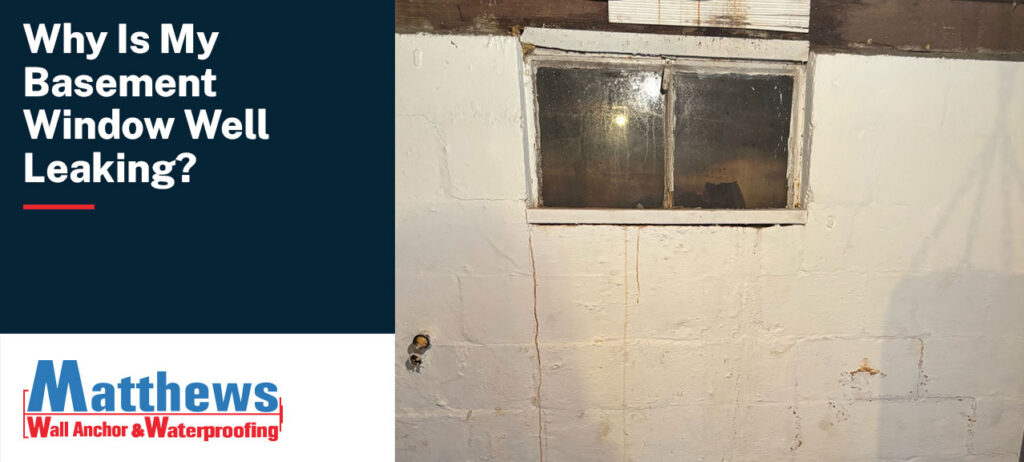
You’re lying in bed when the storm hits. Thunder rattles the windows. Rain pounds the roof. You drift back to sleep, confident your home can handle it.
The next morning, you head to the basement for something from storage. Your foot hits water. Not just dampness—actual standing water pooling near your basement window. The window well outside is filled to the brim, and water has found its way inside.
A basement window well leaking during heavy rain is one of the most common calls we receive from Pittsburgh homeowners. The wet sill shows you where water became visible, but it doesn’t tell you where the problem actually started. That’s what we’re here to help you figure out.
In this guide, we’ll walk you through what causes window well leaks, what you can safely check yourself, and when it’s time to call in professional help. Matthews Wall Anchor will keep it straightforward—no hype, just practical information from more than 35 years of solving these exact problems across Western PA.
Why Your Basement Window Leaks When It Rains
Understanding why your basement window leaks when it rains starts with recognizing that window wells create a below-grade opening in your foundation. When they work properly, they let light into your basement and provide emergency escape routes. When they fail, they become collection points for water that has nowhere to go but inside your home.
The Drainage Problem
The most common cause? Failed or missing drainage at the base of the well. A basement window well leaking problem almost always traces back to water that can’t escape.
Window wells should have a gravel bed—typically 6 to 12 inches deep—that allows water to drain away from the window. When this drainage layer clogs with soil, leaves, or sediment, water accumulates and creates pressure against your window. In Pittsburgh’s clay-heavy soil, this becomes particularly problematic. Clay has extremely low permeability and essentially creates a bathtub effect in your window well.
Many older Pittsburgh homes lack proper drainage altogether. Window wells installed directly on compacted soil or clay have no way to shed water, especially during our region’s heavy spring rains and summer thunderstorms.
Surface Water Running Toward Your Foundation
If your basement window leaks when it rains, the problem often starts at ground level. When soil around your home slopes toward the foundation instead of away from it, every rainstorm sends water directly into your window wells.
The standard recommendation is a minimum slope of 6 inches over 10 feet away from the foundation. But soil settles over time. Landscaping changes. Erosion happens. What started as proper grading twenty years ago may now be directing water straight to your basement windows.
Downspouts make this worse when they discharge near window wells. A single inch of rainfall on a 1,500-square-foot roof generates approximately 935 gallons of water. If that water dumps next to your window well, no drainage system can keep up.
Pittsburgh’s Freeze-Thaw Cycles
Western Pennsylvania’s climate creates unique challenges. We experience significant temperature fluctuations across the freezing point, particularly in late winter and early spring. These freeze-thaw cycles cause:
- Ice expansion that cracks window well structures and seals
- Frost heaving that pushes wells away from foundations
- Ice dams that block drainage pathways
- Accelerated deterioration of materials
Snow that accumulates in window wells during winter creates a reservoir of water as it melts. The slow melt can saturate drainage systems that would handle rain just fine.
Deteriorated Covers and Seals
Window well covers serve multiple purposes. They keep out debris, reduce water entry, and provide safety barriers. But covers crack, rust, or go missing entirely. Without functional covers, window wells collect the full volume of precipitation that falls directly into them, plus leaves, dirt, and anything else the wind carries.
The window itself represents another potential failure point. Deteriorated caulking around the frame, failed weatherstripping, rotted wood components in older windows—all of these allow water coming in basement window openings even when the well isn’t completely flooded.
What You Can Safely Check Before Calling for Help
Before you pick up the phone, there are several things you can observe and document that will help identify the problem. Start with safety.
Safety First
Do not climb into a flooded well. Don’t lean against loose retaining material. Don’t open a window while water is pressing against it. If water is near electrical equipment, stay out of the affected area and get qualified help immediately.
From a safe position, note whether water appears above the window frame, at the sill, through a joint beside the window, or at the floor below it. Take photographs before wiping everything dry. Your description can be simple: “The well fills before the sill leaks,” or “The sill gets wet while the well floor stays visibly dry.”
Check for Obvious Debris
If the area is dry, stable, and accessible without entering a confined space, look for loose debris. Leaves, mulch, and litter may be blocking visible drain openings. Remove what you can reach safely. Leave excavation and drain disassembly to professionals.
If you find heavy deposits repeatedly, that tells you something. Mulch or soil is washing into the well from outside, which deserves attention beyond a single cleanup.
Inspect the Cover
Look at your window well cover from outside. Check for cracks, poor fit, displaced sections, or debris preventing the cover from sitting properly. A damaged cover needs replacement, but make sure any new cover preserves emergency escape requirements if the window serves that purpose.
Observe Nearby Drainage
Walk around your property and note where downspouts discharge. Are they pointing toward the window well? Has a sidewalk or patio settled, creating a slope that directs water toward the opening? Take photos showing these relationships. This information helps professionals understand the full picture.
What the Patterns Tell You
Different observations point to different problems:
| What You See | What It Suggests | Why Quick Fixes Miss It |
|---|---|---|
| Water crosses the top edge of the well | Surface runoff, poor grading, nearby downspouts | Window sealing doesn’t redirect yard water |
| Water accumulates on the well floor | Missing or blocked drain, high water table | A cover may not address water entering from sides or ground |
| Leakage at the frame without visible ponding | Window condition, seal failure | Caulking the visible gap may miss the upstream pathway |
| Dampness spreads through adjacent masonry | Foundation cracks, broader drainage issues | The window may be only one visible location |
Understanding these patterns helps you describe the situation accurately when you do call for professional assessment.
How to Fix a Leaky Basement Window: Solutions That Work
The right repair depends on what’s actually causing the leak. Here’s how we approach window well leaking into basement problems, from simplest to most involved.
Fix Leaking Window Well Drainage Issues
Proper drainage is the foundation of every solution. Without it, everything else is temporary.
Gravel Bed Installation
For window well filling with water from bottom, the first step is often installing or upgrading the gravel layer. We excavate the well base to 12-18 inches below the window sill, install landscape fabric to prevent soil migration, and fill with 3/4-inch clean gravel. This creates a permeable layer that allows water to drain away from the window.
In Pittsburgh’s clay soils, this gravel bed is essential. Clay doesn’t drain—it holds water. The gravel provides a pathway for water to move.
Drain Tile Connection
For persistent problems, we connect the window well to a perimeter drainage system. A 4-inch perforated drain pipe installed at the base of the gravel bed slopes toward a collection point—either a sump pit or a daylight drain where the grade allows.
This active drainage removes water even during heavy precipitation. It’s often the most effective long-term solution for Western PA’s clay-heavy soil conditions.
Stop Water Coming in Basement Window with Surface Management
Drainage inside the well only works if you control water before it gets there.
Regrading
Correcting the slope around your home is fundamental. Soil should slope at minimum 6 inches over the first 10 feet from the foundation. We use clay-based fill soil near the foundation for better water shedding and extend the grade correction at least 3 feet beyond the window well.
Downspout Extensions
Roof water must be directed well away from window wells. We extend downspouts at least 10-15 feet from the foundation using solid pipe rather than flexible corrugated pipe that can sag and pool water.
For permanent solutions, underground drainage systems carry water to appropriate discharge points. This is particularly important on Pittsburgh’s sloped lots where surface extensions might create problems for neighbors.
Basement Window Waterproofing and Sealing
Once drainage is addressed, we turn to the window itself.
Comprehensive Sealing
Learning how to seal basement windows properly prevents water entry even when the well fills during storms. The process includes:
- Complete removal of old, failed caulk
- Thorough cleaning with rubbing alcohol
- Application of backer rod for gaps larger than 1/4 inch
- High-quality polyurethane or silicone caulk rated for exterior use
- Proper tooling for adhesion and water shedding
- Sealing both interior and exterior sides of the frame
Window Replacement
When windows are severely deteriorated, replacement makes sense. Modern vinyl or composite windows offer better water resistance than old wood frames. Proper flashing installation during replacement is critical—it’s often where the original installation failed.
Window Well Repair and Replacement
Deteriorated well structures need replacement. We use heavy-gauge galvanized or powder-coated steel for longevity, sized to extend 6-12 inches beyond the window frame on all sides. Secure attachment to the foundation with masonry anchors prevents the separation that causes leaks.
Cover Installation
Properly selected covers limit direct precipitation and keep debris out. Clear polycarbonate dome covers maintain light while shedding water effectively. They should extend beyond the well perimeter to direct water away and be securely attached to prevent wind displacement.
For egress windows, covers must be easily opened from inside—it’s not just good practice, it’s code.
Leaking Window Well Repair: Prevention and Maintenance
Professional window well repair addresses the immediate problem. Ongoing maintenance keeps it from coming back.
Seasonal Attention
Window wells need different care throughout the year:
Spring: Inspect after snowmelt for freeze-thaw damage. Clear accumulated debris. Test drainage by filling the well with water and observing flow rate. Check seals for winter damage.
Summer: Monitor during thunderstorms. Trim vegetation to prevent root intrusion. Clean covers to maintain light transmission.
Fall: Remove fallen leaves promptly. Inspect and clean drainage systems before winter. Verify covers are secure before snow season.
Winter: Remove snow accumulation after storms. Check for ice dam formation. Ensure covers remain in place during wind events.
Monthly Quick Checks
A few minutes each month can prevent major problems:
- Window well is free of standing water
- No visible debris accumulation
- Cover is secure and undamaged
- No new cracks in window or foundation
Warning Signs
Act quickly when you notice:
- Standing water that doesn’t drain within 24 hours after rain
- Water stains on basement walls near windows
- Musty odors in basement areas
- Visible mold or mildew growth
- Cracks in foundation or window frames
- Separation between window well and foundation
These signs indicate problems that will only get worse if ignored.
When to Call Matthews for Professional Help
Some window well problems are straightforward. Others require expertise, specialized equipment, and the kind of experience that comes from solving these issues for more than 35 years.
DIY Makes Sense For:
- Cleaning debris from accessible wells
- Installing or replacing covers
- Basic caulking and sealing
- Clearing minor surface drainage issues
Professional Help Is Needed For:
- Foundation cracks requiring repair
- Window well replacement with proper foundation attachment
- Drainage systems connecting to perimeter drains or sump pumps
- Complex grading on sloped lots
- High water table management
- Deep excavation work
- Situations where safety is a concern
We’ve seen what happens when homeowners try to tackle complex drainage problems without the right tools or knowledge. The money saved on the initial attempt gets spent twice over fixing the damage and then doing it right.
We’ll Get You Out of the Fix You’re In
A basement window well leaking doesn’t have to mean disaster for your home. With proper diagnosis, the right repairs, and ongoing maintenance, you can keep your basement dry through Pittsburgh’s wettest storms.
The process starts with understanding where water is actually coming from. Is it surface runoff? Failed drainage? A deteriorated window? Often, it’s a combination. That’s why quick fixes rarely work—they address symptoms without solving the underlying problem.
At Matthews Wall Anchor & Waterproofing, we know your home depends on a solid foundation and effective water management. For more than 35 years, homeowners across Western PA and Eastern OH have trusted us to repair, waterproof, and protect their most important investment.
Dealing with a Leaking Window Well?
Start with a free, no-obligation inspection from one of our local experts. We’ll identify what’s causing the water intrusion, explain your options in plain language, and recommend solutions that make sense for your home and budget.
We’re not a corporate chain. We’re your hometown experts, standing by every job with honesty, craftsmanship, and lasting warranties. No gimmicks or pressure sales—just honest recommendations from people who’ve been solving these exact problems in Pittsburgh for decades.
Request a Free Estimate
Don’t wait for the next storm to find out if your window well can handle it. Contact Matthews Wall Anchor & Waterproofing today and protect your basement with proven solutions that last.