
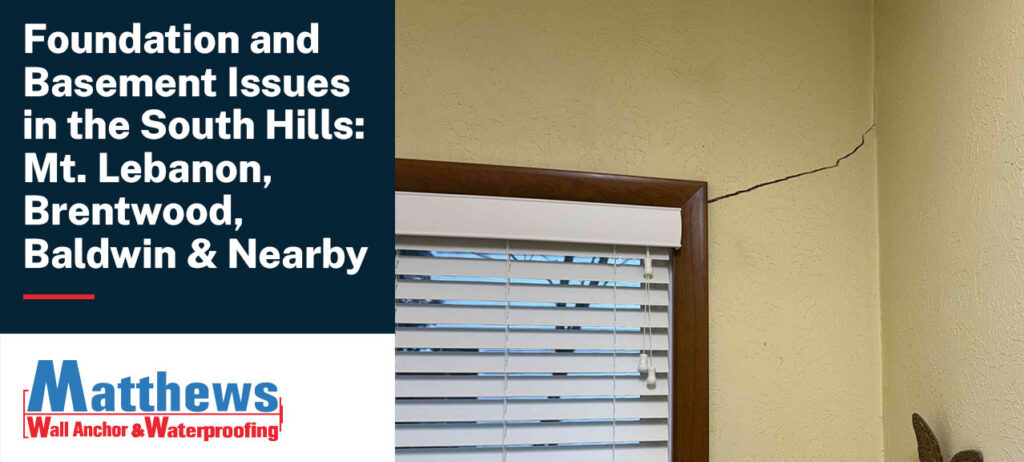
You’re walking through your Mt. Lebanon basement when you notice it—a crack in the wall that wasn’t there last month. Or maybe you’re in your Brentwood home trying to close a door that suddenly won’t latch properly. Perhaps you’re a Baldwin homeowner who’s discovered a damp corner that appears after every heavy rain.
Searching for foundation repair south hills Pittsburgh solutions often starts with a specific symptom. A crack. A damp spot. A door that sticks. Your town name helps you find nearby service, but it doesn’t diagnose the problem. And that’s where many homeowners get stuck.
Here’s what you need to know: homes in Mt. Lebanon, Brentwood, Baldwin, Bethel Park, and surrounding South Hills communities need evaluations based on their actual foundations, drainage patterns, and repair history. Not assumptions. Not generic online advice. Real assessment of what’s happening at your specific property.
At Matthews Wall Anchor & Waterproofing, we’ve worked with South Hills homeowners for more than 35 years. We know the soil conditions in your neighborhood. We understand how hillside properties behave differently than flat lots. We’ve seen what happens when Pittsburgh’s freeze-thaw cycles meet the region’s clay-heavy soil.
This guide helps you prepare for a professional evaluation by understanding what you’re seeing, what questions to ask, and what information makes the difference between guessing and knowing.
Why Foundation Repair Pittsburgh Homeowners Need Starts with Understanding Your Home
Before you call anyone about foundation repair Pittsburgh specialists can provide, you need to know what type of foundation you actually have. This matters more than most homeowners realize.
A home’s age gives you background information, but it doesn’t prove construction type. Additions and past renovations can leave one property with several foundation types. The repair that worked perfectly for your neighbor’s concrete block basement might be completely wrong for your stone foundation.
What to Look For
Head to accessible unfinished areas—your basement, crawl space, or utility room. Look at the walls without removing any finishes. What do you see?
- Regular concrete blocks stacked in courses
- Poured concrete walls with smooth surfaces
- Stone and mortar construction
- A combination of different materials
Are the cracks you’re worried about in the material itself, in the joints between blocks, or just in a surface coating? If walls are concealed behind drywall or paneling, record that limitation. You can’t evaluate what you can’t see.
The South Hills region has homes spanning more than a century of construction practices. A 1920s stone foundation in Mt. Lebanon requires different assessment and repair than a 1980s poured concrete basement in Baldwin. The foundation contractors Pittsburgh homeowners hire should explain how your actual construction affects their recommendation.
Don’t assume. Ask. Document what you can see, and be clear about what’s hidden.
From Basement Waterproofing Brentwood PA to Baldwin: Separating Different Problems
One of the biggest mistakes homeowners make is treating every foundation symptom as the same problem. Water in your basement, cracks in your walls, and doors that won’t close might all be foundation-related, but they’re not the same issue. They don’t get the same fix.
Whether you’re dealing with basement waterproofing brentwood pa challenges or foundation movement in Scott Township, accurate diagnosis starts with separating what you’re actually seeing.
Three Problems That Get Grouped Together
| What You Observe | What to Investigate | Why Quick Fixes Miss It |
|---|---|---|
| Water entering the basement | Note where the first wet spot appears and whether it follows rain, snowmelt, plumbing use, or humid weather. Water at a window, at a wall-floor joint, and through a floor drain deserves different investigation. | A general description like “wet basement” is useful for finding a provider, but a photograph showing water crossing a window sill gives that provider a much better starting point. |
| A wall moving inward | Visible bowing, bulging, or displacement deserves qualified evaluation. Record the location without trying to push, brace, or alter the wall yourself. | Filling a crack doesn’t restore the wall’s ability to resist loads. Ask whether structural input is needed and what the proposed repair is intended to accomplish. |
| Foundation settlement or support issues | Cracks, uneven floors, or sticking doors may prompt investigation, but a symptom doesn’t establish the cause. | Don’t buy piers simply because they appear in an online list of foundation solutions. A repair plan should connect the observed condition to the designed support system. |
This table isn’t just organization—it’s a diagnostic tool. Use it to document what you’re seeing before you make that first call.
Water Entry Specifics
When you notice moisture, timing matters. Does it appear:
- Within hours of heavy rain
- Days after prolonged wet weather
- During spring snowmelt
- Regardless of outdoor conditions
- After using specific plumbing fixtures
Each pattern points to different causes. Surface water behaves differently than groundwater. Plumbing leaks aren’t foundation problems at all, even though they show up in your basement.
Wall Movement Warning Signs
Horizontal cracks are more serious than vertical ones. Bowing walls need immediate attention. But here’s what many homeowners don’t realize: you can’t fix structural movement by covering it up.
If monitoring is recommended, request a defined method. Who’s responsible for checking? What measurements matter? When does monitoring end and repair begin? These aren’t optional questions—they’re essential for protecting your home.
Settlement vs. Normal Behavior
Some settling is normal, especially in newer homes. But differential settlement—where one part of your foundation moves more than another—causes real damage. Floors slope. Doors stick. Cracks appear and grow.
The foundation repair Pittsburgh specialists you hire should explain the evidence for a support problem and any further assessment needed. If they can’t explain it clearly, keep looking.
Foundation Repair Mount Lebanon PA and Nearby Communities: Local Considerations
The South Hills isn’t flat. That simple fact creates foundation challenges that homeowners in other parts of Pittsburgh don’t face.
Whether you need foundation repair mount lebanon pa services, help in Bethel Park, or solutions in Jefferson Hills, sloped properties require special attention. The water that starts uphill from your house doesn’t stop just because it reaches your property line.
Document the Route, Not Just the Hill
Take wide photographs showing your house in relation to higher ground. Include retaining walls, driveways, and downspouts in your pictures. Mark observed water paths on a simple sketch.
Don’t assume all runoff comes from your uphill neighbor. Don’t assume your downhill side can’t flood. A localized patio depression or exterior stairwell can collect water independently of the overall slope.
Here’s what matters: where does water arrive, what holds it against your building, and where could it safely go instead?
The Bethel Park Example
We’ve published a case study about a Bethel Park wall-crack repair where a prospective buyer was concerned about a basement wall. The evaluation identified a step crack near a window and inward bowing. Anchors were recommended for that specific property.
That example provides a local account of evaluation leading to defined repair. But it doesn’t mean every step crack in Bethel Park needs anchors. It doesn’t mean every South Hills project will have the same access or schedule.
When you look at any case study—ours or anyone else’s—ask which conditions match your house and which don’t. Compare wall construction, movement patterns, access limitations, and repair objectives. Not just the town name.
Retaining Walls and Slope Stability
Many South Hills properties have retaining walls. These structures change how water moves across your lot and may be part of your drainage system. Visible leaning, bulging, or soil movement deserves evaluation before anyone excavates nearby or adds drainage trenches.
Don’t drill holes, remove soil, or redirect substantial flow behind a wall based on generic online advice. Ask whether your project needs structural or geotechnical input. Foundation and retaining wall work may need coordination.
What to Document Before Your Evaluation
You don’t need a technical report. You need a concise record of observations that gives the evaluator useful context and reduces guesswork.
| Information | What to Include | Example of a Useful Observation |
|---|---|---|
| Location | Room, wall, and nearby opening | Basement wall facing the uphill driveway |
| Timing | First noticed and recurrence | Damp patch appeared after two recent storms |
| Change | Dated comparisons | Crack visible in the same location in older photos |
| Prior Work | Invoices, drawings, equipment | Existing sump installation and service date |
| Access | Concealed or obstructed areas | Finished wall prevents a full view |
Label uncertain information as uncertain. If a seller said a wall was repaired years ago but no paperwork is available, report that history without presenting it as verified work.
Photographs That Help
Take pictures of:
- The symptom itself (crack, damp spot, gap)
- The surrounding area showing context
- The exterior wall from outside
- Nearby drainage features
- Any previous repair work you can see
Close-ups show detail. Wide shots show relationships. Both matter.
What Not to Do
Don’t deliberately fill the well with a hose to reproduce the problem. Don’t remove covers from drains or pits. Don’t climb into flooded areas. Don’t open windows while water is pressing against them.
Safety first. Documentation second. Repairs third.
What Foundation Contractors Pittsburgh Experts Should Explain During Evaluation
The best foundation repair in south hills Pittsburgh comes from contractors who explain clearly what they found, what they recommend, and what remains unknown.
The Evaluation Should Identify:
The actual condition of your foundation. Not “foundations in this area typically…” but “your foundation shows…”
The evidence supporting their recommendation. Why do they think settlement is occurring? What indicates wall movement? Where is water actually entering?
What remains unknown. Are there concealed areas they couldn’t inspect? Do soil conditions need testing? Would structural engineering input help?
For Water Management
Ask which entry points the scope addresses. If water comes in at three locations but the proposal only covers one, you need to know that upfront.
For Structural Repairs
Ask whether the objective is stabilization, lifting, or another outcome. These aren’t the same thing. Stabilization prevents further movement. Lifting attempts to restore original position. The approach and cost differ significantly.
Clarify what cosmetic damage and finish restoration remain outside the proposal. Foundation repair often leaves you with walls that need repainting, floors that need releveling, or landscaping that needs restoration.
Documentation You Should Receive
Request a location drawing showing where work will occur. Ask for included components, cost contingencies, schedule assumptions, and maintenance requirements. Get actual warranty terms in writing—not just “we warranty our work” but specific coverage details.
Clear exclusions help because they show where another trade or a later phase may be needed. A contractor who explains exclusions clearly makes the project easier to evaluate. An unexplained lump sum leaves you guessing about both the work and potential change orders.
Avoid Three Shortcuts That Create Confusion
First: White Deposits Aren’t Always Structural Failure
That white, powdery substance on your basement walls is probably efflorescence—mineral deposits left by evaporating water. It indicates moisture movement, but it’s not the same as structural damage.
Mineral residue and wall movement are different observations that may require separate investigation. Don’t let anyone tell you the white powder means your foundation is failing without explaining the actual structural evidence.
Second: Fresh Paint Isn’t Proof of Waterproofing
A newly painted basement looks great. It doesn’t prove the water problem is solved. Ask what work was performed, when, and how its performance has been observed since.
Residential foundation repair south hills Pittsburgh properties need should address causes, not just cover symptoms.
Third: Product Names Don’t Tell the Whole Story
Two proposals mentioning “anchors” or “drainage” may cover different locations, quantities, restoration work, and documentation. Compare the complete scope, not just the product names.
One contractor might propose six anchors on one wall. Another might recommend twelve anchors on three walls. Both use “anchors,” but they’re not comparable proposals.
Questions South Hills Homeowners Ask
Are older homes automatically more expensive to repair?
Age alone doesn’t establish scope or price. Access, wall condition, construction type, prior repairs, and the identified problem all matter. A well-maintained 1930s home might need less work than a poorly built 1990s house.
Ask which specific property conditions affect the proposal. “Old homes cost more” isn’t an answer—it’s an excuse.
Can a basement have water problems without foundation movement?
Yes. Evaluate moisture entry and structural condition separately. Water can enter through poor drainage, failed waterproofing, or plumbing leaks without any foundation movement occurring.
An assessment should explain whether the evidence links water and structure or whether they need different responses.
Should I wait to see if a crack changes?
Don’t decide from crack width alone. Obtain qualified advice when there’s displacement, visible bowing, rapid change, or uncertainty.
If monitoring is appropriate, ask for a documented plan rather than an indefinite instruction to “watch it.” Who checks? How often? What measurements matter? When does monitoring end?
What if my town isn’t listed on a service page?
Ask the provider to confirm your address and project type. Absence from one page isn’t a reliable way to determine current service availability.
We serve Mt. Lebanon, Bethel Park, Brentwood, Baldwin, Scott Township, South Park, Jefferson Hills, and nearby South Hills communities. If you’re in the area, we can help.
How do I know if I need emergency foundation repair Pittsburgh services?
Immediate attention is required for:
- Horizontal cracks in foundation walls
- Rapidly growing cracks
- Bowing or leaning walls
- Water entering faster than you can remove it
- Structural sounds (cracking, popping)
For these situations, don’t wait for a scheduled appointment. Call immediately.
Choose a Plan Based on Your House
The most useful foundation evaluation combines local familiarity with property-specific evidence. Your town helps establish location. Your wall type, water pattern, and repair history determine the questions that matter.
We’ve worked across the South Hills for more than 35 years. We know the soil conditions in Mt. Lebanon differ from those in Jefferson Hills. We understand how Brentwood’s older homes were built compared to newer construction in South Park. We’ve seen what happens when Pittsburgh’s weather meets the region’s clay-heavy soil year after year.
We’ll Get You Out of the Fix You’re In
At Matthews Wall Anchor & Waterproofing, we know your home depends on a solid foundation. That’s why we focus on accurate diagnosis, clear communication, and repairs that last.
We’re not a corporate chain. We’re your hometown experts, standing by every job with honesty, craftsmanship, and lasting warranties. No gimmicks or pressure sales—just honest recommendations from people who’ve been solving these exact problems in your neighborhood for decades.
Start with a Free, No-Obligation Inspection
Contact Matthews Wall Anchor & Waterproofing to discuss a South Hills assessment. Share your address, photographs, and your main concern so the visit can focus on a clear explanation and an appropriate next step.
We’ll evaluate your specific foundation type, document what we find, and explain your options in plain language. You’ll get a written proposal that details the work, exclusions, and ongoing maintenance so you can make an informed decision.
Request a Free Estimate
Don’t wait for small problems to become expensive disasters. Protect your South Hills home with proven solutions from the local company built on trust.