
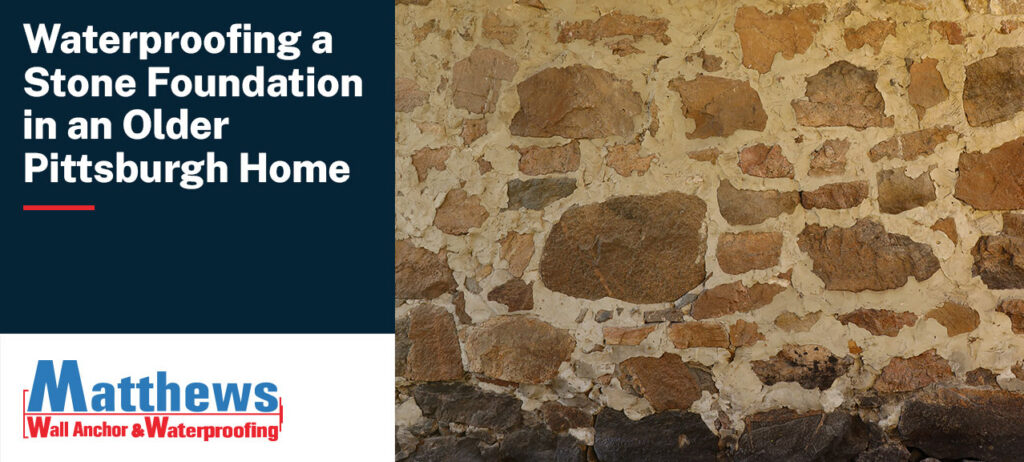
You’re standing in your basement when you notice it. Water seeping through the joints between stones. White powder crusting on the surface. Maybe the mortar is crumbling when you touch it. Your home was built in 1890, and that fieldstone foundation has held strong for more than a century. But now something’s wrong.
Fieldstone foundation waterproofing starts with understanding the wall you’re trying to protect. An older stone basement isn’t simply a concrete block wall with an uneven surface. The stones, mortar, construction details, previous repairs, and surrounding site all influence how a water management project should be planned. Slapping on a coating or copying a modern basement detail without proper assessment can hide important problems or make them worse.
For owners of older Pittsburgh homes, the goal is a workable basement and a repair approach that respects your building. We need to separate water entry from deteriorated mortar and structural movement. These conditions may occur together, but they don’t share a single fix.
At Matthews Wall Anchor & Waterproofing, we’ve worked with Pittsburgh’s historic homes for more than 35 years. We know what makes fieldstone basements different. We understand why the wrong waterproofing approach can damage a stone foundation that’s stood for generations. And we know how to protect these structures for decades to come.
This guide explains what makes stone foundations unique, what questions to ask before choosing a solution, and why preservation-compatible methods matter for long-term protection.
What Makes a Fieldstone Foundation Different from Modern Concrete?
“Stone foundation” can describe several arrangements. Fieldstone, dressed stone, and rubble construction aren’t interchangeable descriptions. An interior surface doesn’t necessarily reveal how the whole wall was built. Some walls have been patched, coated, or altered repeatedly over the years.
The Critical Difference: Breathability
Here’s what most homeowners don’t realize about their fieldstone foundation: it was designed to breathe. Historic stone foundations allow controlled moisture movement through the wall assembly. This isn’t a flaw—it’s how they were meant to work.
Modern concrete foundations create an impermeable barrier. Water can’t pass through. Stone foundations work differently. The porous nature of both the stone and historic mortar allows moisture vapor transmission. This breathability prevents moisture from accumulating inside the wall, which would cause freeze-thaw damage and deterioration.
Any waterproofing strategy must respect this characteristic. Seal a stone foundation with the wrong product, and you trap moisture inside the wall system. That accelerates deterioration, creates freeze-thaw damage, and can compromise structural integrity.
Construction Methods Matter
Fieldstone basements in Pittsburgh typically consist of rubble stone masonry or coursed construction. The stones came from local quarries—sandstone, limestone, or fieldstone gathered from the property. These foundations were built with lime-based mortars, not modern cement.
Lime mortar possesses characteristics essential for stone foundation performance:
- Lower compressive strength than the stone itself (typically 200-500 psi vs. 1,000-10,000+ psi for stone)
- High vapor permeability allowing moisture movement
- Flexibility to accommodate minor structural movement
- Sacrificial nature designed to erode preferentially to protect stone units
When you repair fieldstone foundation walls with modern Portland cement mortar, you reverse this relationship. The hard cement (often exceeding 2,500 psi) becomes stronger than the stone. Now the stone becomes sacrificial. It deteriorates, spalls, and fails while the cement joints remain intact.
What You Should Document
Record what’s visible before any contractor visits:
- Stone shape and size (irregular fieldstone vs. cut stone)
- Mortar condition (crumbling, missing, hard cement patches)
- Surface coatings (paint, sealers, previous waterproofing)
- Locations where construction changes (additions, repairs, different materials)
Ask evaluators to identify uncertainty rather than assume the visible face tells the complete story. A useful proposal explains how these conditions affect preparation, attachment, drainage, and repair access.
Fieldstone Basements: Understanding Pittsburgh’s Climate Challenges
Pittsburgh’s environment creates specific threats to stone foundations that homeowners in other regions don’t face.
Freeze-Thaw Cycles: The Silent Destroyer
Western Pennsylvania experiences 40-60 freeze-thaw cycles annually. Temperatures fluctuate above and below 32°F repeatedly throughout winter and early spring. When moisture penetrates stone or mortar and freezes, it expands by approximately 9%. This expansion creates internal pressures that exceed the tensile strength of the material.
Over time, this cyclical expansion causes spalling, cracking, and progressive deterioration of both stone and mortar joints. You’ll see it as flaking surfaces, crumbling mortar, and stones that work loose from the wall.
Persistent Moisture Exposure
Pittsburgh receives 38-40 inches of precipitation annually, distributed relatively evenly throughout the year. This isn’t occasional flooding—it’s consistent moisture exposure that your drainage system must handle reliably, storm after storm.
The region’s high relative humidity (averaging 60-70% annually) creates persistent hydrostatic pressure against foundation walls. Water doesn’t just hit your foundation during storms. It’s constantly present in the soil around your home.
Clay Soil Complications
Pittsburgh’s clay-rich soils exhibit high plasticity and significant volume change with moisture content variations. During wet periods, expansive clays exert substantial lateral pressure against foundation walls. During drought, soil shrinkage causes settlement.
This soil movement creates additional stress on historic stone foundations that may already be compromised by age and previous deterioration. The combination of freeze-thaw cycles, persistent moisture, and soil movement explains why waterproofing old stone basement walls requires more than surface treatments.
Waterproofing Fieldstone Foundation: Three Critical Questions First
Before discussing products or methods, you need answers to three fundamental questions. Skip these, and you’re guessing about solutions.
Question 1: Where Is Water Coming From?
Track where wetting begins and when it occurs. Different water sources require different responses:
Roof runoff concentrates large volumes at specific points. A single inch of rainfall on a 1,500-square-foot roof generates approximately 935 gallons of water. If that dumps next to your foundation, no waterproofing system can keep up.
Site drainage problems occur when ground slopes toward your house instead of away. Water flows to your foundation and sits there, creating constant pressure.
Plumbing leaks aren’t foundation problems at all, even though they show up in your basement. A leaking supply line or drain needs a plumber, not waterproofing.
Groundwater rises through soil and enters through the base of walls or floor joints. This requires drainage systems, not just surface treatments.
Note whether water appears through joints, near openings, at the base, or behind old coatings. Preserve photographs before cleaning or patching. The relationship between wet areas and exterior conditions can be more informative than the amount of water on one visit.
Question 2: What Is the Condition of the Masonry?
Look from a safe position for:
- Missing mortar in joints
- Loose stones or material
- Flaking, spalling surfaces
- Previous patches (especially hard cement)
- White powder (efflorescence indicating moisture movement)
Don’t pull stones or scrape deeply into joints to investigate. That’s work for professionals with proper assessment tools.
The National Park Service advises identifying the cause of masonry deterioration before repointing. Their preservation guidance stresses selecting physically compatible replacement mortar rather than automatically using the strongest mix.
Question 3: Is There Movement or Loss of Support?
Bowing, displaced stones, significant cracks, or other signs of instability require qualified structural assessment. A water management proposal isn’t a structural repair unless that work is specifically designed and included.
If the wall appears unstable, stay clear and get prompt professional direction. Don’t dig beside it or remove interior material to improve access on your own.
Waterproofing Old Stone Basement Walls: Your Options Explained
Once you understand what you’re dealing with, you can evaluate approaches intelligently. Here’s what works—and what doesn’t—for stone foundations.
| Approach | What It Addresses | What to Ask | Why Generic Advice Fails |
|---|---|---|---|
| Exterior Waterproofing | Water before it enters the wall; allows direct treatment of exterior surface | How will excavation affect stability? What membrane is compatible with stone? How is drainage designed? | Assumes all foundations can be excavated safely; ignores preservation requirements for historic materials |
| Interior Drainage | Water after it penetrates; manages rather than prevents entry | Where does collected water go? How is the system maintained? What wall exposure remains? | Doesn’t address freeze-thaw damage to the wall itself; may not suit all basement uses |
| Repointing | Failed mortar joints creating water pathways | What mortar analysis was done? Is lime-based mortar specified? Who performs the work? | Using cement mortar damages stone; improper technique causes more harm than good |
| Penetrating Sealers | Surface water absorption while maintaining breathability | What product is proposed? How is breathability verified? What’s the reapplication schedule? | Many sealers create impermeable barriers that trap moisture; wrong products accelerate deterioration |
Exterior Stone Foundation Repair: When Excavation Makes Sense
Excavation and external membrane systems represent the most thorough approach to fieldstone foundation waterproofing, though they also present the most significant intervention. This method involves excavating soil away from the foundation to expose the exterior wall surface.
For historic stone foundations, excavation must be carefully considered. It can disturb original construction details and potentially destabilize the structure. But when done properly, it allows direct treatment of the exterior surface where water first contacts the wall.
Breathable Waterproofing Membranes
When you pursue exterior waterproofing, breathable membranes are essential for stone foundations. Modern polymer-modified cementitious coatings or silicate-based penetrating sealers allow moisture vapor transmission while blocking liquid water infiltration.
These products work by penetrating into stone and mortar pores, creating a hydrophobic barrier that repels water while maintaining breathability. Application rates typically range from 100-200 square feet per gallon, depending on substrate porosity.
Drainage System Installation
Exterior waterproofing should include proper drainage. A perimeter drain tile (typically 4-inch perforated PVC pipe) installed at the footing level, surrounded by clean gravel (3/4-inch crushed stone), and wrapped in filter fabric prevents soil infiltration.
The drain tile should slope at minimum 1/8 inch per foot toward a daylight outlet or sump pump system. This drainage relieves hydrostatic pressure and directs water away from the foundation before it can penetrate the wall.
How to Waterproof a Fieldstone Basement: Interior Drainage Solutions
When exterior excavation is impractical or cost-prohibitive, interior waterproofing systems provide an alternative. However, these systems manage water after it has penetrated the foundation wall rather than preventing penetration entirely.
Interior drainage systems typically consist of a perimeter channel installed at the floor-wall junction, connected to a sump pump system. Water that penetrates through the foundation wall is collected in this channel and mechanically pumped away from the structure.
While effective at managing water infiltration, this approach doesn’t address the underlying moisture exposure of the foundation wall itself. The wall remains subject to freeze-thaw damage and deterioration. For many Pittsburgh homeowners, though, interior systems offer the most practical solution when exterior work isn’t feasible.
Crystalline Waterproofing Technology
Crystalline waterproofing offers a unique approach for interior application on stone foundations. These products contain chemicals that react with moisture and masonry compounds to form insoluble crystalline structures within the pores and capillaries of the substrate.
The crystals block water passage while allowing vapor transmission. Crystalline waterproofing has self-sealing capability—if cracks develop after application, incoming water reactivates the crystallization process, sealing the new crack.
Repointing Stone Foundation: Why Mortar Matters More Than You Think
Repointing deteriorated mortar joints represents one of the most critical interventions for fieldstone foundation waterproofing. Failed mortar joints create direct pathways for water infiltration and compromise structural integrity. But repointing must be executed with appropriate materials.
The Lime vs. Cement Question
Historic stone foundations were constructed with lime-based mortars—typically a mix of lime putty, sand, and sometimes natural pozzolans. Modern Portland cement-based mortars are inappropriate for historic stone foundations due to their high strength, low permeability, and rigidity.
When hard cement mortar is used with softer stone, the stone becomes the sacrificial element. This leads to accelerated stone deterioration, spalling, and structural failure. We’ve seen this repeatedly in Pittsburgh homes where well-meaning contractors used cement mortar for repairs.
Appropriate repointing mortars for historic stone foundations should be lime-based (either natural hydraulic lime or lime putty with appropriate pozzolanic additives). The compressive strength must be matched to existing mortar and lower than the stone units.
Typical lime mortar mixes range from 1:2 to 1:3 lime:sand ratios by volume, with specific proportions adjusted based on lime type and desired performance characteristics.
Repointing vs. Waterproofing
Repointing renews deteriorated mortar joints with appropriate material and method. It may be part of caring for an older wall, but it doesn’t automatically correct the reason the wall became wet.
Ask a masonry specialist which joints need work, how much material will be removed, and how the replacement will be selected. A vague instruction to “repoint everything with cement” doesn’t establish compatibility.
For water management, ask what will change outside or inside the wall and where collected water will go. A proposal may need both masonry work and drainage, with the sequence coordinated so one doesn’t undermine the other.
Choosing the Right Stone Foundation Sealer for Breathability
Not all sealers are created equal. The wrong product can cause more damage than no treatment at all.
Silane/Siloxane Water Repellents
These represent the most commonly recommended penetrating sealer for historic stone foundations. Silane/siloxane products penetrate into the substrate (typically 1/8 to 1/4 inch depth) and chemically bond with the masonry, creating a hydrophobic barrier that repels liquid water while allowing vapor transmission.
Key characteristics include:
- Water vapor permeability maintaining breathability (typically >50 perms)
- UV stability for long-term performance
- Longevity of 5-10 years depending on exposure conditions
Application should occur when substrate is dry and temperatures are between 40-90°F, with no rain forecast for 24-48 hours. Multiple coats may be required for highly porous stone.
What to Avoid
Be cautious with coatings and aggressive preparation. A coating should have a clear purpose and documented basis for use on your specific substrate. Ask how the wall was assessed, what preparation is required, and how the treatment affects future inspection and repair.
Don’t assume every existing coating is harmful or every exposed wall needs sealing. The condition of the masonry and the intended assembly matter.
Avoid pressure washing, abrasive removal, and chemical treatment based on quick online recommendations. Start with professional assessment, particularly where mortar is soft, stones are deteriorating, or older finishes may require hazardous-material precautions.
When Professional Assessment Makes the Difference
Some observations you can make safely. Some decisions require expertise you shouldn’t attempt to develop through trial and error on your own home.
What Homeowners Can Safely Check
Begin with accessible exterior observations. Walk the site in dry weather and identify downspouts, nearby paving, window wells, retaining walls, and lower areas where water can collect. Photograph the relationship between those features and the affected interior wall.
Don’t assume the age of your house makes recurring leakage inevitable. Also don’t assume one corrected downspout will address every pathway.
When to Call Matthews
Professional intervention becomes necessary when:
- Structural concerns exist (bowing, displacement, significant cracks)
- Mortar analysis is needed to determine appropriate repointing materials
- Excavation near the foundation is required
- Drainage systems need design and installation
- Historic preservation standards apply
- You’re uncertain about the cause of water entry
A useful basement waterproofing assessment should explain whether the proposed scope addresses the window, the surrounding wall, the site, or several areas together. Exterior waterproofing and yard drainage have different roles and should be discussed in relation to observed conditions.
Define a Realistic Outcome for Your Basement
A storage basement and a proposed finished living area require different planning conversations. Tell the evaluator how you intend to use the space before approving the scope.
Don’t install finishes that conceal unresolved wetting or prevent access to a wall that still needs observation. Ask what testing, monitoring, or repairs should occur before insulation, framing, and finishes are added.
Separate performance expectations: managing liquid water, controlling humidity, repairing mortar, and stabilizing a wall are distinct tasks. Have the proposal state which outcomes are included and which require another phase or professional.
Questions Pittsburgh Homeowners Ask About Stone Foundations
Can a stone foundation be made suitable for finished space?
That requires property-specific assessment of moisture, structure, clearances, building systems, and intended use. A drainage installation alone doesn’t establish that the basement is ready to finish. You need to address moisture sources, ensure structural stability, and create conditions that won’t damage finishes or create health concerns.
Is repointing a permanent leak repair?
Not by itself in every case. Renewing joints and managing the water source are different tasks. Ask the evaluator to explain what each part of the proposed work is expected to accomplish. Repointing with appropriate lime-based mortar addresses failed joints. It doesn’t redirect roof runoff or install drainage systems.
Should I use the hardest available mortar?
No. Don’t choose mortar by strength alone. Compatibility with existing masonry and exposure is important. Have an experienced masonry professional specify the material and preparation. Using cement mortar because it’s “stronger” damages stone foundations.
Do all stone walls need excavation outside?
No universal approach fits every wall. Access, stability, water pathways, and the desired outcome influence the options. Compare the reasons for a recommendation rather than assuming excavation is always required or always avoidable.
How do I know if a sealer is breathable?
Ask for the product’s vapor permeability rating (measured in perms). Historic masonry should maintain permeability above 20 perms minimum, with 50+ perms preferred for stone foundations. If a contractor can’t provide this specification, they’re not using the right product.
Protect Your Stone Foundation While Respecting Its History
A sound plan addresses the source of wetting, respects the existing construction, and separates structural repairs from moisture management. The right method begins with assessment rather than a coating choice.
Your fieldstone foundation has protected your home for generations. With proper care and preservation-compatible waterproofing, it can continue that job for generations to come.
At Matthews Wall Anchor & Waterproofing, we know your home depends on a solid foundation. For more than 35 years, homeowners across Western PA and Eastern OH have trusted us to repair, waterproof, and protect their most important investment.
Concerned About Your Stone Foundation?
We’ll get you out of the fix you’re in.
Start with a free, no-obligation inspection from one of our local experts. We’ll evaluate your specific foundation type, document what we find, and explain your options in plain language. We understand historic preservation requirements. We know which materials work with stone foundations and which cause damage.
We’re not a corporate chain. We’re your hometown experts, standing by every job with honesty, craftsmanship, and lasting warranties. No gimmicks or pressure sales—just honest recommendations from people who’ve been solving these exact problems in Pittsburgh’s older homes for decades.
Request a Free Estimate
Contact Matthews Wall Anchor & Waterproofing today to discuss your stone foundation concerns. Share photographs, prior repair information, and your intended use for the space. We’ll help you understand what’s happening and what it takes to protect your foundation properly.