
If you’ve spent any time in your basement lately and noticed something that doesn’t look quite right about the walls — maybe a crack you don’t remember seeing before, or a subtle curve that seems like it wasn’t there last year — trust that instinct. Bowing basement walls are one of the most serious foundation problems a homeowner can face, but they’re also one of the most fixable when caught early.
Here are five warning signs that your basement walls may be bowing — and what you should do about each one.
What Causes Basement Walls to Bow?
Before the warning signs, it helps to understand the source. Bowing basement walls are caused by lateral pressure from the soil surrounding your foundation — most commonly from water buildup.
In Western Pennsylvania and Eastern Ohio, our clay-rich soils absorb water rapidly and expand when saturated. That swollen soil pushes against your basement walls from the outside with substantial force — a process called hydrostatic pressure. Add our region’s freeze-thaw cycles (soil expands when it freezes, contracts when it thaws, and the net effect is ongoing wall stress), and you have conditions that are uniquely punishing on basement walls.
The result is a wall that’s under constant pressure. And walls that are under constant pressure eventually move.
Warning Sign #1: Horizontal Cracks
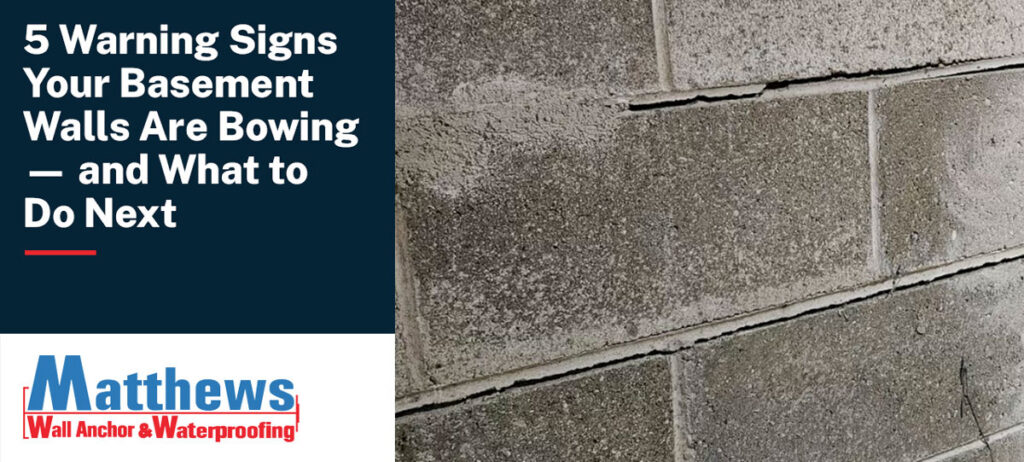
Horizontal cracks are the single most serious type of basement wall crack. Unlike vertical cracks — which often result from normal settling and can be minor — horizontal cracks indicate that the wall is bending under lateral soil pressure. These cracks typically appear at or near mid-wall height, running the full length of the wall.
When you see a horizontal crack, the wall is telling you it’s already moving. The sooner you get it evaluated, the more repair options you’ll have — and the less expensive the fix will be.
Warning Sign #2: Stair-Step Cracks in Block Walls
If your basement has concrete block (CMU) walls rather than poured concrete, watch for diagonal cracks that follow the mortar joints in a stair-step pattern. This type of cracking is the block wall’s equivalent of the horizontal crack — it indicates the wall sections are shifting and separating under external pressure.
Stair-step cracks are often dismissed by homeowners as “just settling.” But if the steps are widening — even slowly — it’s a sign of progressive movement that needs professional evaluation.
Warning Sign #3: Visible Inward Bowing or Bulging
Stand at one end of your basement wall and look down its length from about eye level. A wall that bows inward will show a visible curve or bulge — the middle section will appear closer to you than the top and bottom.
Any wall that has bowed more than 2 inches inward is in urgent need of repair. At that point, lighter interventions like carbon fiber straps may no longer be sufficient, and wall anchors or more significant structural work will likely be needed. If you can see the bow with the naked eye, don’t wait for the next inspection cycle — call a foundation professional now.
Warning Sign #4: Doors and Windows That Stick or Won’t Close Properly
This one surprises a lot of homeowners. When basement walls shift, the effects travel upward through your home’s framing. Door and window frames that are slightly out of square — caused by foundation movement below — will cause doors to stick, windows to resist opening, or gaps to appear at the tops of doorframes.
If you’re experiencing sticking doors or windows and haven’t had any obvious explanation (like a recent addition or remodel), it’s worth having your foundation evaluated. These are often the first signs of wall movement that appear at eye level.
Warning Sign #5: Water Seeping Through Cracks
Water infiltration through basement wall cracks is both a symptom and an accelerant. When a bowing wall develops cracks, those cracks become water entry points. And that water — by entering the wall and re-saturating the soil from the inside out — contributes to more hydrostatic pressure, faster crack expansion, and faster wall movement.
If you see water entering through wall cracks (look for mineral staining, white efflorescence deposits, or actual wet spots), you likely have both a structural and a waterproofing problem that need to be addressed together. A professional evaluation will identify whether wall stabilization, waterproofing, or both are needed.
What Should You Do If You See These Signs?
The most important thing is also the simplest: don’t wait. Bowing basement walls are a progressive problem. They don’t plateau on their own. Every rain event, every freeze-thaw cycle, every season that passes without repair pushes the wall a little further.
The good news is that when caught early, bowing walls are very fixable — often with carbon fiber straps for walls that have moved less than 2 inches, or with wall anchors for walls that need correction and long-term stabilization. Matthews Wall Anchor & Waterproofing has been repairing bowing walls throughout Western Pennsylvania and Eastern Ohio for over three decades. We know these soils, these homes, and these problems.
If you’re seeing any of these warning signs, contact Matthews Wall Anchor & Waterproofing for a free inspection. The sooner we look, the more options you’ll have — and the lower your repair cost is likely to be.