
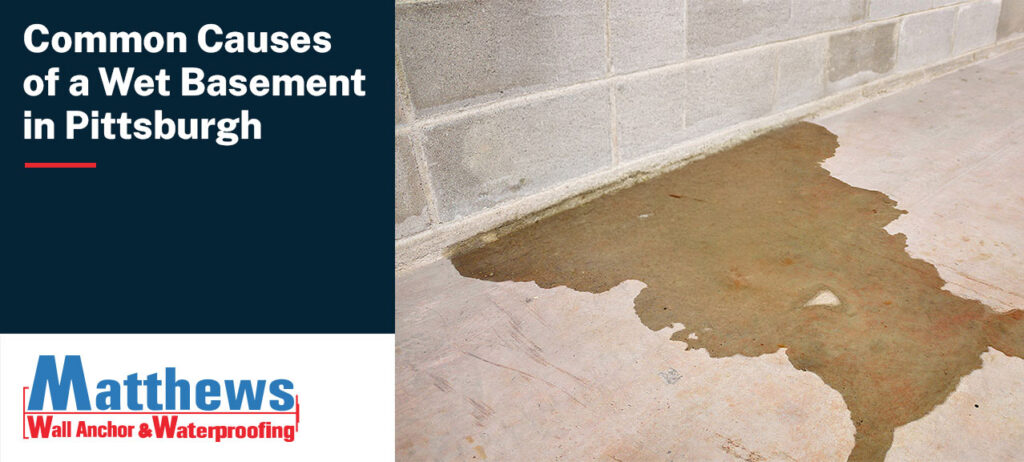
You head downstairs to grab something from storage. Your foot hits the bottom step, and you feel it. Cold. Wet.
You flip on the light and see water pooled in the corner. Dark stains creep up the foundation wall. That musty smell you’ve been ignoring? It’s stronger now.
Your stomach drops. You’ve got a wet basement.
If you’re dealing with this right now, you’re not alone. Understanding wet basement causes Pittsburgh homeowners face starts with knowing our region’s unique challenges. Pittsburgh’s combination of clay soil, heavy rainfall, and freeze-thaw cycles creates the perfect conditions for basement water problems.
At Matthews Wall Anchor, we’ve been helping Pittsburgh homeowners solve basement water issues for over 35 years. We know exactly why basements in our area get wet, and more importantly, we know how to fix them for good.
In this guide, we’ll walk you through the specific causes of wet basements in Pittsburgh, help you identify the warning signs, and explain what you can do to protect your home.
Why Is My Basement Wet Pittsburgh: The Local Factors
Before we dig into specific causes, you need to understand what makes Pittsburgh basements particularly vulnerable to water problems.
Our region faces a unique combination of environmental factors that other areas don’t deal with. It’s not just bad luck. It’s geology, climate, and how homes were built decades ago.
Pittsburgh’s Clay Soil Problem
The soil beneath your home plays a bigger role in basement water problems than most homeowners realize. Pittsburgh sits on expansive clay soil that behaves differently than sandy or loamy soil found in other regions.
Clay soil absorbs water like a sponge. When it rains, that clay swells and pushes against your foundation walls with tremendous force. This creates what we call hydrostatic pressure. Think of it like your foundation walls are holding back a dam of wet, heavy soil.
When the clay dries out, it shrinks. This expansion and contraction cycle happens over and over, year after year. It weakens foundations, creates cracks, and opens pathways for water to seep into your basement.
Heavy Precipitation Throughout the Year
Pittsburgh receives an average of 39.61 inches of precipitation annually. That’s a lot of water trying to find somewhere to go.
We don’t just get steady, gentle rain either. Pittsburgh experiences heavy downpours that saturate the ground quickly. When soil can’t absorb water fast enough, it pools around your foundation. That’s when basement flooding after rain Pittsburgh becomes a serious problem for homeowners.
Spring and fall are particularly challenging. Melting snow combined with spring rains keeps the ground saturated for weeks at a time. Your foundation walls face constant pressure from water-logged soil during these seasons.
The Freeze-Thaw Cycle Impact
Pittsburgh winters bring another challenge: the freeze-thaw cycle. When water in the soil freezes, it expands. This expansion pushes against foundation walls with even more force than regular hydrostatic pressure.
As temperatures fluctuate above and below freezing, this cycle repeats. Each freeze-thaw event can widen existing cracks in your foundation, creating new entry points for water. It’s like your foundation is being slowly pried apart by ice.
This is why many Pittsburgh homeowners notice their basement water problems get worse in late winter and early spring. The damage accumulates over the cold months, and when the thaw comes, water rushes in through all those newly widened cracks.
Understanding Wet Basement Causes Pittsburgh Homeowners Face
Now that you know why Pittsburgh basements are vulnerable, let’s look at the specific ways water gets into your basement. The most common wet basement causes Pittsburgh residents deal with stem from our local geology and climate working against your foundation.
Basement Water Issues Pittsburgh: Hydrostatic Pressure
Hydrostatic pressure is the number one cause of wet basements in Pittsburgh. When soil around your foundation becomes saturated with water, it doesn’t just sit there. It pushes.
Most basement water issues Pittsburgh residents experience stem from our clay soil composition holding moisture against foundation walls. That constant pressure finds any weakness in your foundation. A hairline crack becomes a water entry point. A gap where the wall meets the floor becomes a seepage zone.
You’ll often see this as water coming up through the floor-wall joint, or as dampness spreading across the lower portion of your walls. During heavy rains, you might see actual water trickling down the walls or pooling on the floor.
Poor Drainage Systems
Your home’s drainage system should direct water away from your foundation. When it fails, water pools right where you don’t want it.
Common drainage problems include:
Clogged or damaged gutters. When gutters overflow, thousands of gallons of water pour down right next to your foundation instead of being carried away safely.
Downspouts that discharge too close to the house. If your downspouts dump water within 10 feet of your foundation, that water is likely seeping back toward your basement.
Improper yard grading. Your yard should slope away from your house. If it slopes toward your foundation, every rain sends water flowing straight to your basement walls.
Missing or failed exterior drainage systems. Many older Pittsburgh homes never had proper foundation drainage installed. Others had systems that have failed over time.
Preventing basement flooding in Pittsburgh requires understanding local soil and weather patterns and ensuring your drainage system can handle our heavy precipitation.
Leaking Basement Walls Pittsburgh: Foundation Cracks
Foundation cracks are both a cause and a symptom of basement water problems. Small cracks allow water seepage. Water seepage makes cracks bigger. It’s a cycle that gets worse over time.
Leaking basement walls Pittsburgh homes experience often result from hydrostatic pressure creating or widening foundation cracks. These cracks come in different forms:
Vertical cracks often appear as concrete cures and settles. While they may start small, water intrusion can widen them over time.
Horizontal cracks are more serious. They indicate significant pressure against your foundation wall and can lead to bowing or structural failure if not addressed.
Stair-step cracks in block foundations follow the mortar joints. These often indicate foundation settlement or soil pressure issues.
Any crack wider than 1/8 inch deserves professional attention. Even smaller cracks can allow significant water seepage during heavy rains.
Basement Water Seepage Causes: Window Wells and Basement Windows
Basement windows and window wells create natural collection points for water. When these aren’t properly maintained or installed, they become major sources of water intrusion.
Common basement water seepage causes include foundation cracks and poor exterior drainage, but window wells add another vulnerability. If your window well doesn’t have proper drainage, it fills with water during rain. That water then finds its way through window seals, cracks around the window frame, or even through the window itself if seals have failed.
Leaky basement windows are particularly common in older Pittsburgh homes where original windows have deteriorated over decades of freeze-thaw cycles.
Basement Flooding After Rain Pittsburgh: Overwhelmed Systems
Sometimes your basement stays dry most of the time, but floods during heavy rains. This points to systems that can’t handle high water volumes.
Basement flooding after rain Pittsburgh is particularly common during spring and fall when we get those intense downpours. Your sump pump might not be powerful enough. Your drainage system might be undersized. Or you might not have a sump pump at all.
Many older Pittsburgh homes were built before sump pumps were standard. If your home doesn’t have one, or if your existing pump is old or undersized, you’re at risk every time we get a heavy storm.
Failed or Missing Waterproofing
Exterior waterproofing breaks down over time. If your home is more than 20 years old, any exterior waterproofing that was applied during construction has likely deteriorated.
Interior waterproofing, if it was ever done, can also fail. Paint-on sealers crack and peel. Older waterproofing methods simply weren’t as effective as modern solutions.
The most common basement waterproofing problems Pittsburgh homeowners face are preventable with proper modern waterproofing systems that address both interior and exterior water intrusion.
Sump Pump Failures
Your sump pump is your last line of defense against basement flooding. When it fails, water has nowhere to go but up into your basement.
Sump pumps fail for several reasons:
Age and wear. Most sump pumps last 7-10 years. If yours is older, it’s living on borrowed time.
Power outages. Pittsburgh storms that bring heavy rain often knock out power. If your pump needs electricity to run, you’re vulnerable.
Overwhelmed capacity. A pump that’s too small for your home can’t keep up during heavy rains.
Clogged or frozen discharge lines. If water can’t exit through the discharge line, your pump runs but water stays in your basement.
Common Basement Waterproofing Problems Pittsburgh Residents Experience
Beyond the causes we’ve covered, Pittsburgh homeowners face some recurring waterproofing challenges that are worth understanding.
The “Clay Bowl” Effect
When your home was built, the foundation was excavated and then backfilled after construction. That backfill soil is often looser and more permeable than the surrounding undisturbed clay.
This creates what’s called a “clay bowl” around your foundation. Water flows easily through the loose backfill but then hits the dense clay and can’t drain away. It pools around your foundation, creating constant pressure.
This is why exterior drainage systems are so important in Pittsburgh. They give that trapped water somewhere to go besides through your foundation walls.
Inadequate Footer Drains
Many Pittsburgh homes have footer drains that were installed during construction. These are supposed to collect water at the base of your foundation and direct it away.
The problem? These drains often clog with soil and debris over time. Or they were never properly connected to a discharge point. Or they’ve collapsed or separated at the joints.
When footer drains fail, water accumulates at the base of your foundation where pressure is highest. That’s when you see water coming up through floor cracks or the floor-wall joint.
Crawl Space Moisture Migration
If your home has a crawl space, moisture problems there can affect your entire house. Damp crawl spaces create humidity that rises into your living areas. They also provide ideal conditions for mold growth.
Crawl space moisture issues require specialized encapsulation systems to seal off the space from ground moisture. Without proper encapsulation, you’re fighting a losing battle against moisture.
Recognizing the Warning Signs
Knowing the causes helps, but you also need to recognize when you have a problem. Some signs are obvious. Others are subtle.
Visual Indicators
Water stains on walls or floors. These appear as dark patches or white mineral deposits (efflorescence) where water has evaporated.
Visible cracks in foundation walls. Any crack deserves attention, but cracks wider than 1/8 inch or horizontal cracks are particularly concerning.
Peeling paint or deteriorating drywall. Moisture behind walls causes paint to bubble and peel. Drywall becomes soft and crumbly.
Rust on metal fixtures or appliances. Excessive humidity causes rust on water heaters, furnaces, and metal shelving.
Smell and Air Quality
Musty odors. That distinctive basement smell indicates mold growth and excessive moisture.
Increased humidity. If your basement feels damp or clammy, you have a moisture problem even if you don’t see standing water.
Structural Signs
Bowing or leaning walls. Walls that curve inward indicate serious pressure from saturated soil.
Uneven or cracked floors. Foundation settlement or heaving can cause floor problems.
Doors and windows that stick. Foundation movement affects how doors and windows fit in their frames.
Why Acting Quickly Matters
When you discover wet basement causes Pittsburgh experts can help you identify the source quickly. But why the urgency?
Mold Growth Happens Fast
Mold can start growing within 24-48 hours of water exposure. Once established, it spreads rapidly and creates health risks for your family. The importance of addressing moisture issues promptly cannot be overstated, as delayed action can lead to mold growth and structural damage.
Structural Damage Escalates
Water weakens concrete and erodes mortar. Small cracks become big cracks. Minor bowing becomes major structural failure. What starts as a $2,000 repair can become a $20,000 problem if you wait.
Property Value Impact
A wet basement significantly reduces your home’s value. When you eventually sell, buyers will discover the problem during inspections. You’ll either need to fix it then or accept a much lower offer.
Health Concerns
Damp basements create poor air quality throughout your home. The air in your basement circulates upward into your living spaces. Mold spores, musty odors, and excess humidity affect your family’s health.
Frequently Asked Questions
What’s the most common cause of wet basements in Pittsburgh?
Hydrostatic pressure from our clay soil is the leading cause. Pittsburgh’s heavy precipitation saturates the clay soil around foundations, creating constant pressure that forces water through any weakness in foundation walls. This is why professional waterproofing basement Pittsburgh services address both interior and exterior water sources.
Can I fix a wet basement myself?
Minor issues like cleaning gutters or extending downspouts are DIY-friendly. But most wet basement problems require professional diagnosis and repair. Foundation cracks, failed drainage systems, and hydrostatic pressure issues need expert solutions. Attempting DIY fixes on serious problems often wastes money and allows damage to worsen.
How much does it cost to fix a wet basement in Pittsburgh?
Costs vary widely based on the cause and severity. Simple repairs like sealing minor cracks might cost a few hundred dollars. Installing a sump pump system runs $2,000-$4,000. Full interior waterproofing with drainage systems costs $5,000-$10,000. Exterior waterproofing and foundation repair can reach $15,000-$30,000 for severe cases. The key is addressing problems early before they escalate.
Will my homeowners insurance cover wet basement repairs?
Typically, no. Standard homeowners insurance doesn’t cover water damage from groundwater seepage, foundation cracks, or poor maintenance. Insurance usually only covers sudden, accidental water damage like burst pipes. This is why prevention and early intervention are so important.
How can I prevent my basement from getting wet?
Preventing basement flooding in Pittsburgh means improving your drainage system, maintaining gutters and downspouts, ensuring proper yard grading, installing or upgrading your sump pump, sealing foundation cracks promptly, and considering professional waterproofing systems. Regular inspections help catch problems before they become serious.
Is a dehumidifier enough to solve basement moisture problems?
A dehumidifier treats symptoms, not causes. While it can help manage humidity levels, it won’t stop water from entering your basement. You need to address the source of moisture first, then use a dehumidifier to maintain proper humidity levels. Professional waterproofing solutions often include high-capacity dehumidifiers as part of a complete system.
Protecting Your Pittsburgh Home
Understanding the causes of wet basements is the first step toward protecting your home. The most common wet basement causes Pittsburgh homeowners deal with stem from our local geology and climate, but they’re all solvable with the right approach.
You don’t have to live with a damp, musty basement. You don’t have to worry every time it rains. Professional waterproofing solutions address both the symptoms and root causes of basement water problems.
The key is acting before minor issues become major problems. That small crack you’re ignoring? It’s getting bigger with every freeze-thaw cycle. That musty smell? It’s mold spreading through your basement. The occasional dampness after heavy rain? It’s a warning that your drainage system can’t handle Pittsburgh’s precipitation.
Get Expert Help for Your Wet Basement
We’ve been solving basement water problems in Pittsburgh for over 35 years. We know your home or business depends on a solid, dry foundation. We understand the unique challenges Pittsburgh foundations face, from our clay soil to our freeze-thaw cycles.
Our approach is straightforward. We’ll inspect your basement thoroughly, identify exactly why it’s getting wet, and recommend solutions that actually work. No pressure tactics. No one-size-fits-all answers. Just honest recommendations based on what your specific home needs.
We partner with Earth Contact Products, using American-made materials known for their quality. Our solutions come with long-term warranties, and we back up our work with thorough inspections and customized recommendations.
Ready to solve your wet basement problem for good? Contact our team today for a free, no-pressure estimate. We’ll help you understand exactly what’s causing your basement water issues and what it’ll take to fix them right.