
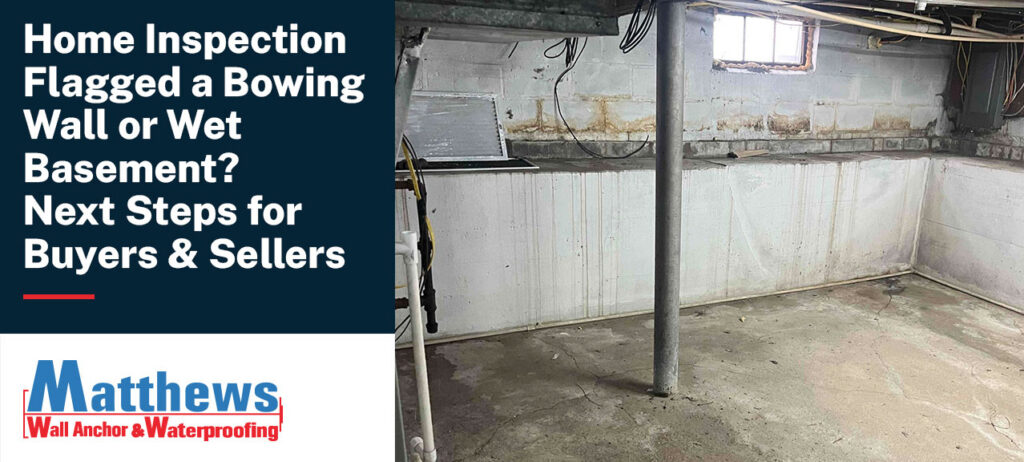
Home inspection foundation problems can turn an ordinary real estate transaction into a rush of calls, estimates, and conflicting opinions. A report mentioning a bowing basement wall, foundation cracks, or water intrusion deserves attention, but it is not automatically a complete diagnosis or a repair design. The next step is to understand what was observed, arrange the right evaluation, and obtain documents that everyone involved can actually use.
For Pittsburgh buyers and sellers, timing adds pressure. Inspection deadlines, access, lender questions, and repair scheduling may all be moving at once. Resist the temptation to settle the issue with a quick verbal price or cosmetic patch. A clear description of the condition, the proposed scope, and any remaining uncertainty is more useful than a promise that everything will be fine.
First, separate the observation from the conclusion
Read the exact inspection language. “Horizontal crack with inward displacement” is a different observation from “minor surface crack,” and “moisture staining” is different from water entering during the inspection. Keep photographs with the relevant report page.
The American Society of Home Inspectors’ Standard of Practice distinguishes a home inspection from engineering analysis. Under that standard, inspectors examine structural components but are not required to provide engineering services or determine the adequacy of structural systems. (Source: ASHI: Standard of Practice.)
That does not make the inspection finding unimportant. It means the report may identify a need for further evaluation rather than establish the final repair. Ask which observation triggered the recommendation and what specialist is appropriate.
Use the first round of calls to organize the work
Contact your agent promptly about transaction deadlines and access. If the report recommends a structural engineer, arrange that evaluation rather than treating a contractor’s sales estimate as an automatic substitute.
For water entry, describe the location and timing to the waterproofing evaluator. For suspected plumbing or sewer issues, ask whether another specialist should attend. Different conditions can appear together in the same basement.
Share the report and photographs before the visit when possible. Identify any areas the inspector could not access. A finished wall or storage-filled corner may limit the initial assessment, and everyone should understand that limitation.
A bowing wall needs a different conversation from a wet floor
Visible wall movement raises structural questions. Water entry raises questions about source and management. There may be a relationship, but repairing one does not automatically resolve the other.
| Finding | Useful follow-up | Document to request |
|---|---|---|
| Bowing or displaced wall | Assess movement, condition, support, and repair needs | Written findings and any required design |
| Crack without a clear cause | Determine whether more investigation or monitoring is appropriate | Evaluation with stated limitations |
| Repeated basement water entry | Trace entry routes and system behavior | Water-management scope and exclusions |
| Prior anchors or piers | Review installation history and present condition | Original records and applicable warranty |
Do not select wall anchors, carbon fiber, or piers based solely on a crack photograph. Ask the qualified evaluator to explain which problem the proposed system addresses and why it fits the property.
What buyers should gather
Request available prior evaluations, repair invoices, drawings, permits where applicable, warranties, maintenance records, and photographs. Keep the original documents instead of relying on a listing description that says “foundation fixed.”
Ask whether previous work addressed the same location and symptom now identified. A basement can have an older repair in one area and a different issue elsewhere. Dates and location drawings help avoid confusing the two.
Also ask what remains inaccessible. If a repair recommendation depends on concealed footing condition or the wall behind a finish, understand how that uncertainty will be resolved and who must authorize access.
What sellers can prepare
Make the basement and exterior areas reasonably accessible for the agreed evaluation. Gather repair records and describe observations accurately. A contractor can work more effectively when they know when water was noticed, what was repaired, and what changed afterward.
Avoid painting over stains or filling significant cracks before documentation. Cosmetic work can make comparison harder and create additional questions about the property’s history.
Disclosure obligations and transaction wording should be discussed with your agent or a qualified attorney. A repair contractor can document technical findings and work performed; that does not replace advice about what the transaction requires.
What a useful repair proposal includes
A proposal should identify the affected area, the observed condition, the recommended work, and important exclusions. Ask for a drawing or photographs that show precisely where work will occur.
It should also explain:
- Whether the objective is stabilization, water management, or another outcome.
- Whether engineering, permits, or inspections are included or separately arranged.
- How concealed conditions and change orders will be handled.
- Which landscaping, concrete, and interior finishes will be restored.
- Which completion records and maintenance instructions will be provided.
- Which warranty applies and where to obtain its full terms.
A verbal assurance that a repair is “standard” does not answer these questions. Written detail helps the buyer, seller, contractor, and other professionals understand the same scope.
Coordinate the transaction timeline separately from construction
An inspection visit, a design, a signed proposal, and a completed installation are different milestones. Ask for realistic availability for each. Weather, access, design work, or concealed conditions may affect the sequence.
Your agent should handle how timing relates to the contract. Ask your lender directly what documentation or completed work it requires, if any. Do not assume a repair estimate satisfies an underwriting condition or that a scheduled job is equivalent to completed work.
If the parties discuss a repair, credit, or another arrangement, have the appropriate transaction professionals document it. The contractor’s role is to define the work and its technical limits.
Read warranty language before relying on it
A statement such as “the house has a warranty” is incomplete. Identify the company, covered system, installation date, exclusions, service process, and any transfer conditions. Request the actual document.
Do not assume coverage applies to the entire foundation or every source of basement water. Ask whether transfer requires notification, a fee, an inspection, or other steps, and confirm those terms with the warranty provider.
Keep warranty review separate from the condition assessment. A warranty document does not establish that the system is currently functioning or that a newly observed problem falls within its scope.
A local example of evaluation before commitment
Matthews’ published Bethel Park wall-crack case study describes a prospective buyer who sought an assessment of a basement wall before purchasing. The account reports a crack and wall bowing, followed by a recommendation for anchors.
The useful lesson is the sequence: investigate the observed condition and define a repair before relying on assumptions. That individual project does not establish the right repair, price, or completion time for another property.
For current service information, review Matthews’ foundation repair services or basement waterproofing services according to the finding.
Questions buyers and sellers ask
Should I walk away from a house with foundation issues?
A finding alone is not enough to make that decision. Obtain an appropriate evaluation and a defined scope, then discuss the cost, uncertainty, timing, and transaction options with your own advisers.
Does a dry basement during the inspection settle the issue?
No. The visit records conditions at that time. Prior photographs, repair history, and observed behavior during rain may add important context. Ask what the evaluator could and could not determine.
Who should decide which repair is appropriate?
Use qualified professionals for their respective roles. An engineer may evaluate structural questions, while a contractor defines and performs an appropriate installation scope. Your agent handles transaction coordination rather than engineering conclusions.
What records should remain after repairs?
Keep the final scope, approved changes, invoices, photographs, applicable inspection or engineering records, warranty, and maintenance instructions. Store them together so the completed work can be understood later.
Replace uncertainty with documented findings
A flagged basement problem needs clear investigation and a coordinated timeline. Preserve the report, arrange the right assessment, and distinguish what is known from what still requires verification.
Contact Matthews Wall Anchor & Waterproofing to discuss a Pittsburgh-area evaluation. Share the inspection finding and transaction timeline, and request written information that your agent and other professionals can review.