
If you’ve lived in Pittsburgh for more than a winter or two, you’ve probably noticed your basement acting a little different depending on the season — a crack that seems to widen every spring, a door that sticks after a cold snap, a damp smell that shows up right around thaw. That’s not a coincidence. It’s the direct result of two forces working on your foundation nearly year-round: expansive clay soil and freeze-thaw cycling.
Most homeowners never think about the ground underneath their house until it starts causing problems above it. But in Western Pennsylvania, the soil is doing more work against your foundation than you’d expect. Understanding how it happens is the first step to catching Pittsburgh clay soil foundation damage early, before it turns into a major repair.
At Matthews Wall Anchor & Waterproofing, we see the effects of this cycle in basements across the region every single season. Here’s what’s actually happening beneath your home — and the warning signs it leaves behind.
Why Pittsburgh’s Soil Is Uniquely Hard on Foundations
Not all soil behaves the same way, and Pittsburgh happens to sit on some of the more foundation-unfriendly ground in the country. Two characteristics matter most.
Expansive Clay Soil Swells and Shrinks With Moisture
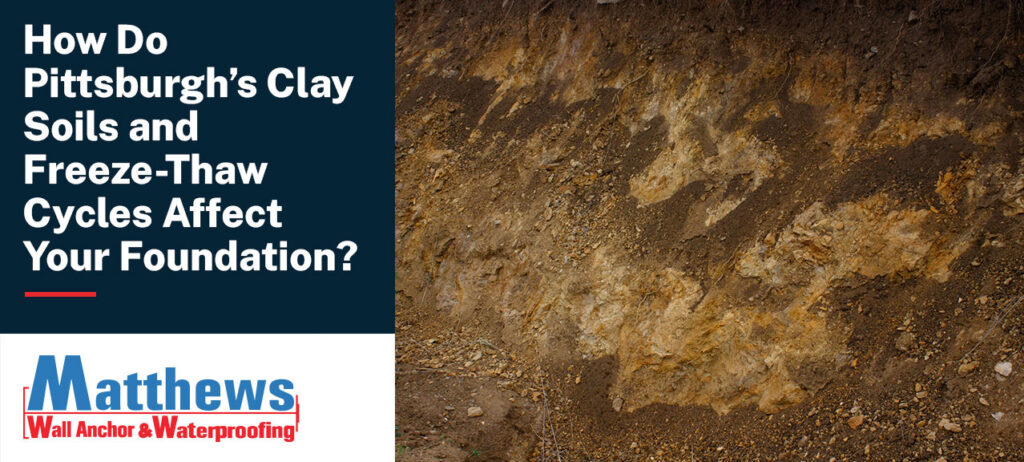
Much of the region’s soil is dense, clay-rich material that behaves almost like a sponge. When it rains, expansive clay soil basement conditions develop as the clay absorbs water and swells, sometimes expanding significantly in volume. When conditions dry out, that same soil contracts and pulls away from the foundation.
This swell-and-shrink cycle happens over and over, season after season, and every cycle puts a different kind of stress on your foundation walls. Swelling clay pushes inward with substantial lateral force — what’s known as hydrostatic pressure when water is involved. Shrinking clay does the opposite, pulling away and sometimes leaving gaps that let soil settle unevenly under footings.
Freeze-Thaw Cycles Compound the Problem
Pittsburgh winters don’t just get cold once and stay that way — they swing. A hard freeze one week followed by a 50-degree thaw the next is common, and each swing adds another layer of stress. This is what makes the freeze-thaw cycle foundation Pittsburgh homeowners deal with so persistent compared to regions with more stable winter temperatures.
Here’s the mechanism: when moisture-saturated soil near your foundation freezes, it expands (ice takes up more volume than liquid water). That expansion pushes against foundation walls. When it thaws, the soil contracts again, and the wall or footing that was just pushed can settle into a slightly different position. Repeat this dozens of times over a winter, and even a well-built foundation is going to show wear eventually.
Combine expansive clay with frequent freeze-thaw swings, and you get a foundation that’s under near-constant, shifting pressure for most of the year — not just during one dramatic storm or one hard freeze.
Signs of Soil-Related Foundation Damage
So what does this pressure actually look like once it shows up in your home? Watch for these signs of soil movement Pittsburgh homes commonly experience:
Foundation Cracks That Appear or Worsen Seasonally
If you notice a crack that seems to widen every spring or after a hard freeze-thaw swing, that’s a strong indicator of foundation cracks freeze thaw activity rather than simple one-time settling. Horizontal cracks and stair-step cracks in block walls are particularly worth watching, since they often indicate the wall is being pushed rather than just settling straight down.
Uneven or Sloping Floors
As clay soil swells and shrinks unevenly beneath different parts of a foundation, footings can settle at different rates. The result is often subtle at first — a floor that seems to tilt slightly, or a spot where a marble would roll toward one wall.
Doors and Windows That Stick
When soil movement shifts your foundation even slightly, that movement travels upward through your home’s framing. Door and window frames that are otherwise fine can suddenly stick, bind, or develop gaps as the structure above shifts out of square.
Gaps Between the Foundation and Exterior Trim or Steps
Take a walk around the outside of your home and look at where your foundation meets porch steps, walkways, or trim. Gaps that weren’t there before — or that seem to open and close with the seasons — are a visible sign of the soil expanding and contracting beneath the structure.
Water Intrusion Following Wall Movement
Cracks caused by soil pressure don’t just weaken a wall structurally — they also become entry points for water. If you’re noticing new dampness, staining, or efflorescence around a crack that’s appeared or grown recently, you’re likely dealing with both a structural and a moisture problem that need to be addressed together.
Why Waterproofing and Foundation Repair Go Hand in Hand Here
Because clay soil expansion is driven largely by moisture, managing water around your foundation is one of the most effective ways to reduce the stress your home is under. This is a big part of why clay soil waterproofing Pittsburgh homeowners invest in isn’t just about keeping a dry basement — it’s about protecting the structure itself.
Good exterior drainage, properly graded soil, and functioning gutters all help keep excess water away from the clay immediately surrounding your foundation, which in turn reduces how dramatically that soil swells and shrinks. Combined with basement waterproofing systems on the interior, this approach addresses both the water problem and the pressure problem at the same time.
For homes that are already showing wall movement or cracking, waterproofing alone isn’t enough — the wall itself needs to be stabilized. That’s where solutions like foundation repair and wall anchoring systems come in, correcting movement that’s already occurred and preventing further shifting as the soil continues its seasonal cycle.
What Should You Do If You’re Seeing These Signs?
The nature of clay soil and freeze-thaw damage is that it’s gradual — which makes it easy to dismiss season after season until it’s a bigger issue. A hairline crack that shows up one spring can be a minor cosmetic fix. The same crack, ignored through several more freeze-thaw cycles, can grow into a structural repair that costs significantly more.
If you’ve noticed cracking, sticking doors, uneven floors, or new water intrusion that seems to track with the seasons, it’s worth getting a professional opinion on Pittsburgh foundation repair before another winter adds to the problem.
Get Ahead of Seasonal Soil Movement Before It Gets Ahead of You
Clay soil and freeze-thaw cycles aren’t going away — they’re simply part of living in this region. But that doesn’t mean your foundation has to bear the brunt of it unmanaged. With the right combination of drainage, waterproofing, and structural reinforcement, homes throughout Western Pennsylvania hold up against this cycle year after year.
Matthews Wall Anchor & Waterproofing has spent decades helping homeowners understand what their foundation is dealing with and what to do about it — no guesswork, no scare tactics. If you’re noticing any of the signs above, contact our team for a straightforward inspection and an honest read on what your home actually needs.