
You’ve noticed it — your basement wall isn’t straight anymore. Maybe there’s a crack running horizontally across the middle. Maybe the wall has a subtle curve you never noticed before. Or maybe a contractor pointed it out during a recent inspection. However you discovered the problem, you’re probably seeing two solutions come up over and over: wall anchors and carbon fiber straps.
Both are legitimate, long-term fixes. But they’re not interchangeable — and choosing the wrong one for your situation could cost you. Here’s an honest breakdown of how each system works, when each is appropriate, and how Matthews determines the right solution for your home.
First, What’s Causing Your Wall to Bow?
Bowing basement walls don’t happen because the wall is weak on its own. They happen because of what’s happening outside your home — specifically in the soil pressing against your foundation.
In Western PA and Eastern Ohio, our clay-heavy soils absorb water like a sponge during heavy rains and spring snowmelt. That saturated soil expands and pushes against your basement walls with tremendous lateral force — a process called hydrostatic pressure. When that pressure is sustained over years, walls begin to crack, lean, and bow inward. Freeze-thaw cycles in our region accelerate the process each winter.
The result is a wall that’s actively moving. Left alone, it won’t stop.
How Wall Anchors Work
A wall anchor system is a three-part tension system designed to stop wall movement and — over time — actually pull the wall back toward its original position. Here’s how it works:
- An interior steel wall plate is secured to the inside of the bowing wall
- An earth anchor helix is installed in stable, undisturbed soil several feet away from the foundation, outside your yard
- A high-strength steel rod connects the two, creating a system that counteracts the soil pressure pushing inward
Once installed, the rods can be periodically tightened over time — gradually drawing the wall back toward plumb as the soil conditions allow. Wall anchors are a highly engineered, long-term solution that addresses not just the symptoms of wall movement but the ongoing pressure driving it.
Wall anchors are best when:
- Your wall has already bowed more than 2 inches inward
- You want the option to correct the wall position over time, not just stabilize it
- The wall shows significant cracking, tilting, or separation from the floor joists
- A structural evaluation indicates the wall needs mechanical resistance to ongoing soil pressure
How Carbon Fiber Straps Work
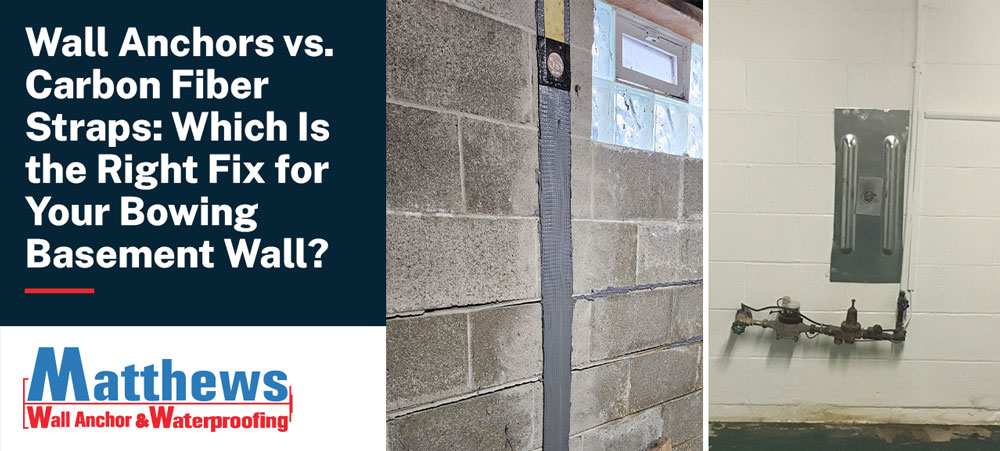
Carbon fiber straps are thin, lightweight strips of woven carbon fiber fabric that are bonded directly to the interior surface of your basement wall with structural epoxy. Despite their low profile — they’re barely visible once installed — carbon fiber is, by weight, stronger than steel.
Once bonded and cured, the straps essentially become a permanent part of the wall. They resist the lateral tensile force that causes walls to bow inward, holding the wall firmly in place and preventing any further movement.
The key advantage of carbon fiber is that the installation is non-invasive and fast. No exterior excavation is needed, no yard is disturbed, and the whole installation typically takes a day or less.
Carbon fiber straps are best when:
- Your wall has bowed less than 2 inches inward
- The goal is stabilization — stopping the wall from moving further — rather than correction
- You want a clean, low-profile solution with minimal disruption to your home and yard
- The wall has early-stage cracking but is not yet significantly displaced
The Key Difference: Correction vs. Stabilization
This is the most important distinction for homeowners to understand:
Carbon fiber holds the wall where it is. Wall anchors can bring it back.
If your wall has already moved significantly — especially past that 2-inch threshold — carbon fiber alone won’t be sufficient. You need a system with enough mechanical force to counteract the existing pressure and gradually correct the displacement. That’s where wall anchors become the right call.
On the other hand, if you’ve caught the problem early, carbon fiber offers an equally permanent solution at lower disruption and often lower cost. Early detection matters — and it’s one of the reasons we recommend regular foundation inspections.
Cost Comparison
For a typical 20-foot basement wall, here’s a general cost range:
| Repair Method | Typical Cost Range |
|---|---|
| Wall Anchors | $1,600 – $2,800 |
| Carbon Fiber Straps | $1,700 – $5,000 |
| Helical Tiebacks | $6,000 – $7,200 |
| Wall Straightening (with reinforcement) | $6,700 – $11,000 |
It’s worth noting that carbon fiber costs can vary significantly based on wall length and the number of straps required. In some cases, a properly installed wall anchor system may actually be more cost-effective for a more seriously damaged wall than attempting to over-engineer a carbon fiber solution for a situation it wasn’t designed to handle.
How Matthews Evaluates Your Situation
At Matthews Wall Anchor & Waterproofing, we don’t have a single preferred solution, we have the right solution for each wall. When we come out for a free inspection, we measure the degree of bow, assess the crack patterns, evaluate your soil conditions and drainage situation, and give you an honest recommendation based on what your wall actually needs.
We install both systems. We’re not going to upsell you to wall anchors if carbon fiber is appropriate, and we’re not going to let a carbon fiber strap do a wall anchor’s job.
Think your basement walls might be moving? Don’t wait. The longer a bowing wall goes unaddressed, the more expensive the repair becomes. Contact Matthews Wall Anchor & Waterproofing for a free inspection throughout Western PA and Eastern Ohio.