
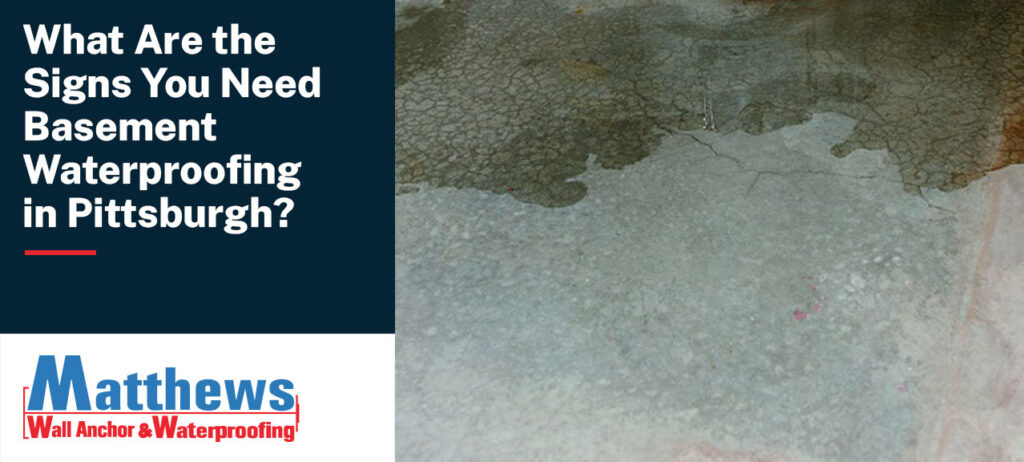
If you’ve caught yourself standing at the bottom of your basement stairs lately, wrinkling your nose at a musty smell or eyeing a damp patch on the wall, you’re not imagining things. Pittsburgh’s clay-heavy soil, steep hillside lots, and constant freeze-thaw cycles put more pressure on basements than most homeowners realize — and that pressure usually shows up as water, sooner or later.
The tricky part is that basement leak signs rarely show up as a dramatic flood. They start small: a faint smell, a chalky stain, a little extra humidity. By the time water is visibly pooling on the floor, the problem has usually been building for months, sometimes years.
At Matthews Wall Anchor & Waterproofing, we’ve inspected thousands of basements across Western Pennsylvania, and the same handful of warning signs show up again and again before homeowners call for help. Below, we’ll walk through what to look for, why it happens here in particular, and when it’s time to get a professional opinion.
Why Pittsburgh Basements Are Especially Prone to Water Problems
Before getting into the signs themselves, it helps to understand why a wet basement in Pittsburgh is such a common complaint. A few local factors stack the deck against homeowners:
- Clay soil. Much of the region sits on dense clay that absorbs water slowly but holds onto it, swelling as it gets saturated and pressing against foundation walls.
- Hillside topography. Many Pittsburgh neighborhoods are built on slopes, which means runoff naturally drains toward — and sometimes into — lower-level foundations.
- Older housing stock. Pittsburgh has a lot of homes built well before modern waterproofing standards existed, with foundations that were never designed to handle today’s storm patterns.
- Freeze-thaw cycles. Winter freezing and spring thawing repeatedly expand and contract the soil around your foundation, gradually opening up cracks and joints that water can exploit.
None of this means every home is doomed to a wet basement — but it does mean the signs below are worth taking seriously the moment they appear.
Common Signs You Need Basement Waterproofing
1. A Musty or Earthy Smell
If your basement has a persistent musty odor — even when there’s no visible water — that’s often the first basement leak sign homeowners notice, and the first one they dismiss. That smell is usually mold or mildew, and mold needs moisture to grow. A musty basement almost always means water is getting in somewhere, even if it’s evaporating before you ever see a puddle.
2. White, Chalky Staining on Walls (Efflorescence)
Efflorescence is the white, powdery mineral deposit that’s left behind when water moves through concrete or block and evaporates on the surface. It’s harmless on its own, but it’s a clear signal that moisture is actively passing through your foundation walls. If you’re seeing efflorescence, water has already found a path inside — it’s just not obvious yet.
3. Visible Cracks in the Foundation Walls or Floor
Cracks are one of the most common basement water damage Pittsburgh homeowners deal with, and not all cracks are equally concerning. Small vertical hairline cracks can be fairly normal settling. But wider cracks, horizontal cracks, or cracks that are actively weeping water are a different story — they’re direct entry points for groundwater and often a sign of more serious foundation or wall pressure issues.
4. Peeling Paint or Bubbling on Basement Walls
Paint that’s bubbling, peeling, or flaking off your basement walls is usually a moisture problem hiding behind a cosmetic one. Water vapor pushing through concrete from the outside will lift paint from underneath, even if the wall never looks visibly “wet.”
5. A Damp or Humid Feeling, Even Without Standing Water
Not every basement moisture problem announces itself with puddles. If your basement consistently feels clammy, if metal objects rust faster down there, or if a dehumidifier is constantly running and refilling, that’s a strong sign of chronic moisture intrusion working against you around the clock.
6. Warped, Buckling, or Discolored Flooring
If you’ve got finished flooring in your basement — laminate, carpet, or even tile — watch for warping, buckling, or dark discoloration along the edges. These are classic basement leak signs that indicate moisture is wicking up from below the slab, not just condensing in the air.
7. A Sump Pump That Runs Constantly (or Not at All)
If you already have a sump pump and it’s cycling on and off far more often than it used to, that’s a sign groundwater levels around your foundation have increased — often due to grading changes, gutter issues, or worsening hydrostatic pressure. On the flip side, a sump pump that isn’t running during a heavy storm may mean it’s failed entirely, leaving your basement without its main defense.
8. Mold or Mildew Growth in Corners and Along Baseboards
Mold doesn’t need a flood to grow — it just needs consistent moisture and time. If you’re spotting dark spots in basement corners, behind stored boxes, or along baseboards, it’s worth investigating the source rather than just cleaning the surface. Mold is a downstream symptom of a moisture problem that hasn’t been addressed.
When Should You Call a Professional?
A single hairline crack or a slightly musty smell after a heavy rain doesn’t necessarily mean your basement is falling apart. But if you’re noticing two or more of the signs above, or if a problem you’ve been “keeping an eye on” seems to be getting worse each season, it’s time to get a professional evaluation rather than wait it out.
The reason timing matters so much is that basement water damage in Pittsburgh compounds. A small crack lets in a little water, which softens the surrounding soil, which increases pressure on the wall, which widens the crack, which lets in more water. Left alone, what starts as a cosmetic annoyance can turn into a structural issue — and structural repairs cost significantly more than early waterproofing does.
If you’re in Pittsburgh, PA and any of these signs sound familiar, it’s worth having a basement waterproofing specialist take a look before the next big storm rolls through.
What Does Basement Waterproofing Actually Involve?
There’s no single fix for every basement — the right solution depends on where the water is coming from and how it’s getting in. A qualified waterproofing company Pittsburgh homeowners can trust will typically start with a thorough inspection, then recommend a combination of solutions such as:
- Interior drainage systems that collect and redirect water before it pools on your floor
- Sump pumps to actively remove water that does make it inside
- Exterior waterproofing to stop water from reaching your foundation walls in the first place
- Crack injections to seal active leaks in poured concrete walls
- Grading and drainage improvements around the exterior to keep water moving away from your home instead of toward it
The goal isn’t just to mop up water after it arrives — it’s to manage where that water goes before it ever becomes a problem inside your home.
Don’t Wait for the Next Storm to Find Out
Basement water problems rarely get better on their own, and in a city with as much rain, clay soil, and hillside drainage as Pittsburgh, waiting usually means dealing with a bigger repair down the road. If you’ve noticed even one or two of the signs above, it’s worth having someone take a look now, while your options — and your budget — are still on your side.
Matthews Wall Anchor & Waterproofing has spent decades helping homeowners across Western Pennsylvania get ahead of basement moisture before it turns into a bigger headache. If your basement is showing any of these warning signs, reach out to our team for a straightforward inspection and an honest recommendation — no guesswork, no pressure.