
You’re standing in your basement when you notice it. The wall isn’t quite straight anymore. There’s a slight inward curve that wasn’t there before, and a horizontal crack running across the middle of the block. You call a contractor, and they mention wall anchors. Another suggests carbon fiber straps. Now you’re wondering which option makes sense for your home.
The answer depends on several factors: how far the wall has moved, what’s causing the pressure, the type and condition of your wall, and whether your goal is to prevent additional movement or gradually improve existing alignment. For homeowners dealing with bowing basement walls Pittsburgh’s unique conditions add another layer to the decision. Our drainage patterns, soil composition, seasonal weather, and older-home construction all affect the repair plan.
This guide explains how carbon fiber reinforcement and wall anchor systems work, what installation involves, typical cost factors, and the questions to ask before choosing a repair. We’ll also cover the Pittsburgh-specific considerations that make foundation repair in our region different from other areas.
Understanding Bowing Basement Walls Pittsburgh Homeowners Experience
Before we compare repair methods, it helps to understand what’s happening to your foundation. Bowing basement walls Pittsburgh residents deal with are primarily caused by hydrostatic pressure. This occurs when water-saturated soil exerts lateral force against foundation walls. The pressure increases significantly during wet conditions such as heavy rain or snowmelt, particularly in areas with poor drainage or high water tables.
Pittsburgh’s climate creates particularly challenging conditions. Our region experiences an average of 39.61 inches of annual precipitation and 44.1 inches of snowfall. That’s a lot of water working its way into the soil around your foundation. When soil becomes saturated, it exerts a constant sideways push against basement walls, leading to potential bowing and structural issues.
Our clay soil makes the problem worse. Clay soils absorb water and expand, creating cycles of pressure that can lead to structural distress in basement walls. When clay soil becomes wet, it swells significantly, pushing against foundation walls. When it dries, it shrinks, potentially creating uneven settling and further structural stress. This continuous cycle weakens the foundation over time.
Winter adds another challenge. When water in the soil freezes, it expands, exerting additional pressure on foundation walls. Pittsburgh’s winter temperatures frequently hover around freezing, creating repeated freeze-thaw cycles throughout the season. This freeze-thaw weathering can widen cracks and shift pressure in the surrounding ground, turning minor issues into major structural problems.
How Carbon Fiber Straps Work
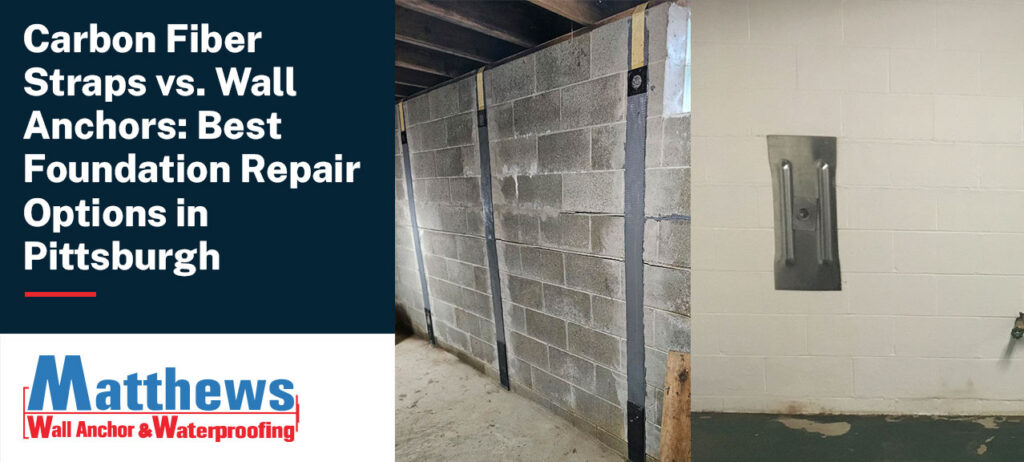
Carbon fiber straps are vertical reinforcement strips made from carbon fiber fabric and a structural epoxy system. A contractor prepares the interior wall surface, applies the epoxy, embeds the reinforcement, and finishes the system according to the manufacturer’s specifications.
Once cured, the straps provide a low-profile layer of reinforcement. They sit flat against the wall and can often be painted, making them less visually intrusive than many steel reinforcement options. You won’t lose usable basement space, and the repair won’t dominate the room visually.
Carbon fiber is valued for its high tensile strength-to-weight ratio. However, the performance of an installed repair depends on the tested product system, strap spacing, wall condition, surface preparation, adhesive bond, anchorage details, and installation quality. It’s not just about the material strength alone.
When Carbon Fiber Straps Make Sense
Carbon fiber reinforcement works well when the wall has limited inward movement and is otherwise suitable for reinforcement. If your primary goal is to help prevent additional movement rather than pull the wall back, carbon fiber may be a good fit.
This method is particularly attractive when interior installation is preferred because exterior access is limited or landscaping disruption is a concern. Maybe you have mature trees near the foundation, or a deck that would need to be partially removed for exterior work. Carbon fiber straps avoid those complications.
The wall needs a low-profile repair that can be painted after installation. If you’re planning to finish your basement or want the repair to blend in, carbon fiber delivers. A qualified contractor will determine whether the wall, framing, and substrate can support the proposed system.
Keep in mind that carbon fiber is generally a stabilization solution. It does not pull a bowed wall back into its original position. If your wall has already moved significantly and you want to improve its alignment, you’ll need to consider other options.
Carbon Fiber Installation Process
Carbon fiber reinforcement is usually installed from inside the basement. The contractor evaluates the wall and marks strap locations based on the wall’s condition and the manufacturer’s specifications. They prepare the surface so the epoxy can bond properly. This step matters. Poor surface preparation leads to poor adhesion and a repair that won’t perform as intended.
The contractor applies the manufacturer-specified epoxy and carbon fiber reinforcement, then completes the system’s top and bottom connection details where required. The epoxy needs time to cure before final finishing or painting. Installation is often completed in a day for many projects, although timing depends on the wall size, preparation needed, the number of straps, temperature, humidity, and the specific product system.
How Wall Anchor Systems Work
A wall anchor system typically includes an interior steel wall plate, a steel rod that passes through the foundation wall, and an exterior earth anchor installed in suitable soil away from the foundation. The components work together to oppose the lateral pressure pushing the wall inward.
Some systems can be adjusted gradually after installation. When conditions allow, that adjustment may help stabilize the wall and, in some cases, improve wall alignment over time. The degree of correction is not guaranteed and depends on the wall’s condition, the system design, soil conditions, and the contractor’s repair plan.
When Wall Anchors Are the Better Solution
Wall anchors may be considered when the wall has substantial inward movement or bowing. If the repair goal includes potential gradual correction, not only stabilization, wall anchors offer that possibility. They’re designed to resist ongoing pressure and can be tightened over time to help straighten the wall.
You’ll need sufficient exterior access for earth anchor installation. The contractor needs to reach suitable soil beyond the zone of pressure that’s affecting your foundation. If your property has the space and access, wall anchors become a viable option.
The repair plan should call for future adjustments as part of the correction process. This isn’t a one-and-done installation. The contractor may schedule follow-up visits to gradually tighten the system, allowing the wall to move back toward its original position without causing additional stress or damage.
Wall Anchor Installation Process
Wall anchor work involves both interior and exterior steps. The contractor locates utilities and confirms exterior access before starting. They determine suitable earth anchor locations based on the system design and site conditions. This requires understanding your property’s soil composition and drainage patterns.
The contractor installs the exterior anchors and drills connection points through the wall. They install interior wall plates and connecting rods, then tension the system according to the repair plan. The initial tensioning stabilizes the wall. Future adjustments may gradually improve its position.
Exterior work can affect landscaping and may be influenced by rain, frozen ground, utility locations, site access, and restoration needs. Ask your contractor exactly where excavation is expected and whether restoration is included in the proposal. You don’t want surprises after the work is done.
Recognizing Buckling Walls and Other Warning Signs
Homeowners often notice buckling walls as the first visible sign of foundation pressure. But there are several other indicators you should watch for. Cracks wider than 1/8 inch suggest serious structural issues. Horizontal cracks indicate significant pressure and potential failure. Stair-step cracks along mortar joints are particularly concerning.
Physical wall movement is another clear sign. You might see visible bowing, uneven or sloping floors indicating foundation settlement, or doors and windows that stick, especially after seasonal changes. Gaps between the foundation and exterior trim indicate soil movement.
Pittsburgh homeowners should be particularly vigilant for seasonal cracks that worsen after freeze-thaw cycles. Our climate creates conditions where small cracks can become major problems quickly. Water seepage through cracks can exacerbate structural damage, creating a cycle that accelerates deterioration.
You should seek professional help if you notice cracks exceeding 1/8 inch or if walls are visibly bowed. Measuring the degree of bowing is essential. You can use a plumb line to determine how far the wall has moved from its vertical position. Addressing bowing walls promptly can save you from costly repairs. Timely intervention prevents further damage and reduces repair costs.
Carbon Fiber Straps vs. Wall Anchors: Making the Right Choice
The choice between carbon fiber straps and wall anchors isn’t always straightforward. Here’s how they compare across key considerations:
Primary Purpose
Carbon fiber straps reinforce a qualifying wall and help prevent additional inward movement. Wall anchor systems resist outside pressure, and some systems may allow gradual adjustment and potential correction.
Handling Existing Bowing
Carbon fiber typically stabilizes rather than straightens the wall. Wall anchors may be considered when active correction is part of the repair goal.
Installation Location
Carbon fiber is primarily installed from inside the basement. Wall anchors require interior wall plates plus exterior earth anchor installation.
Exterior Disruption
Carbon fiber usually avoids excavation beside the home. Wall anchors often require exterior excavation and access planning.
Appearance
Carbon fiber offers a low profile and is often paintable after curing. Wall anchor interior plates remain visible unless otherwise finished.
Soil Dependence
Carbon fiber does not use an exterior earth anchor, but soil pressure and drainage still matter. Wall anchors require suitable soil and an appropriate exterior load path.
Future Adjustment
Carbon fiber is not intended for mechanical adjustment. Some wall anchor systems can be adjusted as part of a planned correction process.
How Much Movement Matters
The amount of wall movement is important, but it should not be the only decision point. Some contractors use roughly 2 inches of inward movement as a general guideline. Bowing less than 2 inches may be stabilized with carbon fiber straps, while more severe cases may require steel beams or wall anchors.
That guideline is not a universal rule. A proper recommendation also depends on whether the wall is concrete block, poured concrete, brick, or another material. The height and length of the wall matter. The location and severity of cracks provide important clues. Whether the wall is bowing, leaning, sliding, or showing more than one movement pattern affects the repair approach.
The condition of the floor framing and rim area can influence the decision. Exterior grading, drainage, and hydrostatic pressure play a role. The source and duration of the movement help determine the best solution. A wall that has moved only a small amount can still need a different repair if cracking, wall deterioration, water pressure, or structural conditions are severe.
Cost Factors for Foundation Repair in Pittsburgh
Foundation repair prices vary widely. A meaningful quote requires an onsite evaluation because the repair design may be affected by wall length, material, degree of movement, number and spacing of reinforcement points, exterior access, excavation conditions, drainage needs, permit requirements, and whether engineering is necessary.
Repair costs can range from $2,000 to $25,000 or more, depending on the severity of the issue and the repair method chosen. Carbon fiber straps for minor issues typically cost between $4,000 and $6,000. More severe cases requiring extensive reconstruction can cost upwards of $20,000.
As a broad planning range, a contractor may price carbon fiber by the number of straps and wall anchor work by the number of anchors, wall length, exterior access, and soil conditions. Don’t treat a published price range as a final quote without confirming what’s included.
When comparing estimates, ask whether the price includes labor and materials, surface preparation and crack repair, excavation and landscaping restoration if applicable, utility locating and access preparation, permit fees or engineering documentation if required, drainage or waterproofing work recommended with the structural repair, and warranty terms and any future adjustment visits.
The lowest initial estimate is not always the lowest total cost. Compare the complete scope of work, the cause of movement being addressed, warranty coverage, and what the contractor expects you to maintain after installation.
Pittsburgh-Specific Considerations
Basement wall movement is often connected to water and soil pressure outside the foundation. In the Pittsburgh area, homeowners encounter sloped lots, older foundations, seasonal rainfall, freeze-thaw conditions, and variable soil and drainage conditions. Those factors increase the importance of a careful site evaluation.
Drainage and Water Pressure
A structural repair may be only one part of the solution. If roof runoff, poor grading, clogged gutters, a failed drain system, or hydrostatic pressure is contributing to movement, those conditions should be investigated. Reinforcing a wall does not automatically eliminate the source of exterior pressure.
The article stresses the necessity of pairing structural repairs with waterproofing and drainage improvements to prevent recurrence of the problem. Managing water around the home is crucial to reducing hydrostatic pressure and preventing future bowing. Proper grading away from the foundation is essential, with a minimum final grade of 5 percent recommended to direct surface water away from foundations.
Exterior Access Challenges
Wall anchor systems need an appropriate exterior installation area. Mature landscaping, decks, fences, utility lines, neighboring structures, retaining walls, and limited lot space can affect whether an anchor-based solution is practical. Pittsburgh’s hilly terrain and closely-spaced homes in many neighborhoods can make exterior access more challenging than in newer suburban developments.
Weather and Timing
Projects requiring exterior excavation can be more sensitive to weather and ground conditions than interior-only reinforcement. An experienced contractor can explain how weather, site access, and seasonal conditions may affect scheduling. Frozen ground in winter or saturated soil in spring can delay exterior work.
Permits and Engineering
Permit and engineering requirements vary by municipality and by the scope of the structural work. Confirm what’s required with the local authority having jurisdiction. A reputable contractor should explain whether permits, inspections, or engineered documentation are part of the proposed project.
Finding the Right Bowing Basement Wall Repair Near Me
When searching for bowing basement wall repair near me, it’s worth getting multiple professional assessments. Look for contractors with local experience who understand Pittsburgh’s unique geological and climate challenges. A contractor who’s worked in our region knows how clay soil behaves, how freeze-thaw cycles affect foundations, and which repair methods perform best in our conditions.
Matthews Wall Anchor has been serving Pittsburgh homeowners for over 35 years. We’re not a corporate chain. We’re a hometown team that stands by our work. We understand the unique challenges Pittsburgh foundations face because we’ve been solving them for decades.
We partner with Earth Contact Products, using American-made materials known for their quality. Our solutions come with long-term warranties, and we back up our work with thorough inspections and customized recommendations.
Our services include foundation repair using wall anchors, push piers, and carbon fiber straps, along with waterproofing solutions like sump pump installations and French drain systems. We also handle crawl space repair and yard drainage to address the complete picture of your foundation health.
We provide free estimates with no-pressure sales tactics. We’ll give you honest recommendations tailored to your specific situation, not a one-size-fits-all solution.
Long-Term Considerations
Carbon fiber reinforcement has no mechanical components to tighten. After a properly installed system cures, the repair is generally low profile and requires little routine attention beyond monitoring the wall and managing the water or soil conditions that contributed to the problem.
Some wall anchor systems may be adjusted over time as part of an established correction plan. Whether future adjustments are necessary, how often they occur, and whether they’re included in the warranty should be discussed before work begins.
For either option, ask for clear documentation covering the specific system being installed, the condition the repair is designed to address, limits on expected correction or movement, recommended drainage, grading, or waterproofing work, warranty coverage, exclusions, and transferability, and any monitoring, maintenance, or follow-up expectations.
Questions to Ask Before You Choose
Before signing a proposal, ask these questions:
What is causing the wall movement? Understanding the root cause helps you evaluate whether the proposed repair addresses the actual problem or just the symptoms.
Is the recommendation intended to stabilize the wall, correct it, or both? Be clear about what outcome you can realistically expect.
How much movement has been measured, and where? Specific measurements help you understand the severity and whether the proposed method is appropriate.
Why is this system appropriate for my wall material and movement pattern? The contractor should explain their reasoning based on your specific situation.
Does the repair address drainage or water pressure, or is separate work recommended? A structural repair without addressing water issues may not solve the problem long-term.
Will exterior excavation be needed? If so, where and how will the area be restored? Know what to expect for your landscaping and property.
Are permits or engineered drawings required? Understand the full scope of what’s needed to complete the project properly.
What does the warranty cover, and are future adjustments included? Get specifics in writing about what’s covered and for how long.
What result is realistic for my specific wall? Don’t accept vague promises. Ask for honest expectations based on your wall’s condition.
Frequently Asked Questions
What is the main difference between carbon fiber straps and wall anchors?
Carbon fiber straps reinforce a qualifying wall from the inside and are generally used to help prevent additional inward movement. Wall anchor systems connect an interior wall plate to an exterior earth anchor and may allow gradual adjustment when correction is part of the repair plan.
Can carbon fiber straps straighten a bowed basement wall?
Carbon fiber straps are generally used for stabilization, not for pulling an already bowed wall back into place. Ask a qualified contractor what result is realistic for your wall’s condition.
Are wall anchors always better for severe bowing?
Not always. They may be appropriate when active correction is needed and exterior access and soil conditions support the system. The right choice depends on the movement pattern, wall condition, available exterior space, drainage, and the repair objective.
Do wall anchors always require excavation?
Earth anchor systems require exterior access and typically require excavation to install the exterior anchors. The scope and location of excavation depend on the system, access conditions, soil, utilities, landscaping, and project design.
How much does foundation repair cost in Pittsburgh?
Costs depend on the repair design, wall condition, access, excavation, drainage work, permits, and engineering needs. An onsite assessment is the best way to receive an accurate proposal. When comparing estimates, verify exactly what the price includes.
Do carbon fiber straps need maintenance?
Carbon fiber systems do not have mechanical components that require tightening. Still, homeowners should address drainage and water management problems and monitor the wall for new cracking or movement.
Can I install carbon fiber straps myself?
Foundation wall movement can involve structural and water management issues. Professional evaluation and installation help ensure proper surface preparation, product selection, placement, connection details, and warranty coverage.
Make an Informed Repair Decision
Carbon fiber straps and wall anchors address different needs. Carbon fiber may be a practical choice when a suitable wall needs low-profile interior reinforcement to help prevent additional movement. Wall anchor systems may be considered when the repair plan calls for exterior anchoring and potential gradual correction.
The best next step is a thorough evaluation of the wall, the movement pattern, and the conditions outside the foundation. Understanding bowing basement walls Pittsburgh homeowners face starts with knowing the unique environmental challenges in our region. Our clay soil, freeze-thaw cycles, and heavy precipitation create conditions that require local expertise to address properly.
If you’re concerned about bowing walls, horizontal cracks, or ongoing basement wall movement, contact Matthews Wall Anchor for an assessment of your Pittsburgh-area home. A qualified professional can explain the available options, identify related drainage concerns, and provide a written recommendation based on your specific situation. We’ll help you understand exactly what’s happening with your foundation and what it’ll take to fix it right.